TL;DR: Amazon sellers do not rely on one universal shipping calculator. Accurate planning usually combines freight or carrier quotes, Amazon shipment estimates, dimensional-weight rules, FBA or FBM fees, and a profitability model. This guide explains how to calculate each shipping leg and how to use the SellerSprite Profitability Calculator to measure the final impact on profit.
Key Takeaways
- Separate supplier freight, transportation into Amazon, inbound placement fees, FBA fulfillment fees, and FBM last-mile postage instead of treating them as one shipping charge.
- Dimensional weight can affect both carrier billing and Amazon FBA fees, but the divisor and calculation method depend on the carrier, rate type, marketplace, and fulfillment stage.
- SellerSprite does not provide live carrier quotes. Its Profitability Calculator helps you combine externally obtained shipping costs with product dimensions, Amazon fees, PPC, returns, and other expenses to test whether a product remains profitable.
Table of Contents
Marketplace note: This guide focuses on the Amazon US marketplace. Size tiers, fees, carrier rules, and dimensional-weight formulas may differ in other countries.
Quick Answer
An Amazon shipping calculator should help you understand how much it costs to move one sellable unit from the supplier to the customer. However, no single input or tool can accurately calculate every shipping leg. Supplier freight, Amazon inbound transportation, inbound placement fees, FBA fulfillment, and FBM postage follow different pricing systems.
A reliable workflow combines several sources. Use your freight forwarder or carrier for transportation quotes, the Send to Amazon workflow for Amazon-partnered shipping estimates and placement options, and an FBA or FBM calculator for fulfillment economics. For a broader explanation of how these tools work together, see our Amazon calculator guide.
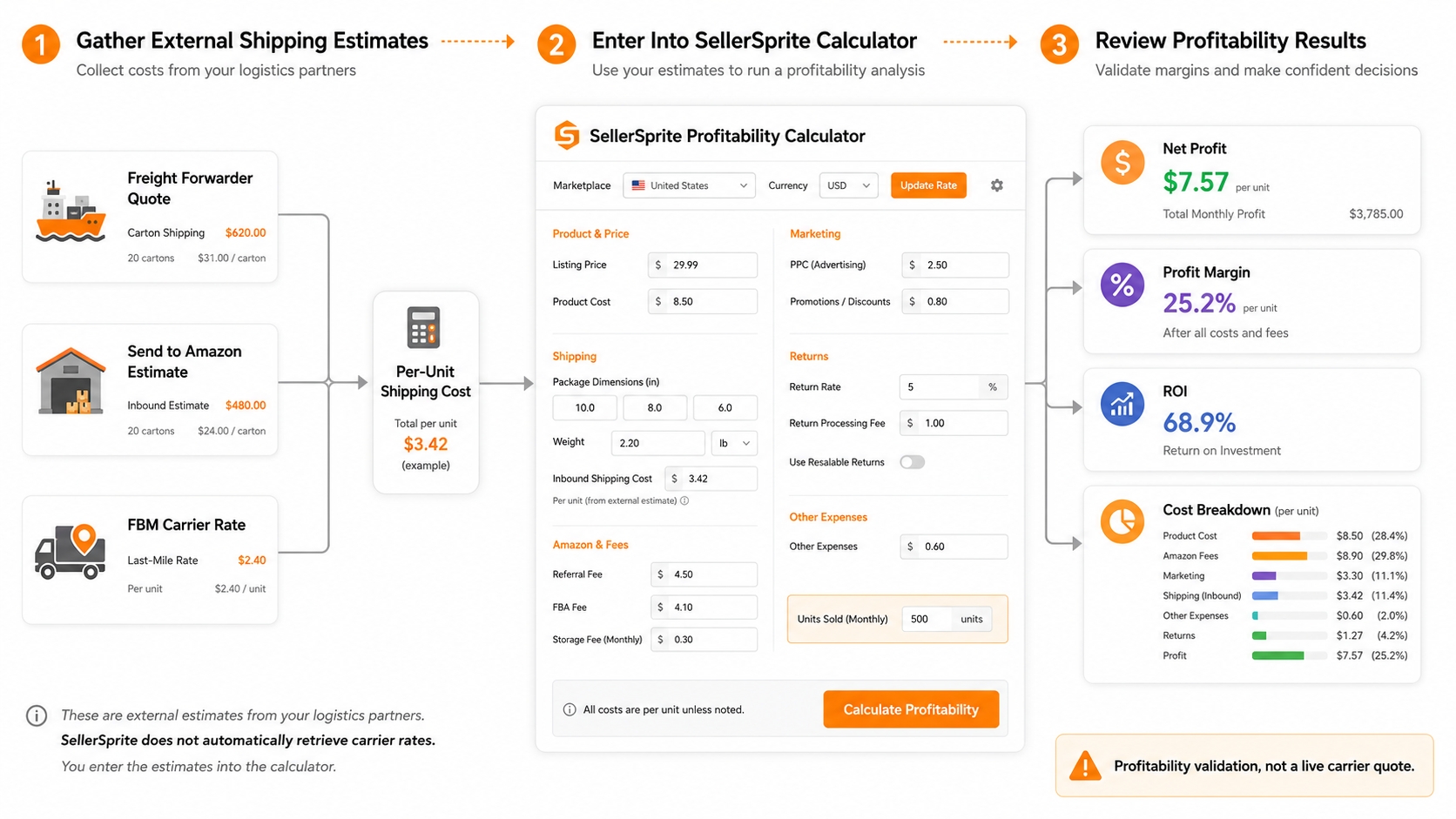
Where SellerSprite fits: SellerSprite does not provide a dedicated carrier-rate or shipping-quote calculator. Its Profitability Calculator is best used after you obtain the relevant freight, inbound, or last-mile estimates. You can then enter shipping-related costs alongside product dimensions, weight, Amazon fees, PPC, promotions, and returns to see the effect on net profit, margin, and ROI.
Model shipping before finalizing packaging and price
Shipping should be evaluated during product development, not after inventory has already been manufactured. A product can appear profitable based on supplier price alone but fail once freight, Amazon inbound costs, FBA fulfillment fees, or FBM postage are included.
Early modeling gives you time to reduce empty packaging space, change carton configuration, compare fulfillment methods, renegotiate freight, or adjust the target selling price. It also helps prevent a lightweight but bulky product from being evaluated as though it will be charged only by actual weight.
Critical rule
Never approve final packaging using product weight alone. Measure the complete sellable package and check whether dimensional weight or a larger Amazon size tier applies.
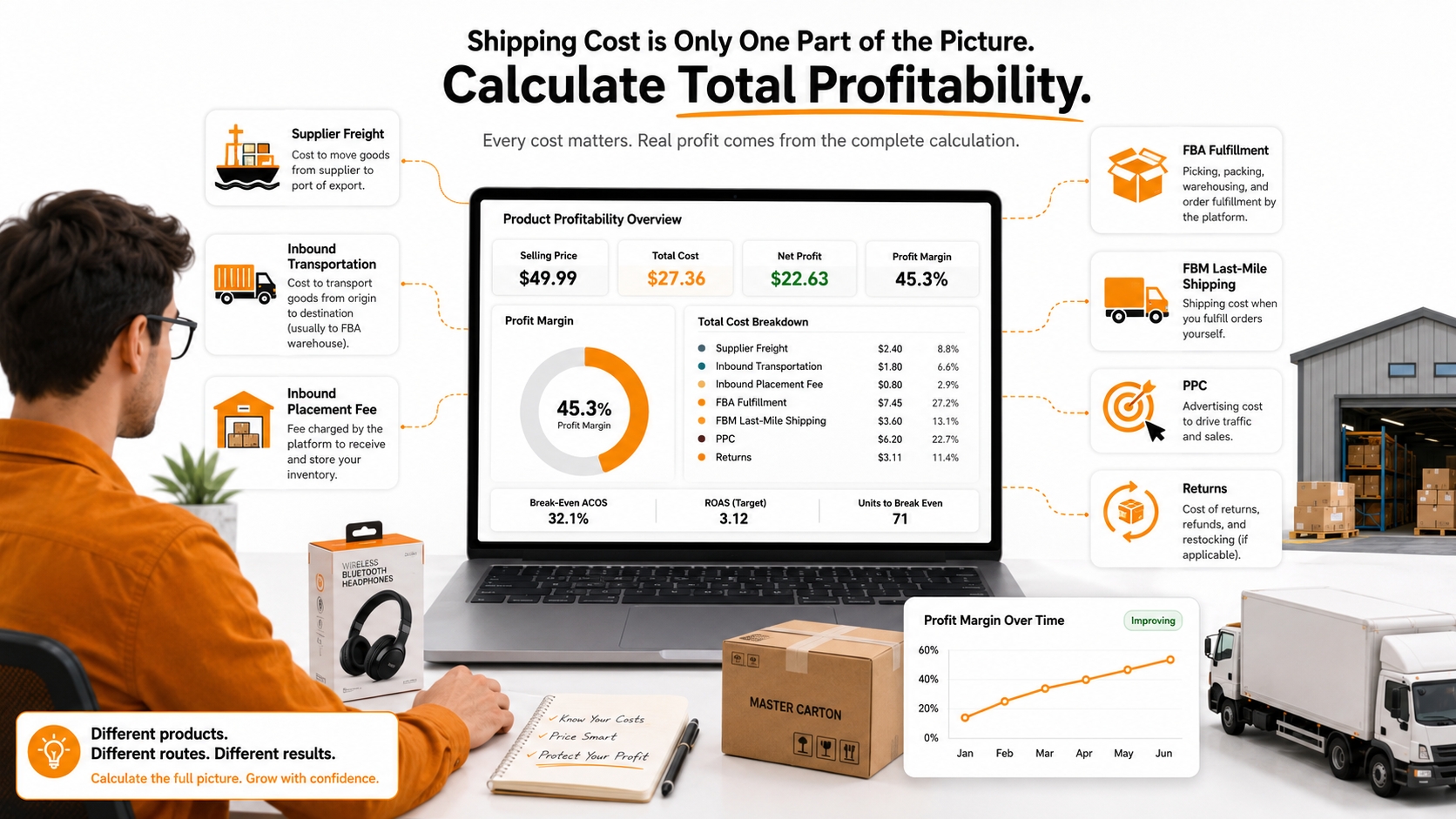
Shipping Cost Types for Amazon Sellers
Amazon sellers may encounter several separate logistics costs before an order reaches the customer. Each cost should be calculated independently and then converted into a per-unit amount for profitability analysis.
Supplier-to-warehouse freight
The first leg moves inventory from the manufacturer to your warehouse, 3PL, prep center, port, or Amazon-bound consolidation point. Depending on the sourcing location and shipment size, this may involve ocean freight, air freight, express shipping, rail, truckload, or a combination of services.
Freight forwarders may price shipments using actual weight, volumetric weight, chargeable weight, container volume, pallet space, or freight class. Incoterms such as EXW, FOB, CIF, and DDP also affect which charges are included in the supplier quote.
Best practice: Ask the supplier for final unit dimensions, master-carton dimensions, carton weight, units per carton, and total shipment volume. Then request a freight quote based on the production-ready packaging rather than an early product estimate.
Once you receive the quote, divide the total relevant freight cost by the number of sellable units. That per-unit figure can be entered as inbound shipping cost in a profitability model.
Transportation into Amazon
Transportation into Amazon is the cost of moving prepared inventory from your facility, supplier, or prep center to the fulfillment center destinations shown in the shipment plan. Sellers may use Amazon Partnered Carrier services or arrange transportation independently.
For small-parcel shipments, the carrier estimate may depend on box count, box dimensions, weight, origin, destination, and service terms. Palletized LTL or FTL shipments may also depend on pallet count, freight class, dimensions, and total weight.
Do not confuse the transportation charge with the FBA inbound placement service fee. The placement fee is a separate Amazon fee that may vary according to the placement option, product size, weight, and shipment configuration selected in Send to Amazon.
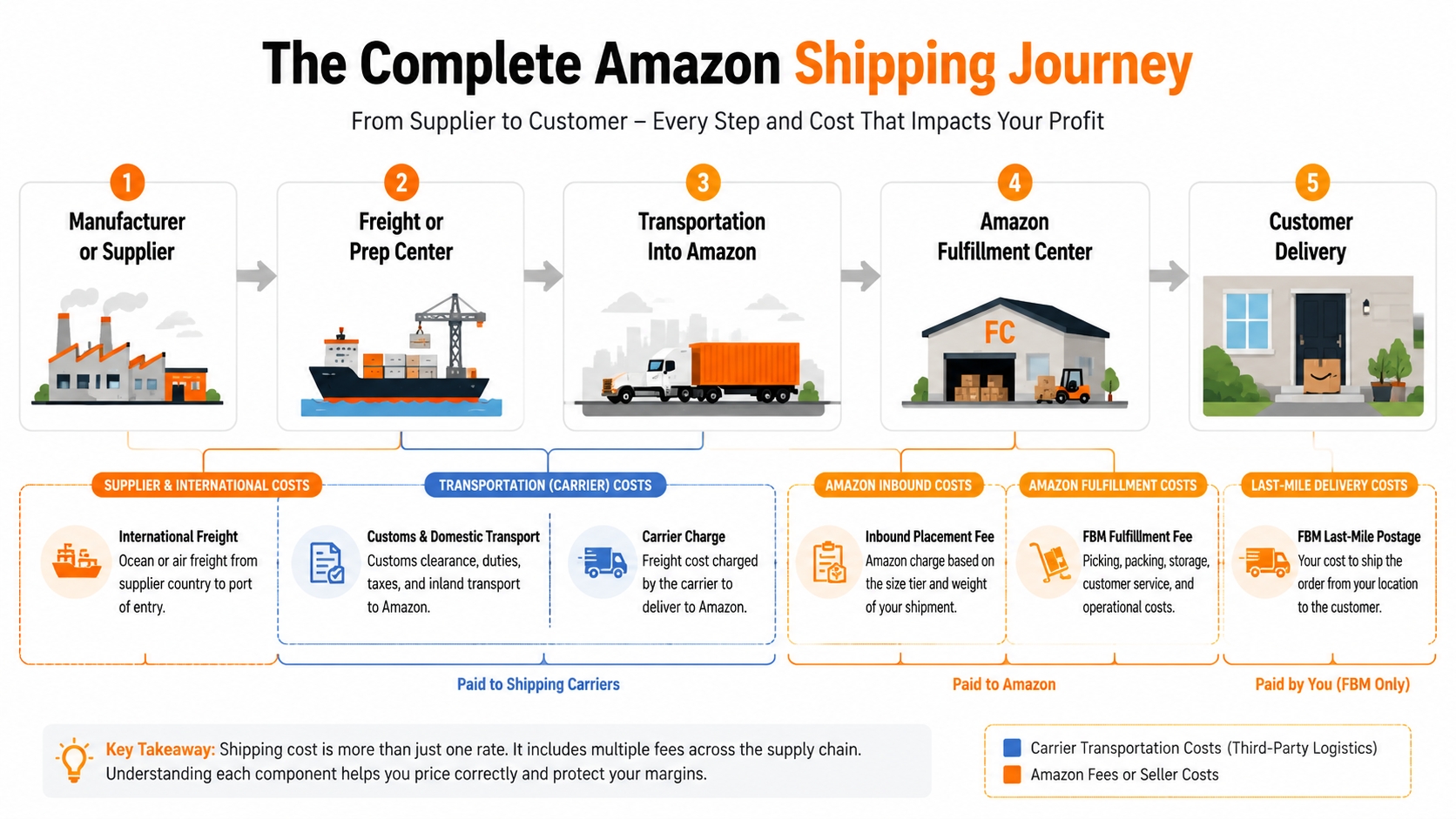
FBA fulfillment fees
FBA fulfillment fees cover services such as picking, packing, shipping the order to the customer, and customer-service handling. These fees are separate from the cost of sending inventory into Amazon.
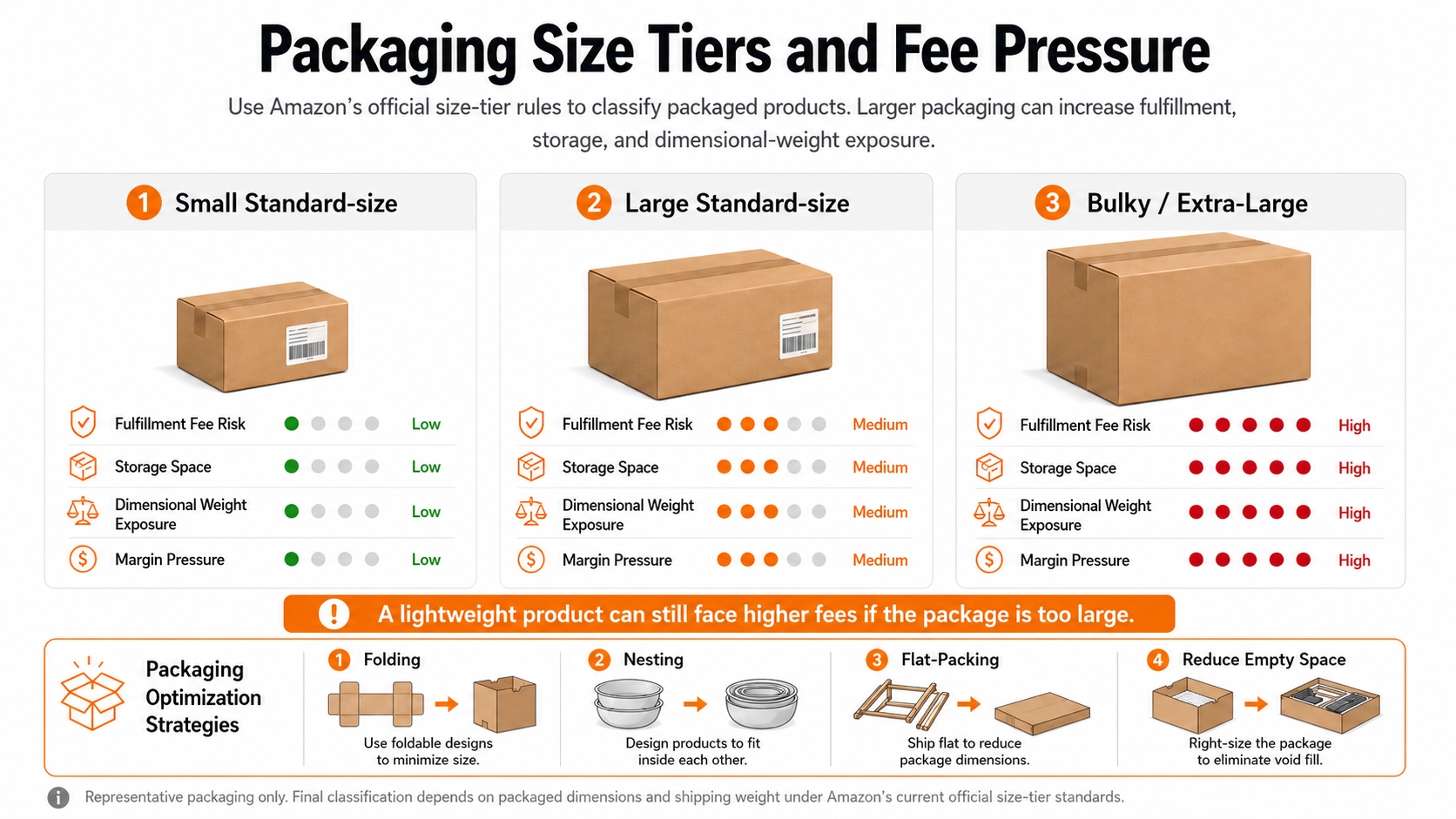
For the US marketplace, Amazon determines the applicable fee using the packaged sellable unit's dimensions, unit weight, dimensional weight when applicable, product size tier, and current fee schedule. As of 2026, the primary size tiers include Small standard, Large standard, Small bulky, Large bulky, and Extra-large.
| 2026 US Size Tier | Maximum Packaged Dimensions | Maximum Weight |
|---|---|---|
| Small standard | 15 x 12 x 0.75 in | 16 oz |
| Large standard | 18 x 14 x 8 in | 20 lb |
| Small bulky | 37 x 28 x 20 in, with length plus girth no more than 130 in | 50 lb |
| Large bulky | 59 x 33 x 33 in, with length plus girth no more than 130 in | 50 lb |
| Extra-large | Applies when qualifying limits for the lower tiers are exceeded | Multiple weight bands |
Amazon fee schedules and surcharges can change. Use the current Fee Preview report, Revenue Calculator, or Seller Central fee pages before making a final sourcing decision.
FBM last-mile shipping
Under Fulfilled by Merchant, the seller or a third-party warehouse ships each customer order. Last-mile cost may depend on destination zone, package dimensions, billable weight, delivery speed, residential surcharges, fuel surcharges, signature requirements, and negotiated account rates.
UPS, FedEx, USPS, and regional carriers do not all apply identical dimensional-weight rules. For example, UPS may use a divisor of 139 for Daily Rates and 166 for Retail Rates, while FedEx commonly uses 139 for US domestic and international package services. Always confirm the rule attached to your own service and account.
How Dimensional Weight Works
Dimensional weight, also called DIM weight or volumetric weight, converts package volume into a theoretical weight. It prevents a large lightweight box from being priced as though it occupies little delivery capacity.
Dimensional weight formula and when it applies
Common US formula:
Dimensional Weight = Length x Width x Height / DIM Divisor
Amazon uses a divisor of 139 when calculating dimensional weight for applicable US FBA size tiers. The result is compared with the packaged unit weight according to Amazon's size-tier rules.
Small standard items generally use unit weight rather than dimensional weight for FBA fee calculation. For Large standard, Small bulky, Large bulky, and most Extra-large products, dimensional weight may be used when it is greater than the unit weight. Extra-large products above 150 lb follow separate rules.
Illustrative example only
A package measuring 20 x 20 x 5 inches has a dimensional weight of 14.39 lb when divided by 139. If the applicable rule rounds up to the next whole pound, the billable or shipping weight may become 15 lb even when the package weighs only 3 lb. The actual charge still depends on whether the calculation is being used for FBA fees, a carrier quote, or another logistics service.
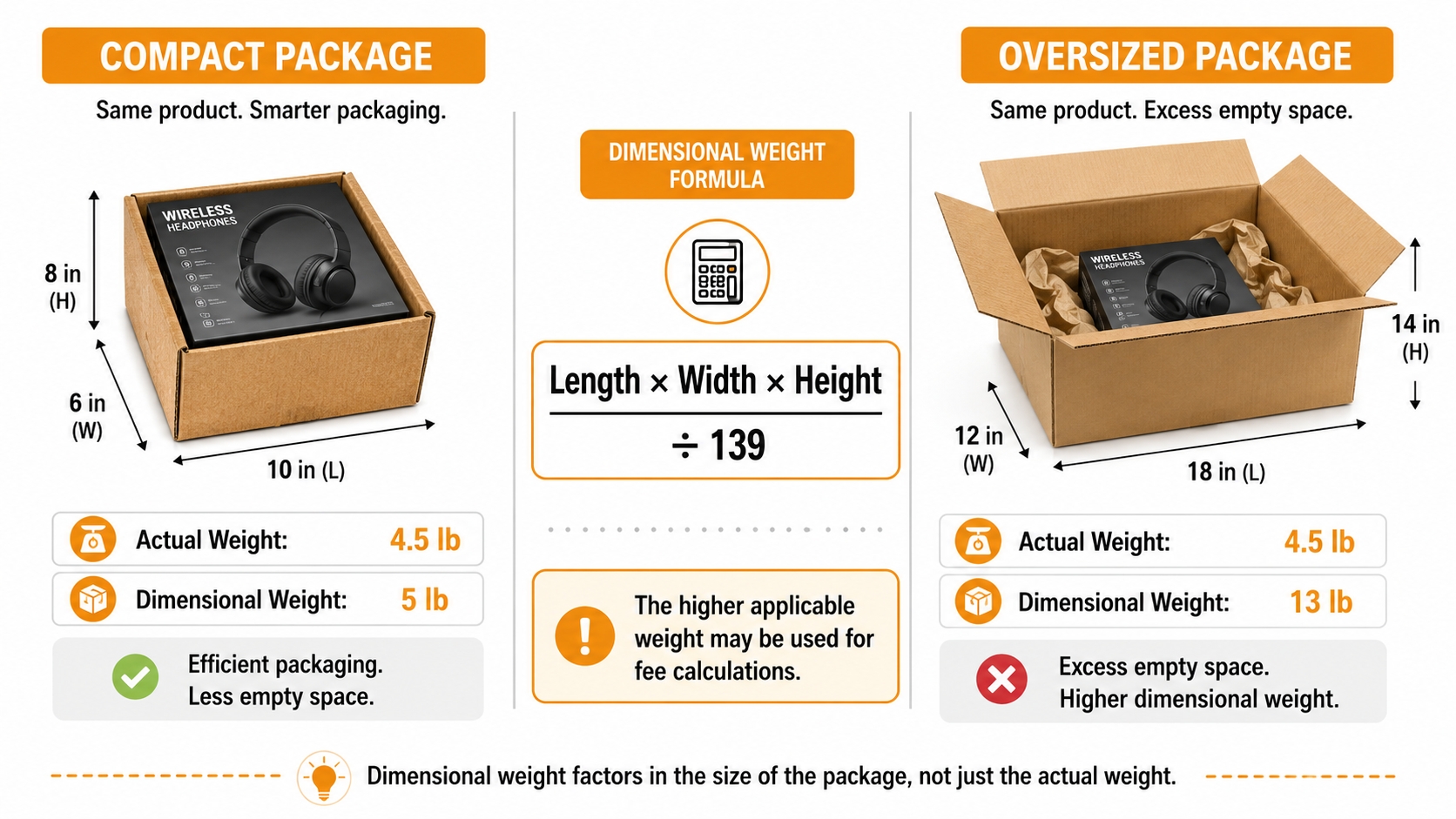
Product package versus shipping carton
Do not use the same dimensions for every calculation. FBA product size tiers use the packaged sellable unit. Inbound transportation quotes use the master carton, parcel, pallet, or freight handling unit sent to Amazon.
- Sellable-unit dimensions: Used for FBA size tiers and per-unit fulfillment estimates.
- Master-carton dimensions: Used for small-parcel inbound transportation.
- Pallet dimensions and weight: Used for LTL or FTL quotes and freight-class calculations.
Inputs for an Amazon Shipping Cost Model
Missing or estimated inputs can materially distort a shipping-cost model, especially when a product sits close to a size-tier or billable-weight threshold. Gather the following information before evaluating product viability.
Packaged product dimensions
Measure the final retail-ready package at its longest points. Include inserts, protective materials, bags, cartons, and any external components that remain part of the sellable unit.
Do not rely only on the supplier's product drawing. Ask for measurements from a completed packaging sample and confirm them again before mass production.
Packaged unit weight
Weigh the complete sellable unit, not only the product inside the box. Use several samples to identify packaging and manufacturing variation.
Master-carton and pallet data
Record the number of units per carton, carton dimensions, carton weight, pallet configuration, pallet height, and total shipment weight. These inputs are needed for carrier or freight estimates rather than per-unit FBA fee calculations.
Origin, destination, and marketplace
Freight and parcel rates vary by origin, destination, zone, marketplace, and service. For Amazon inbound transportation, the final fulfillment-center destinations and placement fees depend on the shipment plan and placement option generated in Send to Amazon.
Transportation method
Compare appropriate methods such as ocean freight, air freight, express shipping, small-parcel delivery, LTL, FTL, ground parcel, and expedited delivery. The lowest rate is not always the best option if longer transit time increases stockout risk or requires more safety stock.
Per-unit shipping-related costs
Convert shipment-level costs into per-unit values before entering them into a profit calculator. Depending on your model, these may include:
- International freight
- Customs clearance and duties
- Domestic drayage or trucking
- Prep-center transportation
- Amazon Partnered Carrier charge
- Inbound placement service fee
- FBM postage and packaging
- Insurance, fuel, residential, and other applicable surcharges
How Shipping Changes Product Viability
Shipping does not affect every product equally. Large, lightweight, fragile, low-priced, or low-margin products are generally more sensitive to packaging and fulfillment assumptions.
Bulky and Extra-large product risk
A product that exceeds the Large standard limits may enter Small bulky, Large bulky, or Extra-large pricing. The change can affect FBA fulfillment fees, storage requirements, placement fees, transportation options, and return costs.
Before ordering inventory, compare the current packaging with at least one more compact configuration. Products that can be nested, folded, disassembled, vacuum-packed, or shipped in a flatter package may have substantially different unit economics.
Bulky Product Risk Checklist
- Confirm the current Amazon product size tier.
- Calculate unit weight and dimensional weight separately.
- Review length plus girth for larger products.
- Request both small-parcel and palletized freight estimates when appropriate.
- Include return transportation and removal costs in the risk model.
- Test whether the product can be folded, nested, or disassembled.
Bundle packaging tradeoffs
Bundling can increase average order value and spread advertising cost across more products, but it may also increase package volume and shipping weight. The correct comparison is not simply bundle versus single-unit shipping cost. It is the net profit per order after accounting for price, fees, fulfillment, packaging, conversion, and advertising.
Run separate calculations for the individual product, two-pack, three-pack, and any gift-box version. A larger bundle may still be more profitable if the price premium exceeds the additional logistics cost.
Small standard advantage
Small standard products can benefit from lower fulfillment fees and unit-weight-based calculations. However, the category is more restrictive than simply weighing less than one pound. The packaged product must remain within the Small standard dimension limits, including a shortest side of no more than 0.75 inches.
A lightweight item can still become Large standard if its packaging is too thick. Measure the final packaging rather than assuming that a low product weight automatically qualifies for the smallest tier.
How to Use SellerSprite in the Shipping-Cost Workflow
The SellerSprite Profitability Calculator does not replace Seller Central, a freight forwarder, or a parcel-rate calculator. It serves a different purpose: combining shipping-related assumptions with the rest of the product's unit economics.
Step 1: Obtain external shipping estimates
Start with the appropriate source for each logistics leg:
- Ask the supplier or freight forwarder for international freight and customs estimates.
- Use Send to Amazon for shipment destinations, placement options, and partnered-carrier estimates.
- Use your UPS, FedEx, USPS, 3PL, or regional-carrier account for FBM postage estimates.
- Use Amazon's Fee Preview or Revenue Calculator to verify current FBA fee assumptions.
Convert shipment-level amounts into a cost per sellable unit. Keep transportation, placement, fulfillment, and storage costs separate so you can identify which assumption changes.
Step 2: Select FBA or FBM in SellerSprite
Open the SellerSprite Profitability Calculator, select the FBA or FBM mode, and choose the relevant Amazon marketplace.
Enter the dimensions and weight of the packaged sellable unit. These inputs help model shipping-related Amazon fees, but they should not be treated as a live carrier quote.
Step 3: Enter revenue and cost data
Add the proposed listing price, unit cost, and the externally calculated inbound shipping cost per unit. Depending on the scenario, also enter relevant tariffs, storage duration, PPC cost, promotion cost, returns, return-processing fees, and other expenses.
Important: When a freight forwarder or carrier provides a revised quote after a packaging change, manually update the inbound or FBM shipping-cost assumption in SellerSprite. Changing dimensions alone should not be treated as an automatic carrier-rate update.
Step 4: Review profitability
Review the estimated Net Profit, Profit Margin, ROI, revenue summary, and cost breakdown. The purpose is to answer questions such as:
- Does the product remain profitable after all shipping legs are included?
- Can the current selling price support the expected FBA or FBM cost?
- Does a packaging redesign produce a meaningful margin improvement?
- Is the bundle more profitable than the single-unit version?
- How much margin remains for PPC, promotions, and returns?
Step 5: Compare packaging scenarios
Run a separate calculation for each packaging configuration, and name each calculation group clearly, such as Original Box, Compact Box, Flat-Pack, or Two-Pack Bundle.
| Scenario | Dimensions | Actual Weight | DIM Weight at 139 | Shipping Cost Input | Profitability Result |
|---|---|---|---|---|---|
| Original box | 20 x 15 x 6 in | 4.5 lb | 13 lb | Enter external quote per unit | Review margin and ROI |
| Compact box | 18 x 13 x 5 in | 4.5 lb | 9 lb | Enter revised external quote per unit | Compare with original scenario |
Illustrative example only: The dimensional weights above show the effect of a 139 divisor and whole-pound rounding. They are not carrier quotes or guaranteed FBA fees.
Practical workflow
Measure the package, obtain a current quote, calculate the per-unit shipping cost, enter it into SellerSprite, review the resulting margin, and repeat the process after each meaningful packaging change.
FAQ
Does SellerSprite have a dedicated Amazon shipping calculator?
SellerSprite does not provide live freight, parcel, or Amazon Partnered Carrier quotes. Its Profitability Calculator lets sellers enter product dimensions, weight, inbound shipping cost, Amazon fees, PPC, returns, and other expenses to evaluate how shipping-related assumptions affect net profit, margin, and ROI.
What shipping costs should Amazon sellers calculate?
Sellers should separately model supplier freight, customs and domestic transportation, shipment transportation into Amazon, inbound placement fees, FBA fulfillment fees, and FBM last-mile postage when applicable. Separating the costs makes it easier to update one assumption without rebuilding the entire model.
How does dimensional weight affect Amazon shipping cost?
Dimensional weight converts package volume into a theoretical weight. Amazon uses dimensional weight for applicable FBA size tiers and generally compares it with the packaged unit weight. Carriers may also use dimensional weight, but their divisors, rounding methods, services, and negotiated rates can differ.
Does Amazon use 139 for every inbound shipment?
No. Amazon uses a 139 divisor for dimensional-weight calculations related to applicable US FBA product size tiers and shipping weights. Inbound transportation charges may follow separate partnered-carrier, parcel, pallet, freight-class, or negotiated-rate rules.
What is the difference between inbound shipping and the inbound placement service fee?
Inbound shipping is the transportation cost of moving inventory to Amazon. The inbound placement service fee is a separate Amazon charge that may apply according to the placement option, product size, weight, and shipment configuration selected in Send to Amazon.
How can packaging changes reduce shipping cost?
Right-sizing a package can reduce dimensional weight, prevent a product from entering a higher Amazon size tier, increase the number of units per carton or pallet, and lower the quoted carrier cost. Actual savings depend on the original package, revised dimensions, weight, service, destination, and current fee schedule.
What is the difference between FBA fulfillment cost and inbound transportation cost?
FBA fulfillment cost is the per-unit fee Amazon charges after a customer places an order, covering services such as picking, packing, and delivery. Inbound transportation cost is incurred earlier when inventory is moved from the supplier, warehouse, or prep center to Amazon fulfillment centers.
Next Steps
- Measure the packaged sellable unit and the master carton separately.
- Obtain current supplier-freight, Amazon-inbound, or FBM carrier estimates from the appropriate source.
- Convert shipment-level costs into per-unit amounts.
- Open the SellerSprite Profitability Calculator and enter the shipping assumptions together with the remaining product costs.
- Compare net profit, margin, and ROI across your original and optimized packaging scenarios.
References
- Amazon Product Size Tiers View
- Amazon Dimensional Weight View
- Amazon FBA Fulfillment Fees View
- Amazon Partnered Carrier Program View
- Amazon Revenue Calculator View
- UPS Shipping Dimensions and Weight View
- FedEx Dimensional Weight Guide View
- SellerSprite Amazon Calculator Guide View
- SellerSprite Amazon FBA Fees Explained View
By SellerSprite Success Team
The SellerSprite Success Team combines Amazon marketplace experience with data-analysis expertise to help sellers evaluate products, keywords, costs, and operational decisions using practical workflows and marketplace data.
Last updated: 2026-07-28