SellerSprite's Amazon 2025 Annual Data Report combines multiple authoritative data sources to map how Amazon is evolving across market size, seller competition, Chinese seller dynamics, market selection, and traffic channels, and turns them into actionable guidance for operators.
For cross-border sellers, the headline for 2025 is straightforward: more professional, more system-driven, and more competitive. Traffic costs are higher, product differentiation is harder, and easy wins are rarer. But the opportunity has not vanished. It has shifted toward sellers who understand market structure and build repeatable operating capabilities.
Below is a shortened public version of the report focused on the core trends, representative data points, and practical implications. The full report is members-only and includes deeper datasets, a structured opportunity scoring model, and detailed market and category benchmarks.
1. Global market shifts: core markets drive scale, emerging markets drive incremental growth
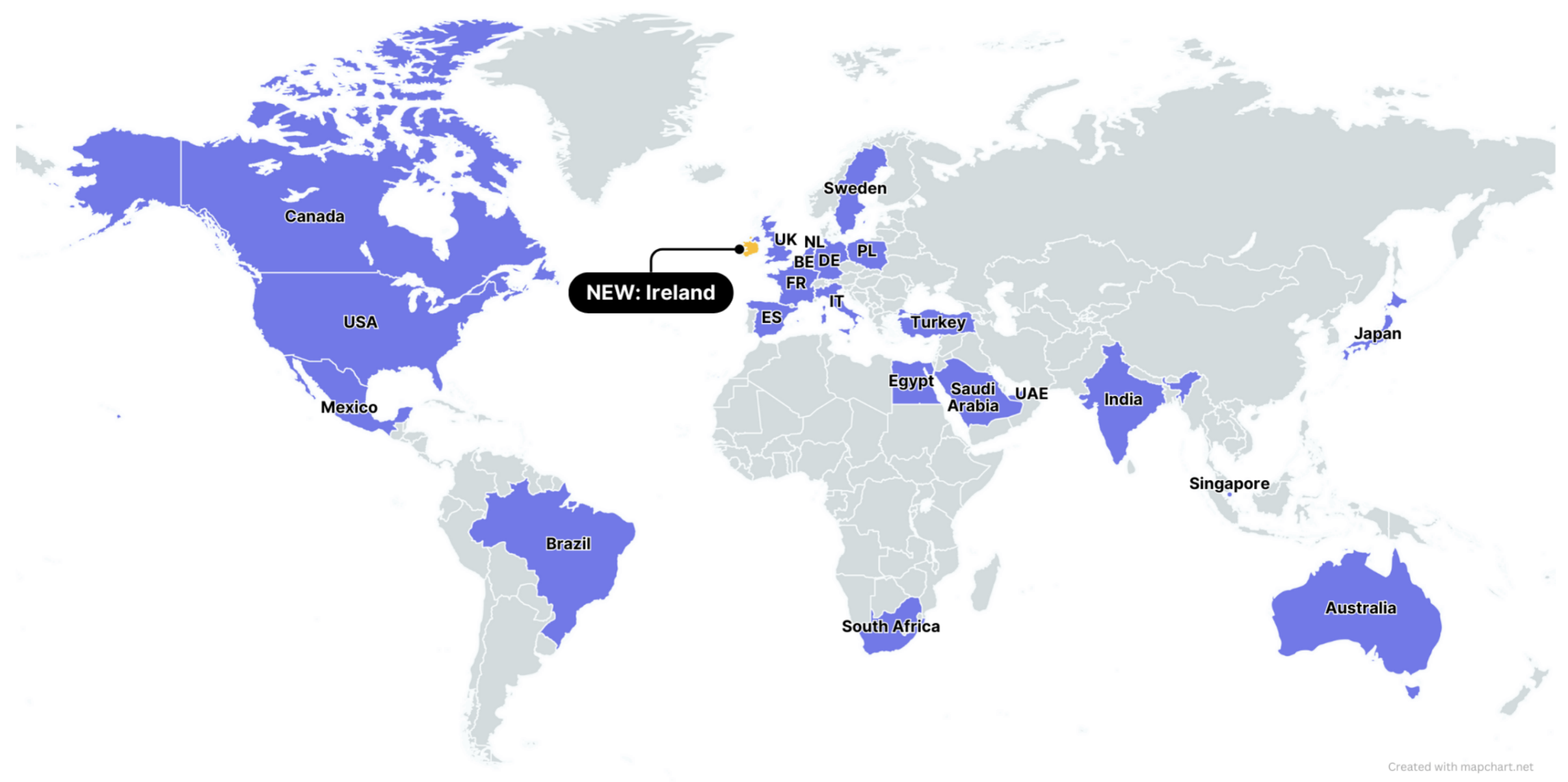
Amazon continues to expand its global footprint, reaching 23 marketplaces after launching Ireland on March 18, 2025. Marketplace expansion matters less as a headline and more as an operational opportunity: proven playbooks can be replicated across more markets to build a second growth curve.
Two structural realities define global expansion today.
- The US remains the super marketplace. It leads on both scale and traffic, with monthly visits around 3.1B in Dec 2025 and estimated GMV of 305B.
- Europe functions as a portfolio of markets. Individual EU and UK marketplaces are smaller than the US, but collectively form a second major arena for mature product lines.
- Emerging markets are smaller, but can be efficient testbeds for localized positioning and new operating models. They often grow faster off a smaller base, and competition density can initially be lower.
Seller takeaways
- Use core markets to build predictable scale, and use emerging markets to test into incremental growth and niche openings.
- Do not select markets on traffic alone. Evaluate localization readiness, including language, compliance, delivery speed, and returns expectations.
- Treat new or smaller marketplaces as lightweight experiments. Test fast, iterate fast, and avoid heavy inventory commitments early.
2. Platform economics: third-party sellers remain the engine as Amazon becomes more service-driven
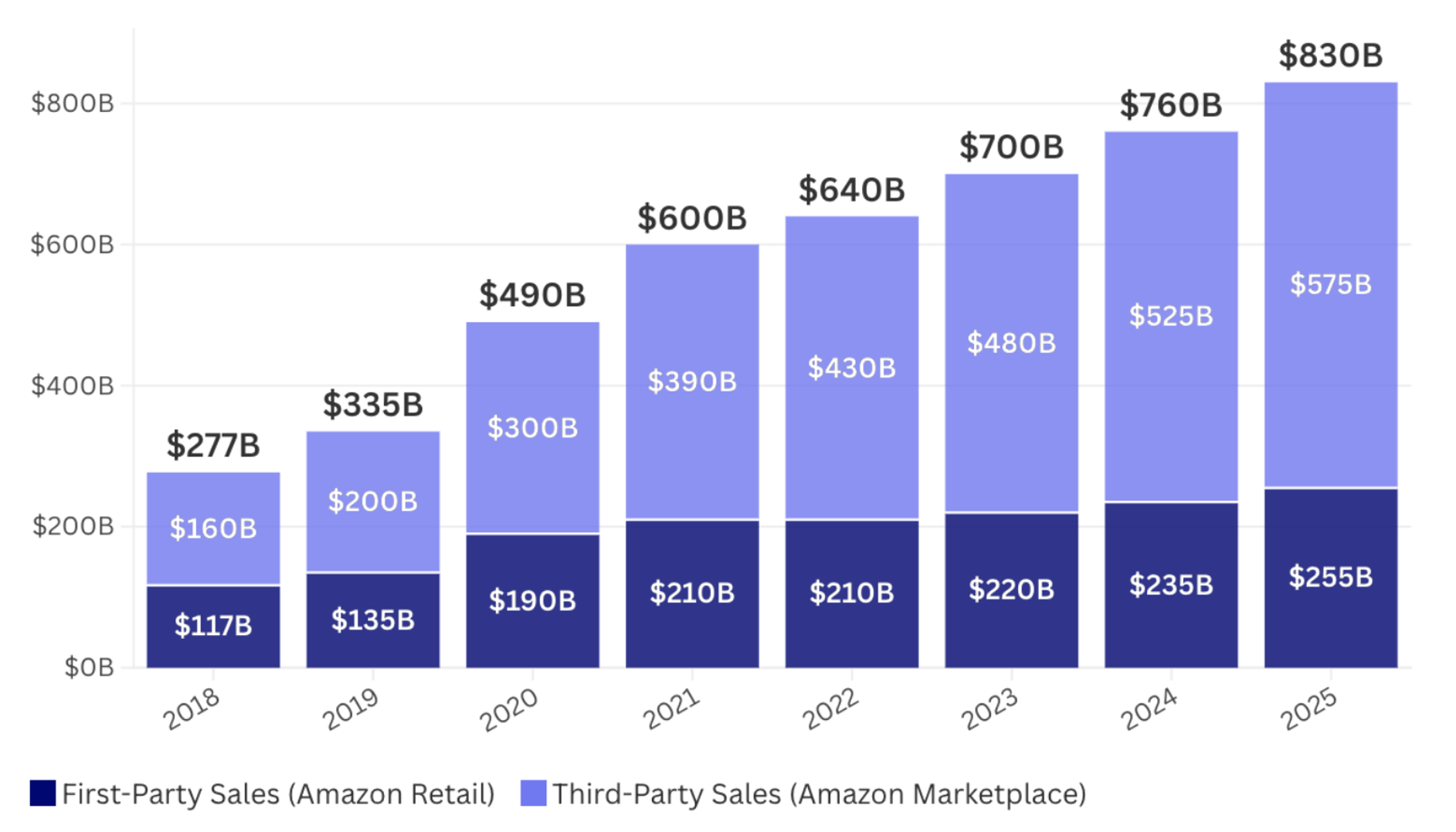
Amazon's growth is increasingly powered by its third-party ecosystem and services, especially logistics and advertising. The report estimates Amazon's 2025 global GMV at 830B, with third-party GMV at 575B, about 69 percent of total.
This matters because it shows how Amazon now monetizes its ecosystem.
- Third-party sellers remain central to Amazon's growth.
- Advertising and seller services are increasingly meaningful drivers of platform economics.
- Competition is less about simply getting listed and more about operating fundamentals: conversion, reviews, repeat purchases, and supply chain execution.
Seller takeaways
- Expect operational excellence to be the baseline. Listing quality, conversion, fulfillment reliability, and unit economics matter more each year.
- Do not optimize only for sales volume. Manage your full cost structure (ads, fees, and inventory turns) as one system.
- Build defensibility beyond price. Sustainable wins rely on product differentiation, brand assets, and repeatable operating processes.
3. Seller ecosystem: fewer new entrants, higher maturity, and external platforms reshaping acquisition
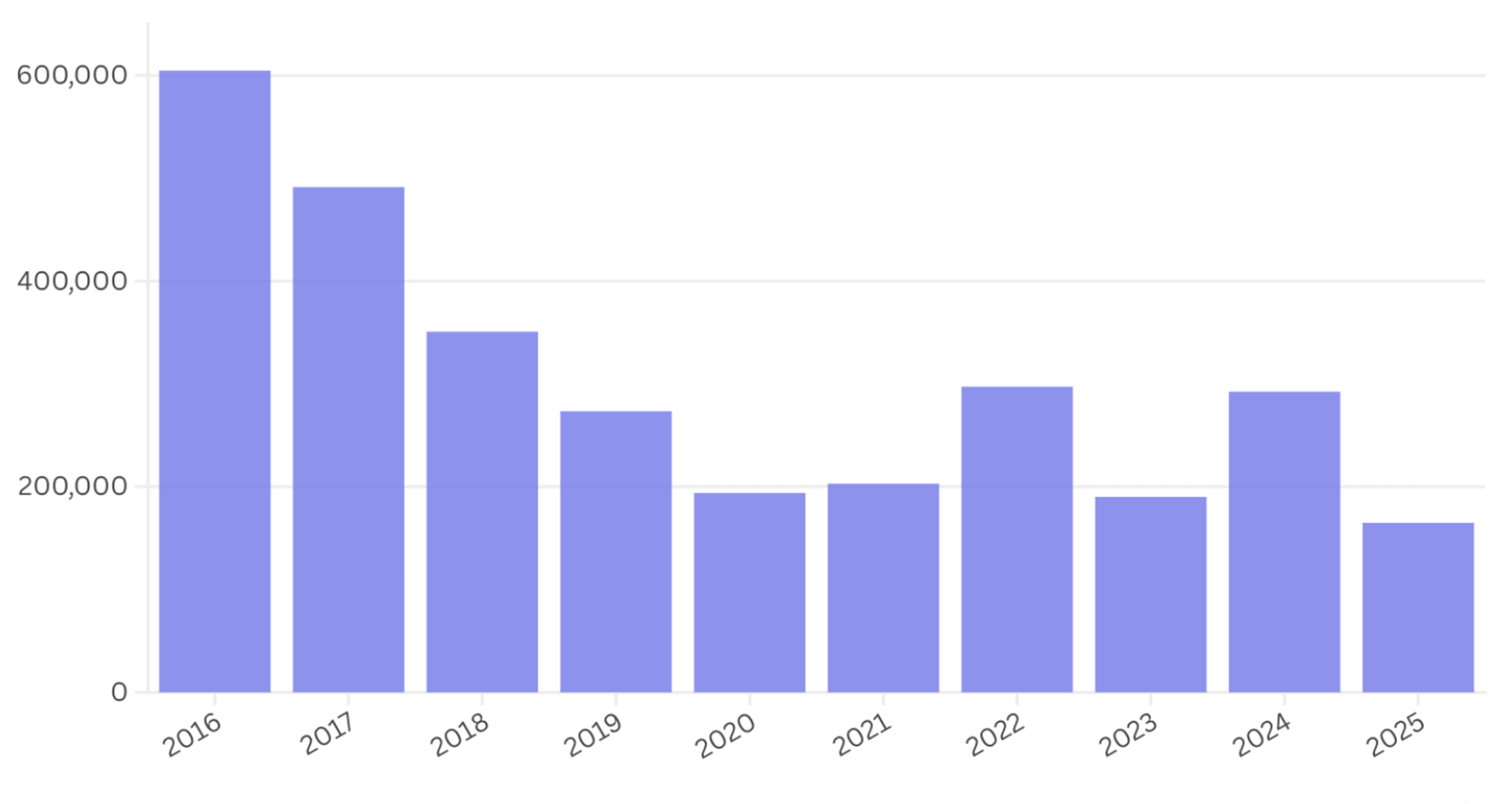
One of the clearest competitive signals is that new seller registrations are declining in key markets. In the US, new sellers fell to under 170,000 in 2025, down from roughly 300,000 in 2024. This points to a market where the easy growth phase is over and operator maturity is rising.
At the same time, acquisition is being reshaped by external platforms, especially TikTok's push into North America. Content-led demand creation is increasingly important as on-Amazon traffic becomes more expensive. For many brands, a common playbook is off-Amazon demand creation followed by on-Amazon conversion and repeat purchases.
Seller takeaways
- New sellers should launch with short validation cycles. Test product–market fit fast rather than overinvesting upfront.
- Established sellers should use this period to defend and deepen category positions.
- Build a dual-engine approach. Use content channels to seed demand, then use Amazon for high-intent conversion through search, reviews, and Prime fulfillment.
4. Chinese sellers: structural dominance, faster shifts in emerging markets, and the differentiation challenge
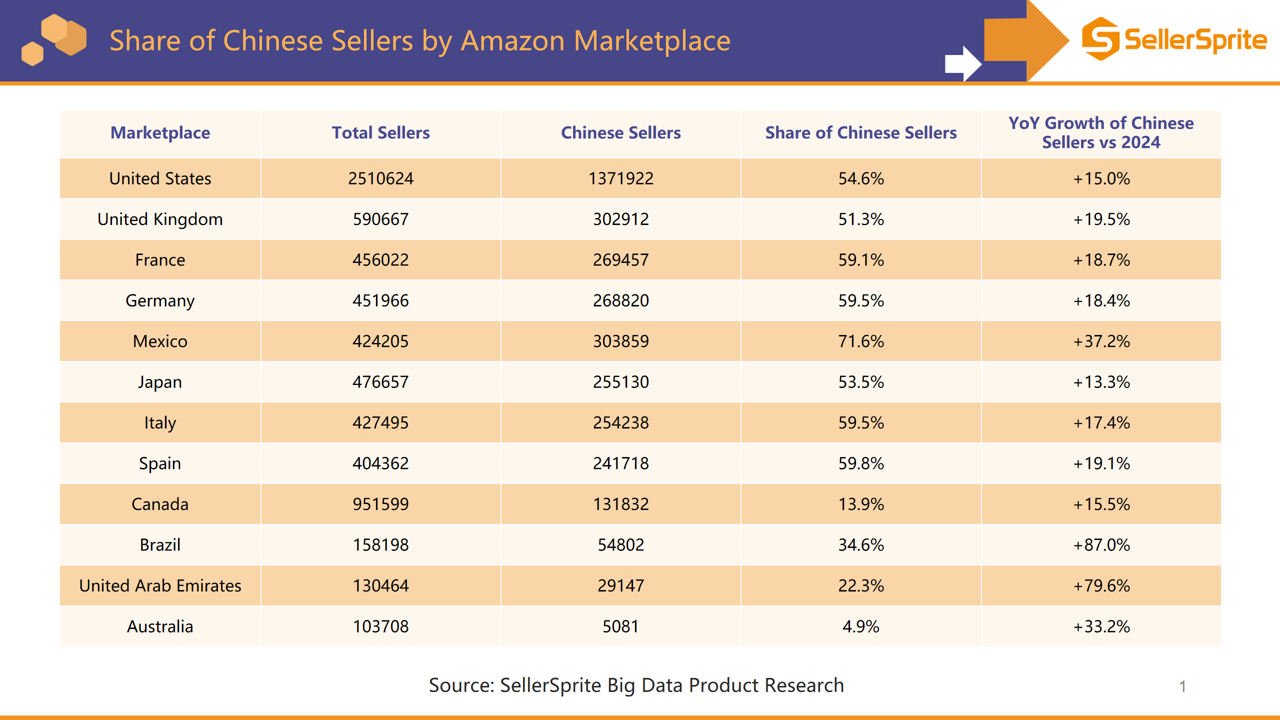
Chinese sellers represent a structural force across Amazon marketplaces. In many core markets, Chinese seller share is already above half, including 54.6 percent in the US, with major European markets broadly in the 51 percent to 59 percent range. Some markets are even higher, such as Mexico at 71.6 percent with rapid year-over-year growth.
This reshapes competitive baselines in pricing, supply chain speed, and iteration cycles, raising the bar for everyone else in the same categories. Markets with both high share and fast growth often become competitive quickly, making differentiation harder over time.
Seller takeaways
- Include competitive structure in market selection. Do not look only at traffic and GMV.
- In highly concentrated markets, price-only competition becomes fragile. Invest in brand, compliance discipline, content, and product innovation.
- Build harder-to-copy capabilities, including customer trust signals, differentiated design, and scalable operating systems.
5. Choosing markets in 2025: opportunity is about structure, not just GMV
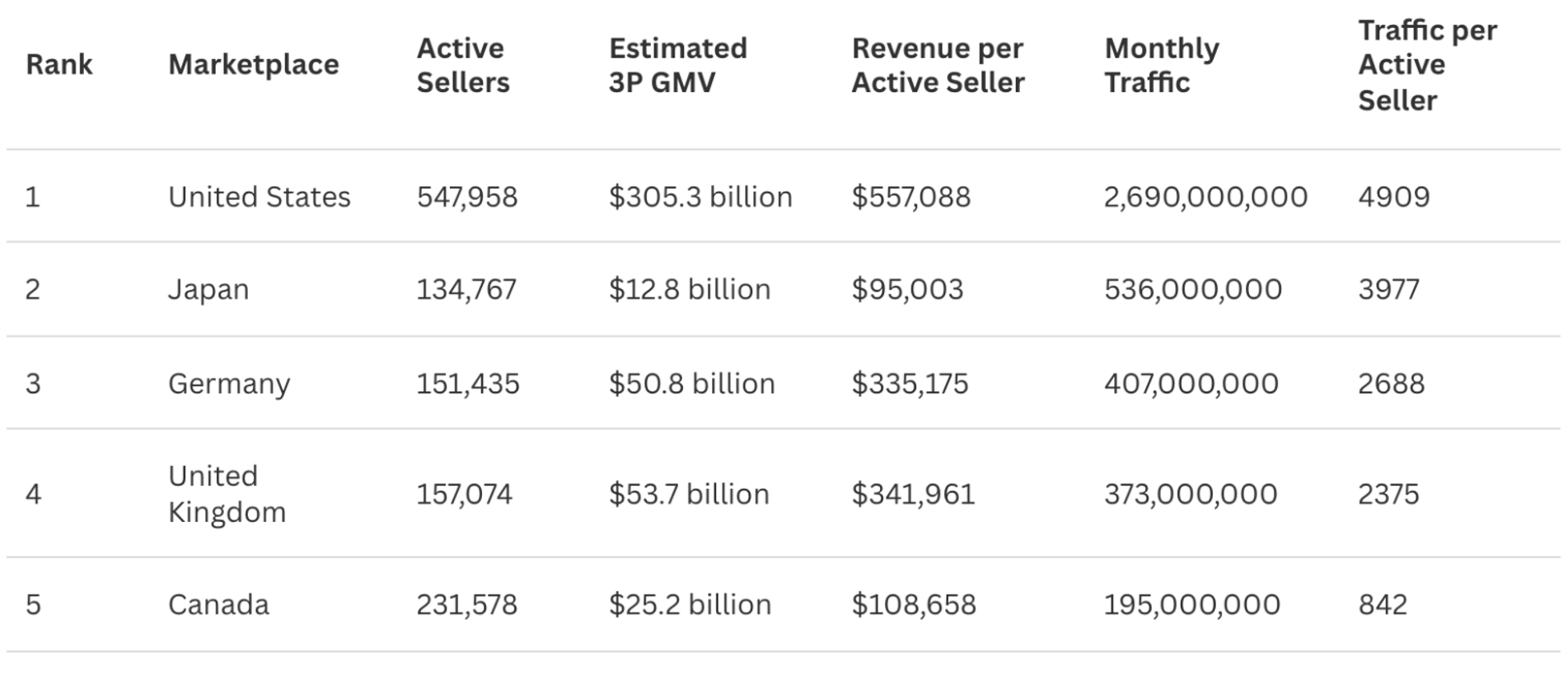
The report evaluates marketplaces using a weighted, multi-dimension opportunity model that looks beyond GMV to factors like long-term viability, seller density, and scaling potential. Based on this composite score, the highest-opportunity core markets are led by the US, Japan, Germany, the UK, and Canada.
Three representative market profiles show how opportunity differs by structure.
- United States: the highest ceiling and strongest validation environment, but with more polarized competition.
- Japan: rewards localization and long-term compounding, with higher sensitivity to consumer expectations.
- Germany and the UK: offer meaningful commercial volume, but performance depends more on conversion discipline and operational maturity than on abundant traffic.
Seller takeaways
- Match market choice to your strengths. Speed, localization, compliance discipline, and brand building lead to different best fits.
- Use the US for fast learning and scalable upside. Use Europe as a portfolio rather than a single bet.
- Treat emerging markets as selective bets. Enter when you can solve localization and fulfillment constraints without overcommitting resources.
6. Traffic and promotion trends: longer peak windows, earlier demand creation, and YouTube's outsized role
Major shopping moments are becoming longer and more contested across platforms. Amazon extended Prime Day to four days in 2025, while TikTok Shop ran a 13-day campaign in the same period. Peak demand is increasingly contested over extended windows rather than concentrated into a single spike.
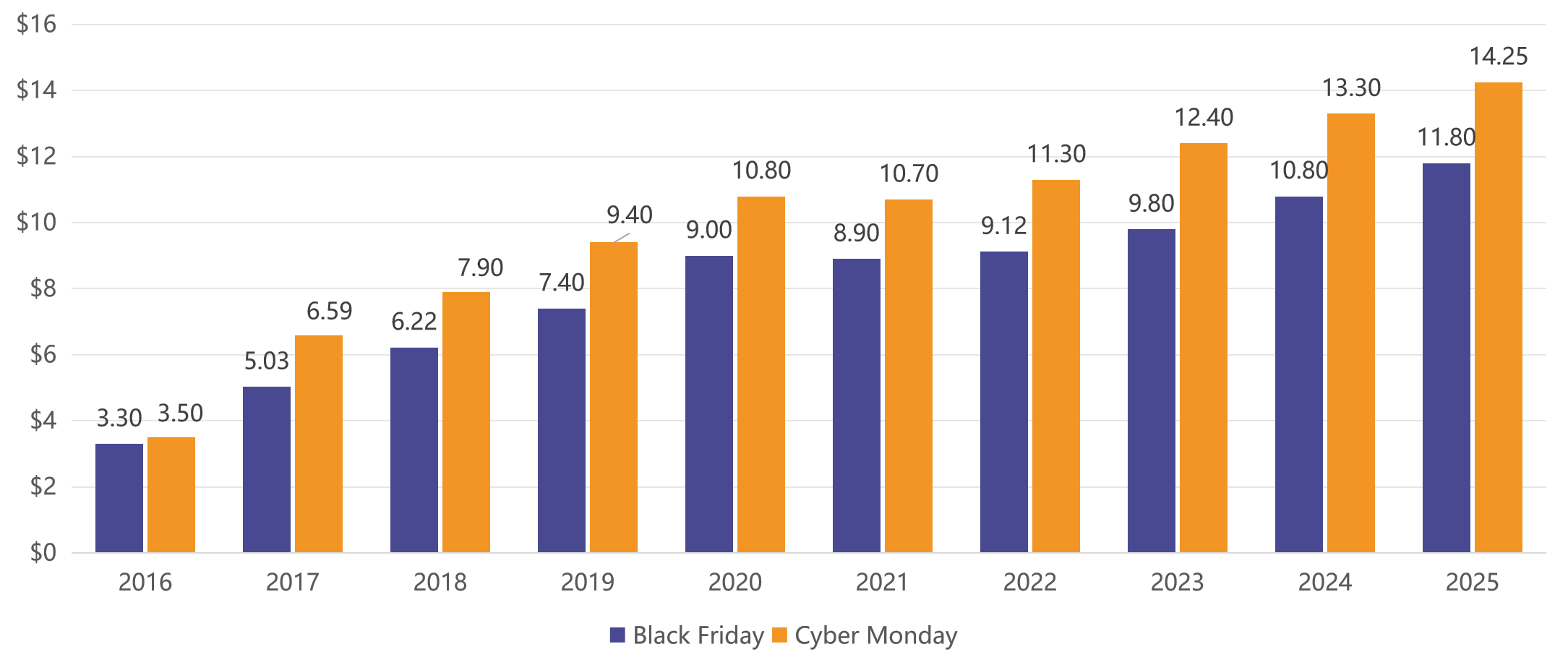
Holiday demand remains strong and structurally resilient in the US. Black Friday reached 11.8B in online sales in 2025, and Cyber Monday reached 14.25B, remaining the peak online day.
Off-Amazon traffic patterns also continue to clarify. For Amazon.com social referrals from July to September 2025, YouTube contributed over 60 percent, far ahead of other platforms. This highlights the importance of review, comparison, and tutorial content in driving purchase intent.
Seller takeaways
- Plan peak seasons as campaigns, not days. Pre-heat demand earlier, convert during the event, and extend the post-event tail.
- Treat off-Amazon as a core capability. YouTube supports review-led intent creation, while TikTok excels at attention and demand seeding.
- Upgrade performance management: move beyond single metrics like ACOS to a system view of margin, advertising spend, and inventory turns.
Get the full Amazon 2025 Annual Data Report for free
Upgrade your SellerSprite membership to unlock the full report for free, including deeper datasets, the complete opportunity scoring framework, and market- and category-level benchmarks to calibrate your pricing, margin targets, and expansion roadmap.