TL;DR: Rank tracking shows where your product ranks for keywords, while sales attribution reveals which keywords actually drive conversions. For Amazon sellers, combining both provides deeper insights into performance and enables data-driven optimization.
Key Takeaways
- Rank tracking measures keyword position, but not sales impact—a high rank doesn’t always mean high conversion.
- Sales attribution identifies which search terms lead to actual purchases, offering a clearer ROI picture.
- Integrating rank data with sales attribution helps Amazon sellers make smarter decisions on keywords, ads, and content.
- Tools like SellerSprite combine both metrics, enabling holistic performance analysis for FBA and private label sellers.
Table of Contents
- Introduction: Why This Debate Matters
- Understanding Rank Tracking on Amazon
- What Is Sales Attribution in Amazon Selling?
- Rank Tracking vs. Sales Attribution: A Side-by-Side Comparison
- The Relationship Between Rank and Sales: Correlation vs. Causation
- Data Integration: How to Combine Rank and Sales Data
- Optimizing Your Strategy Using Both Metrics
- FAQ
- References
Note on marketplaces: This guide is specifically optimized for the US market.
Introduction: Why This Debate Matters
If you're an Amazon seller—whether just starting or scaling a brand—you've likely heard the terms "rank tracking" and "sales attribution." But do you truly understand the difference? More importantly, do you know which one drives real business outcomes?
Many sellers obsess over keyword rankings, believing that hitting #1 means success. But what if your product ranks #1 for a keyword that never converts? Conversely, what if a lower-ranking keyword drives consistent sales but goes unnoticed?
This is where the distinction between rank tracking and sales attribution becomes critical. One tells you where you stand. The other tells you what's working.
In this comprehensive guide, we’ll break down both concepts, compare their strengths and limitations, and show you how to integrate them into a powerful analytics strategy. Whether you're a beginner, a growing seller, or a brand manager overseeing multiple SKUs, this guide will help you move beyond vanity metrics and focus on what truly impacts your bottom line.
Understanding Rank Tracking on Amazon
Rank tracking refers to monitoring the position of your Amazon product listing in search results for specific keywords. For example, if someone searches "wireless earbuds," and your product appears in the third position, your rank for that keyword is #3.
This metric is widely used because it’s easy to measure and gives a quick snapshot of visibility. Many Amazon rank tracking tools allow sellers to monitor hundreds of keywords across categories and competitors.
But here’s the catch: rank doesn’t equal revenue. You can rank #1 for a keyword and still make zero sales. Why? Because ranking is influenced by many factors—some of which have little to do with conversion.
How Amazon Determines Keyword Rank
Amazon’s A9 algorithm determines keyword rankings based on:
- Relevance: How well your title, bullet points, and backend keywords match the search query.
- Sales velocity: Products with higher recent sales tend to rank higher.
- Conversion rate: Listings with strong click-through and purchase rates get a ranking boost.
- Customer reviews: Higher ratings and more reviews improve trust and ranking.
- Inventory availability: In-stock items are favored over out-of-stock ones.
For a deeper dive into how Amazon keyword ranking works, check out our full guide: How Amazon Keyword Ranking Works: A Complete Guide for Sellers.
Common Tools for Amazon Rank Tracking
Popular tools include:
- SellerSprite: Offers real-time rank tracking with historical trend analysis and competitor benchmarking.
- Helium 10: Provides Cerebro for keyword research and Magnet for rank tracking.
- Jungle Scout: Tracks keyword positions and estimates traffic potential.
- AMZScout: Monitors daily rank changes and alerts for drops.
These tools help sellers identify ranking opportunities and optimize content. But again, they don’t tell you whether those keywords are actually driving sales.
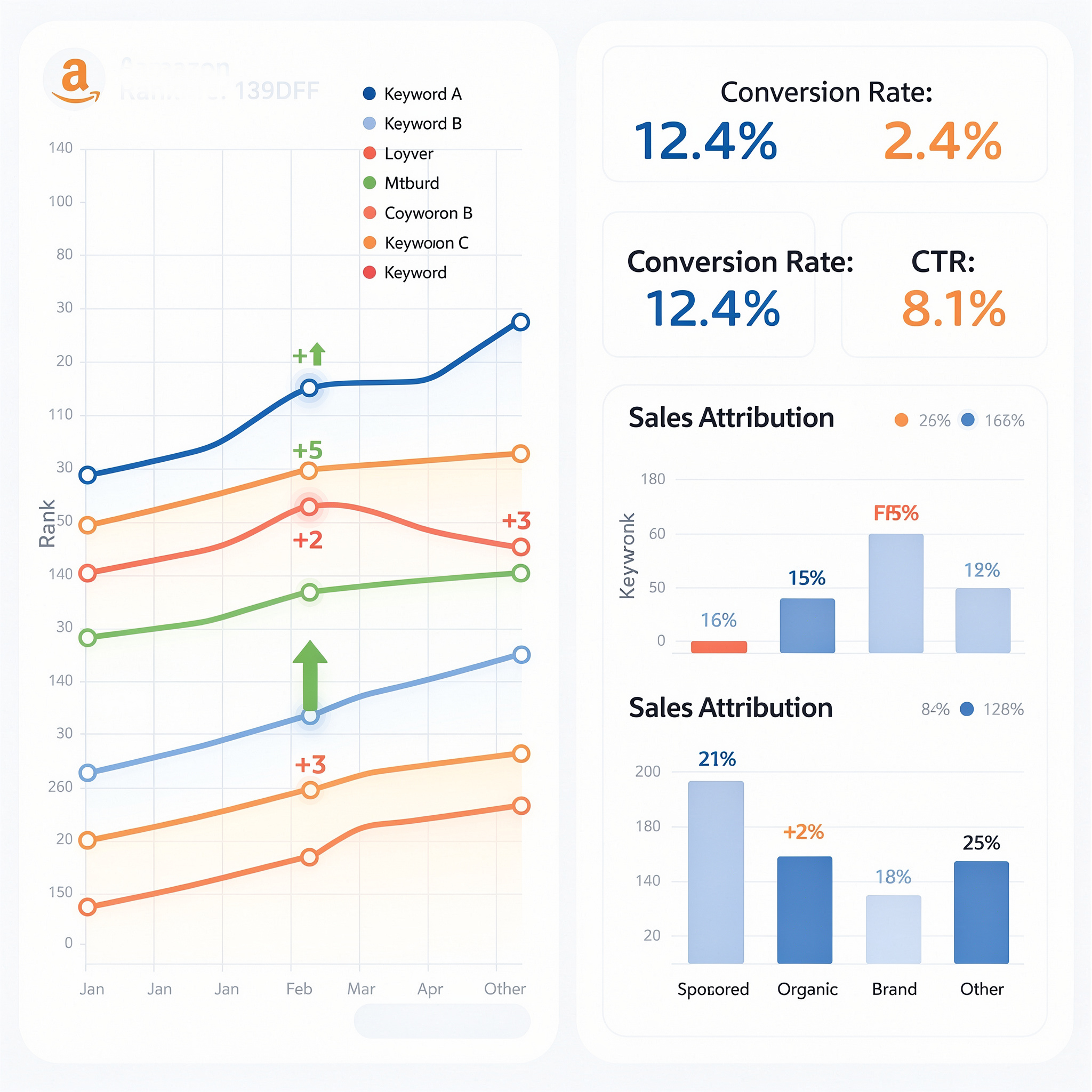
What Is Sales Attribution in Amazon Selling?
Sales attribution goes beyond visibility. It answers the question: Which keywords, ads, or traffic sources are actually leading to purchases?
Unlike rank tracking, which is about position, sales attribution is about performance. It connects the dots between customer search behavior and actual conversion events.
For example, two keywords might have similar search volume:
- "noise cancelling earbuds" – ranks #5, converts at 8%
- "best wireless earbuds 2024" – ranks #12, converts at 15%
Even though the second keyword ranks lower, it drives more sales per impression. That’s the power of sales attribution.
How Sales Attribution Works on Amazon
Amazon doesn’t provide direct sales attribution data in Seller Central. However, third-party sales attribution software uses advanced tracking methods such as:
- Session-level tracking: Captures user behavior from search to purchase.
- Ad campaign tagging: Links Sponsored Products clicks to conversions.
- Backend keyword mapping: Matches search terms to backend keywords and sales data.
- Attribution windows: Tracks conversions within 7–14 days of a click.
By analyzing this data, sellers can identify high-performing keywords—even if they don’t rank at the top—and reallocate budget accordingly.
Why Sales Attribution Matters More Than You Think
Many sellers focus on ranking because it’s visible and measurable. But sales attribution reveals the true ROI of your SEO and ad spend.
For instance, you might spend thousands on Sponsored Brands targeting "premium headphones," only to discover that "studio headphones for music production"—a long-tail keyword with lower traffic—drives 3x more conversions at half the cost.
This insight allows you to:
- Pause underperforming keywords
- Scale high-converting ones
- Optimize product titles and bullet points around converting terms
- Improve ad copy and targeting
To learn more about tracking keyword performance, see our guide: How to Track Amazon Keyword Ranking.
Rank Tracking vs. Sales Attribution: A Side-by-Side Comparison
Let’s break down the key differences between these two metrics:
| Feature | Rank Tracking | Sales Attribution |
|---|---|---|
| Primary Goal | Measure visibility in search | Measure conversion impact |
| Data Type | Positional (e.g., #1, #5) | Behavioral (clicks, conversions) |
| Time Horizon | Daily/weekly changes | 7–30-day conversion windows |
| Tools Required | Amazon rank tracking tools | Sales attribution software |
| Best For | SEO optimization, content updates | Ad spend ROI, pricing strategy |
| Limitation | Doesn’t show sales impact | Harder to implement without tracking |
As the table shows, rank tracking is tactical—it helps you win visibility. Sales attribution is strategic—it helps you win revenue.
The Relationship Between Rank and Sales: Correlation vs. Causation
It’s natural to assume that a higher rank leads to more sales. And in many cases, that’s true. But correlation isn’t causation.
A product might rank high due to a temporary sales spike from a coupon or external promotion. Once the promotion ends, the rank drops. Conversely, a product with steady, high-converting traffic might maintain a mid-tier rank but generate consistent profits.
Case Study: The #1 Ranking That Didn’t Convert
A skincare brand used a popular Amazon rank tracking tool to optimize for the keyword "organic face moisturizer." After weeks of tweaks, they hit #1 in search results.
Excited, they increased ad spend. But sales didn’t improve. In fact, their ACOS (Advertising Cost of Sale) rose to 65%.
When they used sales attribution software to analyze the data, they discovered something shocking: only 2.3% of clicks from that keyword converted. Meanwhile, a long-tail keyword—"non-comedogenic face cream for oily skin"—ranked #18 but had a 12.7% conversion rate.
They shifted focus, optimized their listing for the high-converting term, and reduced ad spend on the vanity keyword. Result? Sales increased by 40%, and ACOS dropped to 38%.
Key Insight: Rank Fuels Visibility, But Conversion Drives Revenue
Ranking high increases impressions and clicks, but if your product page doesn’t convert, you’re just burning ad budget. That’s why top-performing sellers use both metrics:
- Use rank tracking to identify visibility gaps and optimize content.
- Use sales attribution to validate which keywords deliver ROI.
Data Integration: How to Combine Rank and Sales Data
The real power comes from integrating rank tracking and sales attribution data. When you overlay keyword position with conversion performance, you unlock actionable insights.
Step 1: Map Keywords to Performance
Create a spreadsheet or use a dashboard that includes:
- Keyword
- Current Rank
- Average Rank (30-day)
- Clicks (from Brand Analytics or ads)
- Conversions
- Conversion Rate
- Revenue Generated
Step 2: Segment Keywords by Performance
Categorize keywords into four quadrants:
- High Rank, High Conversion: Gold standard. Protect and scale.
- High Rank, Low Conversion: Optimize listing (images, price, bullets).
- Low Rank, High Conversion: Invest in SEO and ads to boost visibility.
- Low Rank, Low Conversion: Deprioritize or eliminate.
Step 3: Use Integrated Tools
Manual tracking is time-consuming. Instead, use platforms like SellerSprite that combine rank tracking with sales attribution insights.
With automated data syncing, you can:
- See real-time rank changes alongside conversion data
- Get alerts when high-performing keywords drop in rank
- Identify keyword cannibalization across listings
- Forecast sales based on rank improvements
Optimizing Your Strategy Using Both Metrics
Now that you understand both metrics, here’s how to apply them across key areas of your Amazon business.
1. Product Listing Optimization
Use rank tracking to identify keywords you’re close to ranking for (e.g., #6–10). Then, optimize your title, bullets, and backend keywords to push into the top 5.
But don’t stop there. Use sales attribution to ensure those keywords actually convert. If they don’t, consider whether the search intent matches your product.
2. Advertising Strategy
For Sponsored Products, use sales attribution to identify high-ACOS and low-converting keywords. Pause or bid down on them.
Meanwhile, boost bids on keywords that rank lower but convert well. This ensures your ad spend drives profit, not just traffic.
3. Competitive Analysis
Monitor competitor rank movements. If a rival suddenly jumps to #1 for a high-value keyword, check if their conversion rate justifies it.
If not, you may have an opportunity to outperform them by focusing on conversion-optimized content.
4. Pricing and Promotions
Run a promotion and watch both rank and sales attribution. Did the temporary sales spike improve your rank? Did it attract new, high-intent buyers?
Use this data to time future promotions for maximum impact.
5. Long-Term Growth Planning
Build a keyword portfolio strategy. Maintain visibility on high-traffic keywords while nurturing high-converting, niche terms.
This dual approach ensures both short-term sales and long-term brand equity.
FAQ
What is the difference between rank tracking and sales attribution for Amazon sellers?
Rank tracking measures where your product appears in Amazon search results for specific keywords (e.g., #1, #5). It focuses on visibility. Sales attribution, on the other hand, identifies which keywords or traffic sources actually lead to purchases. While rank tells you if customers can find you, sales attribution tells you if they buy from you. Both are important, but sales attribution provides deeper insight into ROI and profitability.
How can I use rank tracking data to improve my Amazon sales attribution?
You can use rank tracking to identify keywords where you’re close to the top (e.g., #6–10). By optimizing your listing—improving titles, images, or pricing—you can increase visibility and drive more clicks. When combined with sales attribution data, you can assess whether those additional clicks convert. If they do, scale the effort. If not, refine your product page to better match search intent. This feedback loop helps improve both visibility and conversion over time.
Why is sales attribution more important than rank tracking for Amazon FBA sellers?
For Amazon FBA sellers, profitability is everything. Rank tracking shows visibility, but not revenue. Sales attribution reveals which keywords and campaigns actually generate sales and profit. A product can rank #1 but convert poorly due to mismatched intent, high price, or weak reviews. Conversely, a lower-ranked keyword might attract highly motivated buyers. By focusing on sales attribution, FBA sellers make smarter decisions about ad spend, pricing, and listing optimization—leading to better ROI and sustainable growth.
Next Steps
- Start tracking both keyword rank and conversion data using a tool like SellerSprite.
- Review your top 20 keywords and categorize them by rank and conversion performance.
- Optimize one underperforming but high-potential keyword this week.
References
- Amazon A9 Algorithm Explained View
- How to Track Amazon Keyword Ranking View
- Complete Amazon Rank Tracking Guide View
By SellerSprite Success Team
The SellerSprite Success Team combines deep expertise in Amazon marketplace dynamics, data analytics, and e-commerce growth strategies. With years of experience helping thousands of sellers—from beginners to enterprise brands—we deliver actionable insights grounded in real-world performance data. Our mission is to empower sellers with tools and knowledge that drive measurable results.