TL;DR: Your supplier says the order is ready. The freight forwarder quotes an attractive ocean rate. The shipment leaves the factory on schedule. Six weeks later, however, your Amazon inventory is still unavailable for sale.
The containers may have reached the destination country, but customs release, domestic transportation, FBA appointment scheduling, and warehouse receiving are separate steps. A delay or unexpected charge at any one of them can change the economics of the shipment.
This is the central challenge of Amazon FBA shipping and freight forwarding: moving inventory internationally is not the same as making it available for Amazon customers to purchase.
A reliable shipping plan must connect the supplier, international carrier, customs process, domestic delivery, Amazon inbound requirements, and replenishment schedule. The cheapest freight quote is useful only if the full route works.
Key Takeaways
- FBA and freight forwarding solve different problems. Freight forwarding coordinates transportation. FBA provides fulfillment services after eligible inventory enters Amazon's network.
- Compare the complete route, not the advertised freight rate. Pickup, export handling, international transport, customs, destination charges, domestic delivery, and Amazon inbound costs can all affect landed cost.
- Confirm the importer of record. Hiring a freight forwarder or customs broker does not automatically transfer the importer's legal responsibilities.
- Build Amazon preparation requirements into the shipping instructions. Product barcodes, cartons, shipment labels, routing, and pallets must match the applicable FBA workflow.
- Use a range of lead times. Factory completion, international transit, customs clearance, domestic delivery, and Amazon receiving each introduce uncertainty.
- Recalculate before every major replenishment. Freight prices, import duties, Amazon fees, inventory requirements, and demand can change between purchase orders.
Table of Contents
- Amazon FBA Shipping and Freight Forwarding Are Not the Same Service
- Choose the Route Before Comparing Freight Quotes
- Air Freight, LCL, or FCL: What Changes the Decision?
- The Freight Quote Is Only One Part of Landed Cost
- Customs, Incoterms, and the Importer of Record
- Prepare Inventory for Amazon Before It Leaves the Factory
- A Freight Quote Comparison That Changes the Winner
- Questions to Ask a Freight Forwarder Before Booking
- Plan Replenishment Around Sellable Inventory, Not Port Arrival
- What to Do When a Shipment Is Delayed or Received Incorrectly
- The Cheapest Route Is the One That Works Economically
- FAQs
- References
Scope: This guide focuses on international inventory shipments into the US Amazon FBA network, particularly private-label products sourced overseas. International freight regulations, tariff treatment, customs procedures, and Amazon inbound fees vary by product, country of origin, shipment configuration, and date. The examples are illustrative, not freight quotes or customs advice. Confirm current requirements with Amazon, the responsible customs professionals, and applicable government authorities before shipping.
Amazon FBA Shipping and Freight Forwarding Are Not the Same Service
Fulfillment by Amazon, or FBA, allows sellers to send eligible inventory into Amazon's fulfillment network. Amazon then stores units and handles applicable customer-order picking, packing, delivery, customer service, and returns.
Freight forwarding concerns an earlier part of the supply chain. A freight forwarder coordinates the movement of goods between locations, often using several transportation providers and service partners. Depending on its contract, the forwarder may arrange pickup, export procedures, international transport, customs brokerage coordination, warehouse transfers, and final delivery.
A forwarder does not automatically become the legal importer, product compliance specialist, cargo insurer, or party responsible for preparing inventory to Amazon's specifications. Those responsibilities must be assigned explicitly.
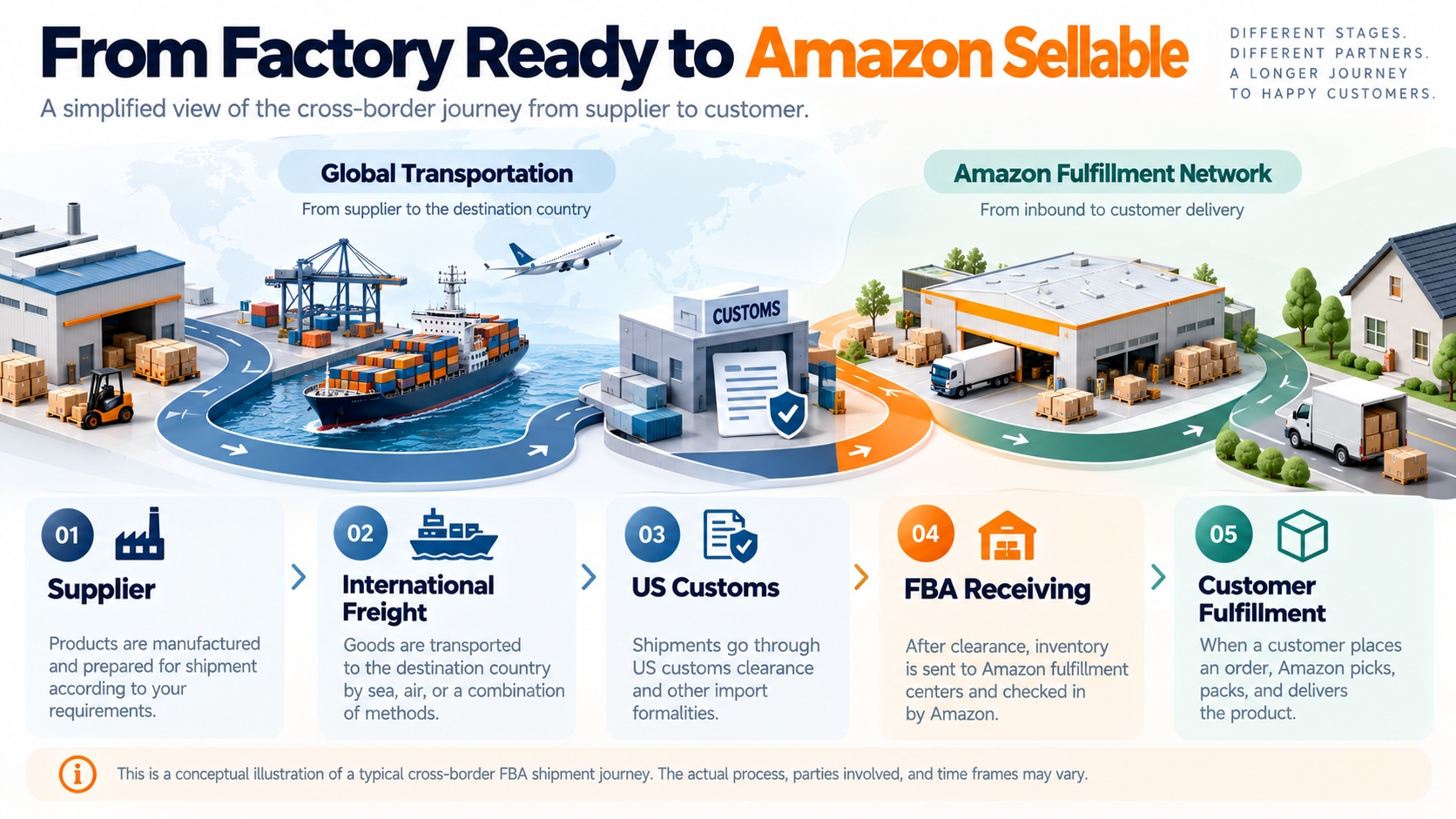
Follow one shipment from supplier to customer
The Physical Journey
01. Supplier and product preparation
Manufacturing, inspection, packaging, unit labels, carton measurements, and shipping documents.
02. Origin handling and international transport
Factory pickup, export procedures, consolidation, port or airport handling, and international movement.
03. US import and domestic transportation
Customs entry, applicable duties and fees, cargo release, destination handling, and transport toward the Amazon network.
04. FBA inbound delivery and receiving
Delivery according to the shipment plan, applicable carrier appointment, receiving checks, and inventory availability.
05. Amazon customer fulfillment
Amazon fulfills eligible orders after sellable inventory is available within its network.
Port arrival is not an Amazon receiving date
A carrier's estimated arrival at a US port or airport is not the date units will become available for purchase. Customs release, cargo handling, domestic movement, inbound delivery, and Amazon receiving may still be outstanding.
A useful shipping plan should therefore include separate milestones for international arrival, customs release, final delivery, and expected inventory availability.
Choose the Route Before Comparing Freight Quotes
Not every Amazon seller needs a conventional third-party freight forwarder. Some shipments fit Amazon-managed international programs; others require a forwarder with experience in specific products, origin countries, or customs arrangements.
Start by identifying the shipping origin, destination, product characteristics, inventory volume, and services that must be included.
Independent freight forwarder
An independent freight forwarder can coordinate international shipments using ocean carriers, airlines, customs brokers, trucking companies, and other service providers.
This may be useful for shipments requiring several supplier pickups, consolidation, specialized handling, alternative delivery destinations, or unusual documentation. The exact services depend on the provider and quote.
Amazon Global Logistics
Amazon Global Logistics, or AGL, provides international ocean and air freight solutions for supported origin-destination routes. Amazon's public US program page describes shipping from China to Amazon fulfillment networks in the US and other supported destinations, as well as specified ocean-freight services from Vietnam to the US.
Services may include origin pickup, export declaration, international transport, destination customs clearance, and delivery to Amazon facilities. Sellers can manage supported bookings and shipment tracking through Seller Central.
AGL also offers certain placement options that affect how inventory enters Amazon's network. Those services have eligibility and shipment-configuration requirements, so compare the actual quoted option rather than assuming every AGL booking includes the same placement arrangement.
Amazon SEND
Amazon Seller Export & Delivery, or SEND, provides access to international shipping services through participating carrier partners on supported routes. Amazon's public information lists several origin countries, including China, India, Taiwan, Thailand, Vietnam, and others.
AGL and SEND are different programs. Check the currently available origin, destination, carrier, service scope, and account eligibility before choosing between them.
Amazon Partner Carrier Program
Amazon's Partner Carrier Program provides supported domestic inbound transportation to the US Amazon fulfillment and distribution networks, including small-parcel, less-than-truckload, and full-truckload shipping options.
This is not the same as arranging the entire international movement from an overseas factory. It may serve the domestic leg after products have already reached an eligible US shipping location.
| Option | Primary use | What to verify |
|---|---|---|
| Independent forwarder | Flexible international freight coordination. | Origin pickup, customs brokerage, duties, destination charges, FBA delivery, and insurance. |
| Amazon Global Logistics | Integrated international shipping on supported routes. | Route availability, service level, customs arrangements, and placement option. |
| Amazon SEND | Cross-border shipping through participating service partners. | Supported origin, destination, carrier, product, and service coverage. |
| Partner Carrier Program | Domestic inbound shipping to supported Amazon facilities. | Origin eligibility, shipment type, carrier rates, and destination instructions. |
Air Freight, LCL, or FCL: What Changes the Decision?
Choosing air or ocean freight is not simply a question of speed versus price. Shipment size, cargo characteristics, delivery urgency, and the costs of holding inventory also affect the result.
Ocean freight commonly uses less-than-container-load or full-container-load arrangements. Smaller or urgent consignments may be candidates for air cargo or express shipping, depending on product restrictions and economics.
Air freight prioritizes transit speed
Air freight may be appropriate for lightweight, higher-value, or urgent replenishment stock. It generally carries different rate structures and cargo restrictions from ocean shipping.
Air cargo can be priced using chargeable weight, which may reflect dimensional weight rather than actual weight. A light but bulky product can therefore cost more to ship than its scale weight suggests. Confirm the carrier's dimensional-weight formula and minimum charges rather than assuming one universal divisor.
LCL shares container capacity
Less-than-container-load shipping consolidates cargo from several shippers. It can be practical when the seller does not need an entire container, but consolidation, destination handling, and deconsolidation may introduce additional charges or delays.
Sellers should ask whether the LCL quotation covers origin handling, destination handling, customs arrangements, and delivery to the intended US destination.
FCL uses a dedicated container booking
Full-container-load shipping may be suitable for larger, consolidated inventory movements. A dedicated container can simplify certain handling steps but introduces its own equipment, trucking, port, and potential detention or demurrage exposures.
FCL should not automatically be selected because the unit volume is growing. Compare the actual total route cost and equipment utilization against a properly scoped LCL alternative.
| Mode | Potential advantage | Cost or risk to examine |
|---|---|---|
| Air freight | Can reduce international transit time. | Chargeable weight, cargo restrictions, and higher transport charges. |
| Ocean LCL | Allows smaller volumes without booking a full container. | Consolidation, handling fees, and variable release timelines. |
| Ocean FCL | Can be economical for sufficiently large shipments. | Container utilization, drayage, equipment charges, and port delays. |
Consider splitting urgent and non-urgent stock
A seller facing a near-term stockout may consider sending a smaller quantity by air while moving the remaining order by ocean. This can limit the amount exposed to higher air freight charges.
The choice should follow a calculation of the likely stockout impact, extra freight cost, inventory availability, and cash requirements. Splitting shipments does not automatically save money because minimum charges and duplicate handling costs may apply.
The Freight Quote Is Only One Part of Landed Cost
Sellers sometimes compare freight forwarders by one quoted number, even when that number covers different services. One provider may quote port-to-port transport, while another includes factory pickup and the final US delivery.
Those prices are not comparable until the service boundaries, shipment quantities, product classification, and destination requirements are aligned.
Separate landed inventory cost from Amazon selling fees
Landed inventory cost generally includes the product cost and directly attributable expenses required to bring inventory to the defined destination, using a clearly stated accounting convention.
For operational planning, it is useful to distinguish four groups rather than combine every Amazon expense into a loosely defined landed-cost figure.
PRODUCT COST
Manufacturing, product-specific packaging, inspection, and other agreed supplier costs.
CROSS-BORDER LANDED COST
Origin handling, international freight, insurance where purchased, customs brokerage, applicable duties, destination charges, and transportation to the selected inventory destination.
AMAZON INBOUND AND STORAGE COSTS
Applicable inbound placement fees, Amazon storage charges, and other inbound or inventory-related fees that depend on the shipping plan and services used.
SALE-RELATED COSTS
Referral fees, FBA order fulfillment, advertising, and other expenses arising when products are sold.
Some organizations allocate inbound placement and storage costs into product-level profitability differently. The essential requirement is consistency: do not omit a cost or count it twice when comparing routes.
Inbound placement can change the comparison
Amazon's inbound placement services can affect the cost of distributing inventory across fulfillment centers. The available options and charges depend on factors including product size, shipping plan, and routing.
Some Amazon Global Logistics placement configurations include specific destination and placement services within the freight quote, while others are subject to separately applicable FBA inbound charges. Do not assume an inbound placement fee is always included or always additional.
The final cost comparison should reflect the actual Send to Amazon shipment plan and the booked service, rather than a generic fee estimate copied from another shipment.
Compare product dimensions before placing a purchase order
Product size and weight influence more than freight. They can affect carton configuration, chargeable weight, FBA fulfillment charges, storage economics, and transportation mode.
A compact redesign or more efficient packaging may improve supply chain economics without changing the retail offer. However, any proposed design change must preserve product quality, legal compliance, and accurate dimensions.
Customs, Incoterms, and the Importer of Record
A freight quote that says "door-to-door" or "DDP" may sound complete. It does not remove the need to establish who is legally responsible for importing the goods, how the customs entry will be filed, or whether the product can legally enter the United States.
These questions should be resolved before cargo leaves the supplier.
The importer of record has a defined responsibility
US Customs and Border Protection explains that the importer of record is responsible for the accuracy of relevant customs entry information and compliance with applicable import requirements. Importers can engage licensed customs brokers, but doing so does not automatically eliminate their underlying responsibilities.
Ask the forwarder or customs broker to identify the actual importer of record, applicable importer number, customs bond arrangements, entry filing responsibilities, and how import duties and fees will be paid.
Amazon should not be assumed to act as the importer of record for a seller's ordinary international inventory shipment. Amazon's published global-selling guidance warns that sellers or their providers must arrange the relevant import and export responsibilities, and that shipments arriving at fulfillment centers with unpaid customs duty charges can be returned.
Understand EXW, FOB, and DDP before accepting a price
Incoterms define certain delivery, cost, and risk responsibilities between buyer and seller under a sales contract. They do not, by themselves, identify every logistics subcontractor or resolve all customs-compliance questions.
| Term | Broad meaning | Seller question |
|---|---|---|
| EXW | The seller makes goods available at the named place; substantial transportation responsibilities fall to the buyer. | Who arranges pickup, loading, and export formalities? |
| FOB | For sea and inland waterway transport, the seller delivers the goods on board the vessel at the named port. | Which named port and which origin charges are included? |
| DDP | The seller undertakes extensive delivery and import-clearance obligations to the named destination under the agreed term. | Who can legally act as importer, and what taxes and charges are actually included? |
FOB is intended for sea or inland waterway transport, not a generic label for every air or courier shipment. Specify the named place and applicable Incoterms version in the commercial agreement, and seek professional guidance for unfamiliar transactions.
"DDP" is not a substitute for import documentation
Some logistics providers advertise an all-inclusive DDP price. Sellers should confirm the actual contracting parties, importer of record, customs entry values, product classification, duties, and documentary trail.
Do not agree to artificially low declared values, incorrect product descriptions, or an unexplained importer arrangement simply to obtain a lower freight quote. Such practices can create customs and product-compliance exposure.
Check product classification and import restrictions
Duties can depend on the product's tariff classification, customs value, origin, and applicable trade measures. Product-specific regulatory requirements may also apply, including those involving food-contact materials, children's products, electronics, or other regulated categories.
For ocean vessel imports into the United States, Importer Security Filing requirements may also apply. CBP describes advance cargo information obligations for the responsible ISF party and its authorized filing agent.
A freight forwarder can help coordinate these procedures, but sellers should confirm the roles, deadlines, and product-specific requirements instead of assuming that a general shipping quote covers them.
Prepare Inventory for Amazon Before It Leaves the Factory
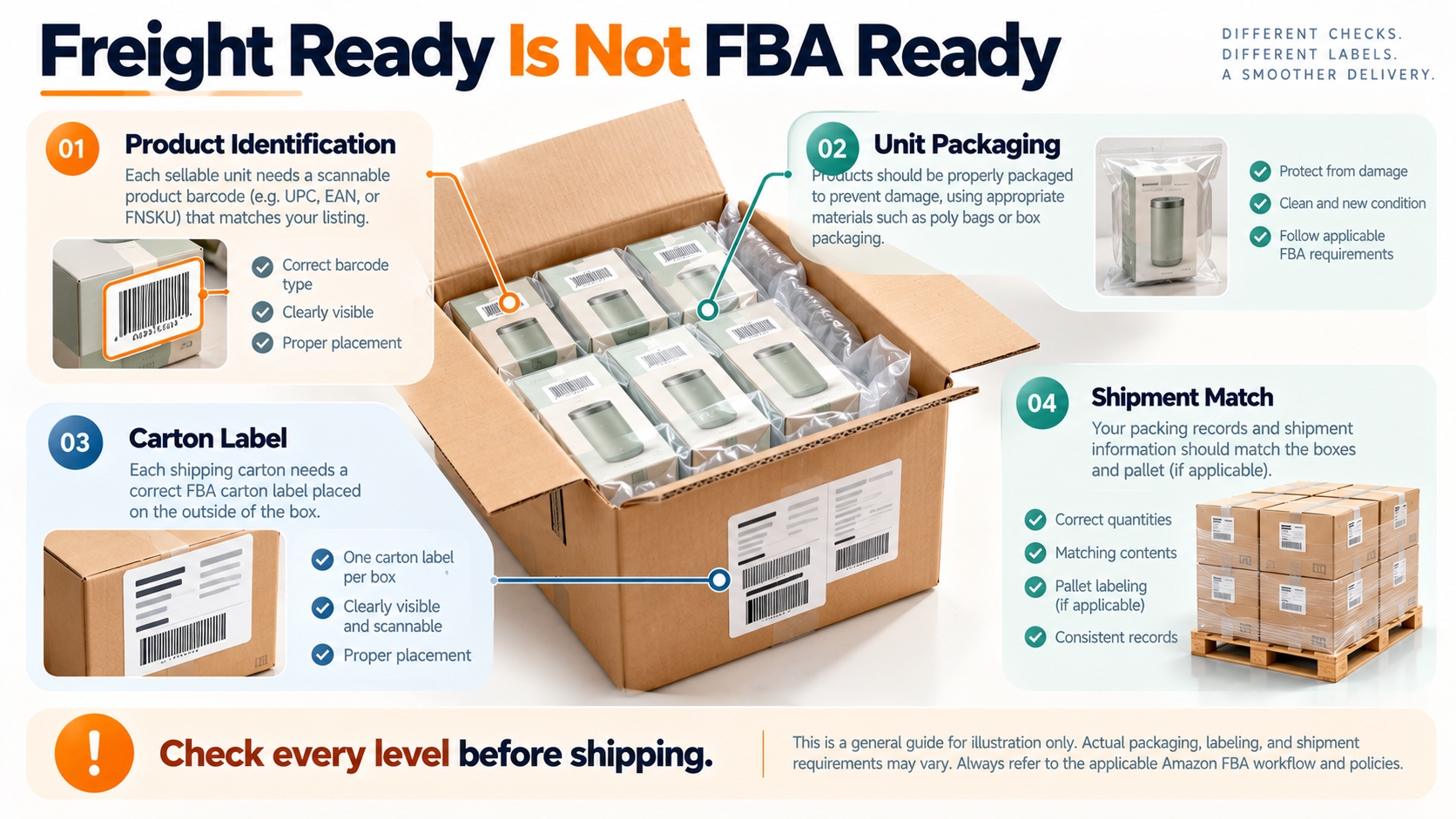
International freight can arrive successfully while the FBA shipment is still unprepared for receipt. Missing labels, incorrect carton contents, mismatched quantities, and unsuitable palletization can produce delays or extra handling.
Amazon's public packaging and labeling guidance emphasizes preparation, scannable identifiers, secure packaging, and compliance with the applicable inbound requirements.
Verify the product-level requirements
Confirm whether the ASIN is eligible for FBA, whether its unit barcode is suitable, and whether the product requires special packaging, warning labels, expiration dating, or handling.
Product requirements depend on the category and item. Fragile goods, liquids, sets, bundles, sharp products, and regulated goods may need different preparation. Do not assume the supplier's ordinary retail packaging is automatically FBA-ready.
Create the shipment through Send to Amazon
The Send to Amazon workflow identifies the inventory being shipped, the packing configuration, shipping method, and the labels or carrier information required for the shipment.
Amazon's published workflow includes confirming inventory, entering shipping details, printing box labels, and providing carrier or pallet information where applicable. The exact steps depend on shipment type and selected service.
Do not send outdated destination instructions
The final Amazon receiving destination should come from the applicable shipping workflow and booked service. Do not assume that an address used for a previous shipment remains valid for the next one.
If Amazon requires inventory to be routed to several facilities, determine how the shipping plan affects domestic transportation, inbound placement charges, and the forwarder's delivery responsibilities.
Verify cartons and pallets before dispatch
The supplier or preparation warehouse should confirm unit counts, carton contents, applicable barcode placement, box labels, dimensions, and pallet requirements before the cargo is released.
A simple packing-list reconciliation can catch errors before they become receiving discrepancies. The forwarder should be informed of the final shipment plan and any Amazon-specific delivery instructions.
Pre-dispatch rule: Do not release cargo solely because manufacturing is complete. Confirm the correct product identifiers, final quantities, packaging, shipment plan, transport booking, customs information, and destination instructions first.
A Freight Quote Comparison That Changes the Winner
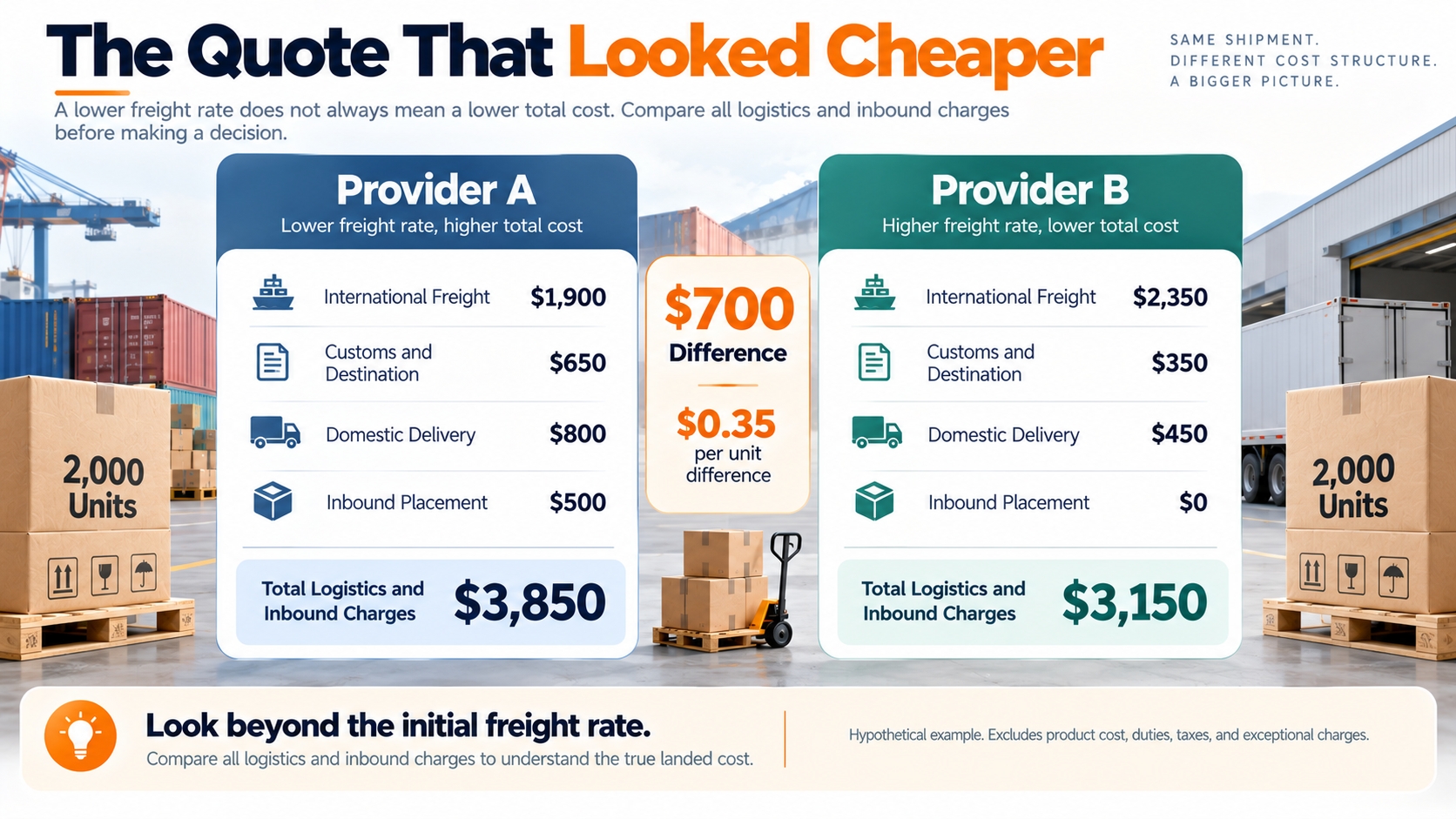
Two providers quote an international shipment of 2,000 units from an overseas supplier to Amazon's US fulfillment network. Both quotations appear suitable for the same inventory, but they include different destination services and fees.
The following numbers are hypothetical. They are not real freight rates, customs duty estimates, or quotes from any named provider.
| Cost component | Provider A | Provider B |
|---|---|---|
| Origin and international freight | $1,900 | $2,350 |
| Customs brokerage and destination handling | $650 | $350 |
| Domestic delivery and receiving coordination | $800 | $450 |
| Applicable inbound placement charges | $500 | $0 |
| Total compared logistics and inbound cost | $3,850 | $3,150 |
| Cost per unit | $1.925 | $1.575 |
Provider A appears cheaper on the international freight line by $450. Yet the modeled total is $700 higher after the destination services and inbound placement assumptions are included.
The $0 inbound placement line for Provider B is an illustrative assumption that the selected service already covers the relevant placement arrangement. It is not a claim that Provider B, Amazon Global Logistics, or any other carrier universally offers free inbound placement.
The Comparison That Matters
Provider A: $1,900 + $650 + $800 + $500 = $3,850
Provider B: $2,350 + $350 + $450 + $0 = $3,150
Difference: $3,850 - $3,150 = $700 for 2,000 units, or $0.35 per unit
What the example excludes
To keep the comparison focused, the example excludes product manufacturing cost, customs duties and taxes, insurance, unexpected examinations, storage delays, and later Amazon sale-related fulfillment or referral fees.
Those excluded items still matter for complete landed cost and profitability. If duties or service responsibilities differ between real quotes, the seller must include them before making a final booking decision.
Compare the quote against product economics
A $0.35 per-unit logistics difference can meaningfully affect a low-margin product, but cost is not the only variable. A route with greater delay risk can create inventory shortages or emergency replenishment charges.
Evaluate the total expected business outcome, including delivery reliability and the cost of missing a critical replenishment date, rather than automatically selecting the lowest quoted number.
Questions to Ask a Freight Forwarder Before Booking
A freight forwarder should be evaluated by how clearly it defines the shipment, responsibilities, and exceptions, not simply by whether it promises the fastest or lowest-cost delivery.
Send competing providers the same shipment brief so the responses can be compared without guessing what each provider assumed.
Give every provider the same shipment data
Include the origin and delivery location, product descriptions, country of origin, number of units, carton dimensions, gross weight, cargo volume, estimated ready date, and any special handling requirements.
Provide the expected transportation mode and shipment plan details when known. If the final Amazon receiving destination has not yet been assigned, state that explicitly rather than inventing an FC address.
Require written answers on the critical service boundaries
WHAT DOES THE RATE INCLUDE?
Ask about pickup, export handling, transport, port charges, destination handling, customs brokerage, domestic delivery, appointment coordination, and potential minimum charges.
WHO IS RESPONSIBLE FOR CUSTOMS?
Identify the importer of record, customs broker, filing responsibilities, tariff classification process, bond arrangements, and duty payment procedure.
WHAT HAPPENS IF DELIVERY IS DELAYED?
Ask about storage, demurrage, detention, redelivery, appointment failures, customs examinations, and who pays costs arising from exceptions.
HOW WILL FBA DELIVERY BE CONFIRMED?
Confirm access to tracking information, delivery documentation, pallet or carton details, and the procedure for reconciling shipment discrepancies.
WHAT INSURANCE AND CLAIM PROCESS APPLY?
Ask whether cargo insurance is included or optional, what risks are covered, the applicable limits and exclusions, and how a loss or damage claim must be documented.
Ask for a realistic range, not a guaranteed delivery date
A forwarder may be able to provide an estimated schedule, but port congestion, weather, customs examinations, carrier capacity, and receiving conditions can affect the result.
Ask which milestones are included in the estimate. A ten-day transport quotation may describe air movement or carrier transit, not the full period until inventory is available for sale.
Plan Replenishment Around Sellable Inventory, Not Port Arrival
A shipment can be operationally successful and still arrive too late to prevent a stockout. Replenishment needs to connect the sales forecast with the full time required to manufacture, ship, clear, deliver, and receive the goods.
That planning begins before the purchase order is placed.
Use demand evidence, not one exceptional sales week
Forecasting should reflect recent sales, promotions, seasonality, inventory constraints, and the maturity of the listing. A temporary spike during a promotion may not represent the normal demand rate.
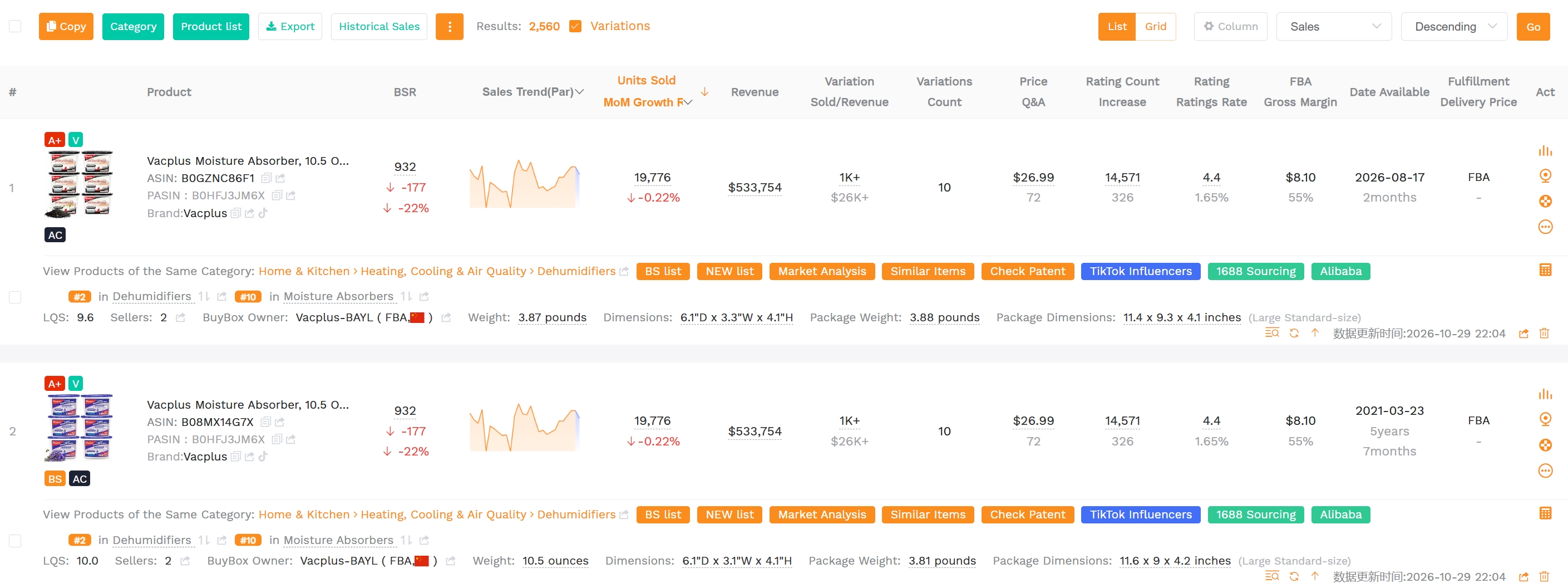
Before committing to a large first shipment, sellers can use SellerSprite Product Research to compare product demand and competition. Historical BSR, estimated sales, product dimensions, and other marketplace indicators can help develop more cautious product and inventory assumptions.
These metrics do not replace the seller's own completed-order data or determine an exact shipment quantity. Estimates are particularly uncertain for new products, seasonal categories, and listings with unusual recent stock availability.
Include the entire replenishment lead time
Consider a hypothetical product selling 12 units per day. The brand estimates 25 days for manufacturing, 35 days for freight and customs, 7 days for domestic delivery, and 8 days for receiving and availability.
Hypothetical Full Replenishment Lead Time
Manufacturing: 25 days
International transport and customs: 35 days
Domestic delivery: 7 days
FBA receiving and availability: 8 days
25 + 35 + 7 + 8 = 75 days
At 12 units per day, modeled lead-time demand is 900 units, before adding any safety-stock allowance.
These lead times are invented for illustration. They are not typical Amazon receiving times or guaranteed shipping schedules.
The calculation illustrates why a seller with only 30 days of inventory coverage may already be too late to avoid a stockout if its full replenishment lead time is 75 days.
Treat safety stock as a business decision
A safety-stock allowance protects against reasonable variation in demand and lead time, but it also ties up capital and may create storage costs. Its size should reflect volatility, supply reliability, cash constraints, and the consequences of stocking out.
Monitor inventory position, including sellable on-hand stock and incoming purchase orders, rather than treating a shipment that has merely left the factory as available inventory.
Consider a staged inventory approach
Sellers with larger or uncertain demand may consider separating bulk storage from FBA-ready stock. Amazon Warehousing and Distribution, or AWD, offers bulk storage and supported replenishment services that can complement FBA.
The best destination depends on service eligibility, storage charges, placement costs, replenishment timing, and operational needs. AWD is not automatically more economical for every product.
What to Do When a Shipment Is Delayed or Received Incorrectly
Once a shipment is in motion, a problem should be investigated according to where it occurs. Customs delays, lost cartons, delivery appointment failures, and Amazon receiving discrepancies do not have the same responsible parties or documentation requirements.
If customs release is delayed
Ask the responsible broker or forwarder for the current entry status, any documentation request, and the party assigned to provide the missing information. Preserve customs messages and confirm whether additional charges are accumulating.
Do not attempt to resolve a classification or valuation question by supplying a convenient but inaccurate description. Seek the relevant professional or regulatory guidance.
If a carrier reports delivery but Amazon has not made stock available
Separate carrier delivery confirmation from Amazon receiving status. Check the shipment's actual status in Seller Central, along with the applicable receiving and reconciliation requirements.
A delivery receipt does not automatically mean every expected unit has been checked in. Wait for the relevant Amazon workflow to establish whether there is an actionable receiving discrepancy.
If units are missing or damaged
Preserve supplier packing lists, carton counts, shipment labels, bills of lading or air waybills, carrier records, delivery confirmation, and any product or packaging photographs.
Use the correct carrier, insurance, or Amazon reconciliation process for the stage at which the loss or damage may have occurred. Do not assume that a shipment discrepancy is automatically reimbursable by Amazon.
Maintain an exception record
What the Shipment Record Should Capture
- Shipment reference, Amazon shipment ID, and associated purchase order.
- Booked carrier or forwarder, shipment route, and service terms.
- Quantity sent, carton count, and expected product identifiers.
- Original booking estimate and actual milestone dates.
- Additional costs, evidence, communications, and claim status.
- Final resolution and action to reduce repeat incidents.
Review recurring exceptions before reusing the same logistics provider. A route with fewer unexpected charges and better delivery documentation may justify a higher initial quote.
The Cheapest Route Is the One That Works Economically
Shipping inventory to Amazon FBA is not one transportation purchase. It is a chain of responsibilities that begins with the supplier and ends when inventory is available to fulfill customer orders.
A low ocean rate can be offset by destination charges, unsuitable customs arrangements, missed delivery windows, or the need to replenish urgently by air. A more expensive service may be worthwhile when it reduces those risks, but the benefit should be supported by a clear cost and timing comparison.
Before the next purchase order, confirm what is being shipped, who is importing it, which services are included, what Amazon requires, and how long it may take before the stock is actually sellable.
That is how freight forwarding becomes part of a reliable Amazon inventory strategy rather than a recurring source of surprises.
FAQs
What is the difference between Amazon FBA shipping and freight forwarding?
Freight forwarding coordinates cargo movement, potentially including international transportation, customs brokerage coordination, and domestic delivery. Amazon FBA handles eligible inventory after it enters Amazon's fulfillment network, including storage and customer-order fulfillment. Sellers must arrange the inbound transportation and applicable import responsibilities.
Do I need a freight forwarder to ship from China to Amazon FBA?
Not necessarily. Sellers may use an independent forwarder, eligible Amazon Global Logistics or SEND services, or other appropriate shipping arrangements. The right option depends on the shipment origin, product, volume, destination, required customs support, and available account services.
Is Amazon Global Logistics the same as a freight forwarder?
Amazon Global Logistics is an Amazon-managed international freight program offering supported ocean and air shipping services. It can coordinate several supply chain steps through Seller Central. Independent forwarders may offer more customized arrangements, depending on the shipment and provider. Compare actual coverage and charges rather than assuming either option is always cheaper.
Is air freight or sea freight better for Amazon FBA?
Air freight may be suitable for urgent, lightweight, or higher-value inventory, while ocean freight may be economical for larger shipments. The decision depends on actual quoted costs, cargo restrictions, chargeable volume or weight, urgency, destination handling, and the financial impact of potential stockouts.
What is the difference between LCL and FCL shipping?
LCL consolidates a smaller shipment with cargo from other shippers. FCL involves booking a container for the shipment. LCL may suit lower volumes, while FCL may be advantageous for sufficiently large shipments. Compare all handling and inland transportation costs before choosing.
Can Amazon act as the importer of record for my FBA inventory?
Sellers should not assume Amazon will act as importer of record for ordinary international FBA inventory shipments. The correct party must be established through the applicable import and shipping arrangements. Amazon's global-selling guidance explains that sellers or their providers must address import and export obligations and that Amazon is not responsible for duties and taxes on seller inventory imports.
Does DDP shipping include customs duties and all Amazon fees?
DDP defines extensive delivery and import responsibilities under the applicable trade term, but a shipping quote still needs a precise service scope and legally workable importer arrangement. Amazon inbound placement, storage, and order-fulfillment fees should not be assumed included unless explicitly covered and correctly accounted for.
What costs should be included in an FBA shipping budget?
Include manufacturing and preparation, relevant origin charges, international freight, insurance when purchased, customs duties and brokerage, destination handling, domestic delivery, and applicable Amazon inbound fees. Evaluate later storage, fulfillment, referral, and advertising costs separately to understand product profitability without double-counting expenses.
What is the Amazon FBA inbound placement service fee?
It is a fee associated with distributing qualifying inbound inventory across Amazon's fulfillment network. Charges and available options depend on the applicable shipment and service configuration. Some integrated logistics arrangements have different placement treatments, so verify the live shipping-plan charges.
How do I create an FBA inbound shipment?
Use the Send to Amazon workflow in Seller Central to select eligible inventory, confirm packing and shipping information, obtain relevant shipment labels, and complete carrier or pallet details when required. The steps vary with shipment type and service selected.
How long does shipping from China to Amazon FBA take?
There is no universal transit time. The full schedule depends on manufacturing, origin handling, transport mode, customs clearance, domestic delivery, and Amazon receiving. Sellers should request a route-specific estimate and plan inventory coverage using a realistic range rather than one promised arrival date.
What if the carrier delivered my inventory but Amazon has not received it?
Check the shipment status in Seller Central and confirm whether it is still within the relevant receiving process. Preserve delivery documentation, shipping labels, packing records, and carrier details. Use Amazon's applicable reconciliation workflow if an actionable discrepancy remains after the required conditions are met.
How can SellerSprite help with FBA shipping decisions?
SellerSprite Product Research can help sellers investigate demand, estimated sales, competition, and product characteristics before committing inventory. These findings can inform shipment quantities and product economics. SellerSprite is not a customs broker or freight forwarder and does not independently determine legal import requirements, freight quotes, or final Amazon receiving dates.
References
- Amazon: Fulfillment by Amazon, Services and Costs View
- Amazon: Amazon Global Logistics View
- Amazon: Seller Export & Delivery (SEND) View
- Amazon: Partner Carrier Program View
- Amazon: FBA Prep, Packaging, and Labeling Guide View
- Amazon: How to Pack and Ship Ecommerce Orders, Including Send to Amazon View
- US Customs and Border Protection: Tips for New Importers and Exporters View
- US Customs and Border Protection: Do I Need a Customs Broker? View
- Amazon: Global Selling and International Shipping Considerations View
- SellerSprite: Product Research Quick Tips View
By SellerSprite Content Team
The SellerSprite Content Team examines how Amazon marketplace demand translates into sourcing, inventory, and operating decisions. Our supply chain coverage connects product dimensions, estimated sales trends, competitive conditions, and fulfillment economics with practical questions sellers face before committing stock. For cross-border logistics topics, we distinguish publicly documented Amazon and customs requirements from route-specific assumptions that must be confirmed with carriers, brokers, and import specialists. Our editorial focus is on helping sellers evaluate the complete cost and timing of inventory decisions rather than relying on isolated freight prices or sales estimates.
Last reviewed: October 30, 2026