Retail arbitrage is one of the fastest ways to start reselling on Amazon without launching a brand-new product. You buy discounted items from retail stores, then resell them on Amazon for a profit. If you prefer sourcing from websites instead of store aisles, online arbitrage follows the same idea, just with different sourcing channels.
This guide shows you how an Amazon reseller can find deals, validate demand, list correctly, and scale with discipline. Throughout the process, you will use SellerSprite to evaluate competition, estimate demand, and protect your margins. Whether you are brand new or already selling, the workflow stays the same: source smart, check the numbers, then execute consistently.
You will also learn how to spot products that move like top sellers on Amazon without getting trapped in price wars, how to avoid restricted brands, and how to track costs so reselling on Amazon stays profitable long term.
Start Smarter With SellerSprite Data
Use SellerSprite to validate demand, measure competition, and protect your margin before you buy inventory for retail arbitrage or online arbitrage.
What is Retail Arbitrage (and Online Arbitrage)
The Concept of Buying Low, Selling High
Retail arbitrage means buying a product at a lower price in one market and selling it at a higher price in another market. On Amazon, the pattern is simple: find discounted products at a retail store, then resell on Amazon for a profit after fees. If you can repeat this process reliably, you can build steady cash flow without creating listings from scratch.
Think of arbitrage as a decision game with three inputs: buy cost, sell price, and demand. You control costs through sourcing skills. The market controls the selling price through competition. Demand determines how quickly your money comes back. SellerSprite helps you read the market side by showing competition signals and demand estimates so you can make better buying decisions.
Retail vs. Online Arbitrage
Retail arbitrage happens in physical stores. You walk clearance aisles, scan barcodes, compare Amazon prices, and purchase inventory the same day. Online arbitrage happens on e-commerce websites. You find discounts on retailer sites, purchase online, then ship inventory to your home or prep workflow before listing and fulfilling.
Both models can work for any Amazon reseller. Retail arbitrage tends to reward speed and local knowledge. Online arbitrage tends to reward research and repeatable sourcing. Many sellers combine both, so they always have new inventory ideas while they learn which categories and brands fit their account and risk tolerance.
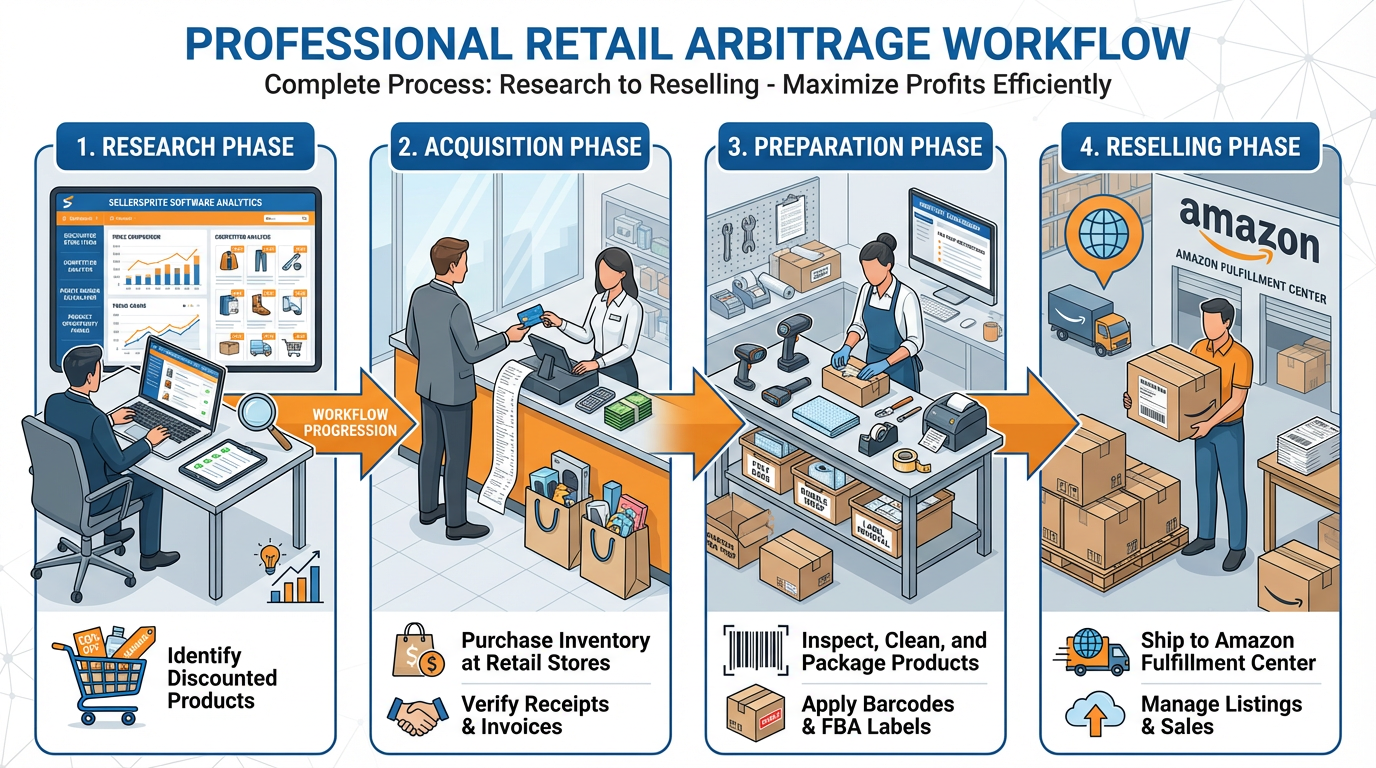
Getting Started with Retail Arbitrage on Amazon
Tools of the Trade
The best arbitrage sellers move fast, but they do not guess. Your workflow should have two layers: quick checks for basic viability, then deeper validation before you buy a large quantity. SellerSprite is your core research layer for product and market signals.
- SellerSprite Extension for fast competition and demand signals on Amazon listing pages
- SellerSprite sales and trend insights to judge whether the current price is stable or likely to fall
- SellerSprite product lists or tracking to monitor items you want to source again and again
- A simple spreadsheet for costs, receipts, and inventory location, so reselling on Amazon stays organized
If you are new, your first goal is not to find perfect products. Your first goal is to build a repeatable routine. Scan, research with SellerSprite, buy small, list, fulfill, then review what happened. That feedback loop is how you level up quickly.
Finding Products In Store
In-store sourcing rewards consistency. The best retail arbitrage routes are built over time. Start with stores that regularly run clearance and markdown programs, then learn the patterns by department and season. Popular starting points include Walmart, Target, pharmacy chains, outlet stores, and local discount retailers.
- Check clearance end caps and seasonal transitions first because markdowns are concentrated there
- Favor products that are new, sealed, and easy to prep for fulfillment to reduce returns and complaints
- Use SellerSprite after your first scan to validate demand and competition before you buy multiples
Example scenario: You find a clearance kitchen gadget for 8 dollars at Target. On Amazon, the listing shows a selling price of around 24 dollars. Before you buy ten units, open the listing on desktop and run the SellerSprite Chrome Extension. If the data shows steady demand and not too many competing sellers, the deal is real. If demand is low or the price has been falling for weeks, you skip it and keep scanning.
Sourcing Products Online
Online arbitrage can be more scalable because you can source from multiple websites in one sitting. Start by checking sale and clearance sections on major retailer sites, then expand into coupon stacking and seasonal promotions. The key is to verify that the exact product matches the Amazon listing so you do not buy the wrong variation.
- Search retailer clearance pages and filter by high discount percentages
- Validate the Amazon listing with SellerSprite to avoid crowded listings and unstable prices
- Start with small quantities until you see real sell-through, then reorder when the workflow works
Example scenario: You spot a limited-time online sale for a popular board game. The discount looks huge, so you open the Amazon listing and check SellerSprite signals. If SellerSprite shows consistent demand and a manageable seller count, you proceed. If it shows a flood of sellers and a recent price drop, you avoid the trap and look for a less obvious product that still sells well.
How to List and Sell Arbitrage Products
Listing Your Finds on Amazon
Most arbitrage items already exist in Amazon’s catalog, so you usually add your offer to an existing listing. Your job is to match the product exactly, choose the correct condition, and set a price that keeps you profitable. This is where many new sellers lose money, because they list fast and do not validate the market.
- Confirm exact match by UPC, model, size, and pack count before listing
- Check SellerSprite signals to understand competition and whether the current price is likely to hold
- Keep proof of purchase receipts and organize them by month and store
If you are building a serious reselling operation on Amazon, treat every listing like a tiny investment decision. The listing is easy. The research is where the profit is created.
Fulfillment Options, FBA or FBM for Arbitrage
You have two main ways to fulfill orders: FBA, where Amazon stores and ships your inventory, and FBM, where you ship orders yourself. For many Amazon reseller workflows, FBA improves conversion because Prime shoppers trust fast shipping. FBM can work well for low-volume, oversized items or situations where you want full control.
- FBA pros: Prime eligibility, less daily shipping work, easier scaling for retail arbitrage and online arbitrage
- FBA cons: fees, storage costs, prep requirements, slower changes if you need inventory immediately
- FBM pros: full control, flexible for test batches, fewer storage fee concerns
- FBM cons: daily shipping workload, generally lower conversion without Prime, tighter performance requirements
Choose based on your current phase. Beginners often start with small FBM batches to learn, then move to FBA for scale. Advanced sellers often use both depending on category, season, and risk.
Pricing for Profit
Pricing is where many arbitrage plans fail. You must account for all fees, shipping, and prep. Then you need to confirm the price is stable enough that you can sell at your target profit. SellerSprite helps with stability signals by showing competition patterns and market behavior, so you do not buy into a collapsing listing.
- Set a minimum profit and ROI threshold before you buy, then stick to it consistently
- Avoid listings where many sellers are racing down in price, even if the current margin looks fine
- Use SellerSprite insights to choose products with demand that can absorb your inventory without panic repricing
Tips for Success in Arbitrage
Understanding Sales Rank and Demand
Demand determines how fast you get paid back. That is why experienced sellers study sales rank behavior and sales velocity. Top sellers on Amazon usually have strong demand signals, but that does not automatically mean they are good arbitrage targets. Many top listings attract heavy competition that destroys margins.
Your goal is to find products that sell consistently, not just products that look popular. Use SellerSprite to estimate demand and compare it to the number of competing sellers. When demand is high and competition is moderate, you can sell faster without constant repricing stress.
- Prefer listings with consistent sales behavior over sudden spikes that might be seasonal or trend-driven
- Use SellerSprite to identify whether demand can support your intended quantity without pushing the market down
- Build a list of repeatable winners, not just one-time clearance luck
Avoiding Restricted Brands and Categories
One of the fastest ways to waste time and money is buying inventory you cannot sell. Some brands and categories require approval. Some brands are sensitive about third-party sellers. As an Amazon reseller, you must check eligibility early, then focus on products you can list safely.
- Check listing eligibility before buying, especially for well-known brands that attract complaints
- Keep receipts organized so you can respond quickly if authenticity questions arise
- Use SellerSprite research to avoid crowded brand listings where sellers get pushed into risky behaviors
Keeping Track of Expenses and Reinvesting
The easiest way to scale reselling on Amazon is reinvesting profits into more inventory while you refine your sourcing process. But you can only scale what you can measure. Track buy cost, tax, prep, shipping, and time. Over time, you will see which categories give you the best return and which products create headaches.
- Log every purchase with cost and store so you can repeat good sources and avoid bad ones
- Reinvest in inventory first, then upgrade processes after the profits are consistent
- Use SellerSprite product lists to build a repeatable sourcing catalog and monitor market changes
Challenges and How to Overcome Them
Competition and Price Wars
Competition is the most common arbitrage challenge. When many sellers list the same item, prices can fall fast. The solution is not constant undercutting. The solution is better selection and better timing. SellerSprite helps you spot crowded listings early so you can avoid buying into a race to the bottom.
- Prioritize products with healthy demand relative to seller count, not just high visibility
- Look for less obvious variations, bundles, or multipacks only when they match Amazon policy and customer expectations
- Use SellerSprite to monitor market behavior, so you know when to hold and when to exit
Store Limitations and Purchase Limits
Some stores limit quantities, and some managers dislike bulk buying. Online retailers may also cancel large orders. The best defense is diversification. Build multiple sourcing routes, mix online arbitrage with retail arbitrage, and keep your quantities reasonable until you confirm consistent sell-through.
- Rotate stores and categories to reduce dependency on any single source
- Buy smaller test quantities first, then scale with confidence
- Use SellerSprite to identify repeatable products that can be replenished across multiple sources
Staying Organized
Organization protects your time and your account. Keep receipts, track inventory locations, and document costs. Use SellerSprite lists to track products you want to replenish and to keep a clean view of what is worth buying again. When your workflow is organized, you can scale without chaos.
- Store receipts digitally and sort them by month and retailer for fast access
- Create simple inventory bins and label them by SKU so FBM shipping stays smooth
- Review SellerSprite notes weekly to refine your sourcing standards
Conclusion: From Clearance Aisle to Amazon Success
Realistic Expectations and Long-Term Strategy
Retail arbitrage and online arbitrage are not get-rich-quick tactics. They are skill-based models that reward consistent execution. Start with small test buys, focus on clean processes, and use SellerSprite to improve your decision quality. Over time, your product selection improves, your buy costs drop, and your capital turns faster.
A strong strategy is built on repeatable winners, not one lucky score. Aim to build a replenishable list of products where you can reliably resell on Amazon at a profit. That is how an Amazon reseller turns a side hustle into a stable business.
Motivation to Start Your Reselling Journey
You can begin with a small budget and grow by reinvesting profits. The biggest difference between people who succeed and people who quit is action. Start scanning, start researching with SellerSprite, and start listing. Your first sales teach you more than any guide. Keep going, keep refining, and let data guide your next move.
Turn Research Into Profitable Buys
Before you buy inventory to resell on Amazon, use SellerSprite to check demand, competition, and market stability so your next flip stays profitable.