TL;DR: Amazon review and reviewer insights help sellers understand what customers experienced, which problems recur, and what action the evidence supports. Analyze reviews by product, variation, time period, and use case. Keep product improvement, customer support, neutral review requests, and abuse reporting separate. Reviewer context can clarify feedback, but it is not a license to identify customers privately or label criticism as fake.
Key Takeaways
- Analyze the experience, not the identity. The useful reviewer details are the stated use case, expectations, and product version, not an assumed real-world profile.
- Separate ratings from written reviews. An exported review sample is not the entire rating population, and Amazon's displayed star rating is not a simple average.
- Give every metric a clear denominator. A complaint share within sampled reviews is not a defect rate among all buyers.
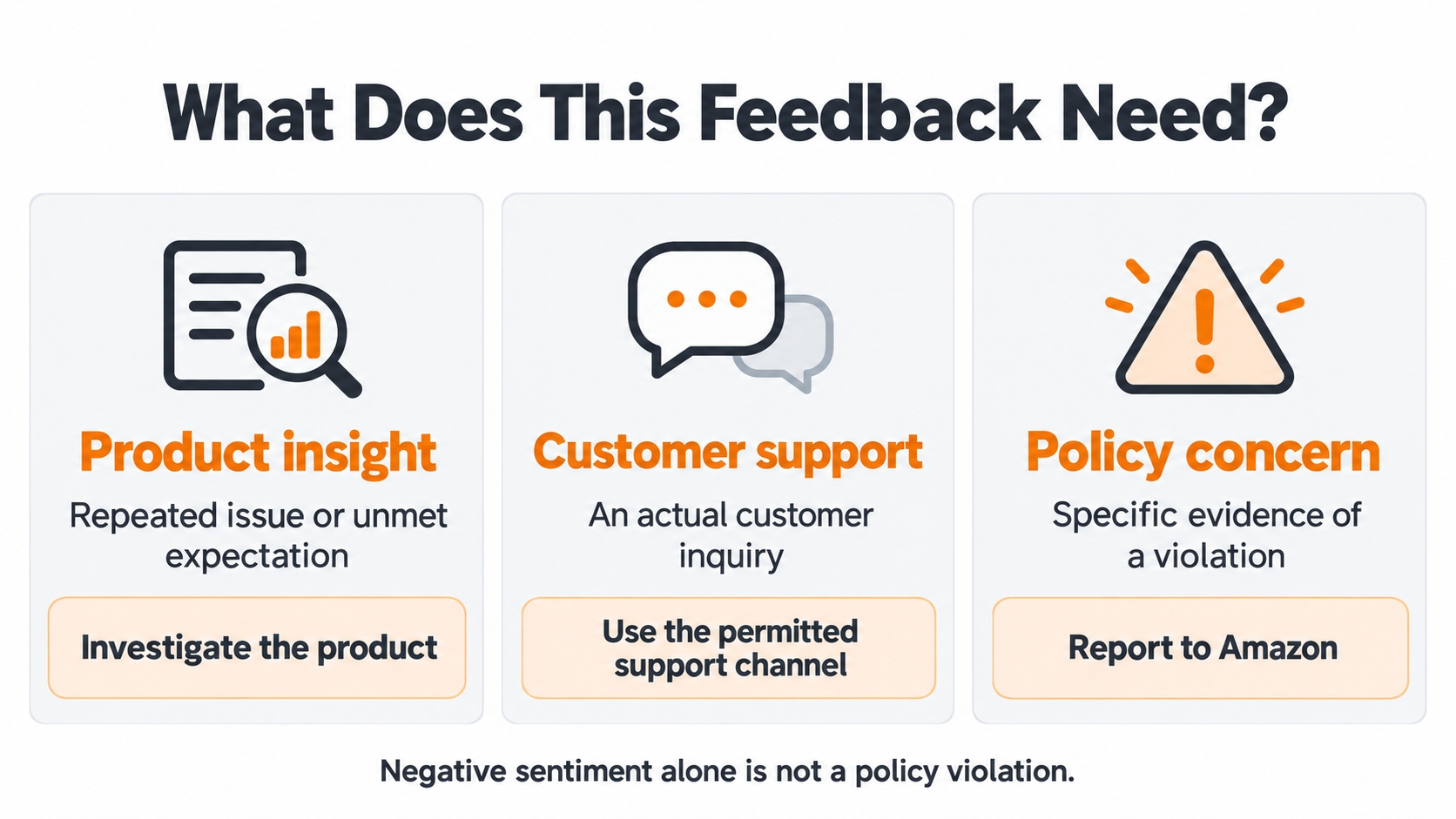
- Choose the right response. Fix product problems, handle support through permitted channels, and report specific policy concerns without pressuring customers to alter reviews.
Table of Contents
- Quick Answer: What Are Amazon Review and Reviewer Insights?
- What Reviewer Signals Can and Cannot Tell You
- A Practical Workflow for Review and Reviewer Insights
- Metrics and Decision Criteria
- When to Report a Suspicious Review
- Request Reviews Without Steering the Rating
- Handle Critical Feedback Without Chasing Reviewers
- Use Review Tools to Organize Evidence, Not Judge People
- Check Whether the Product or Listing Fix Worked
- Common Mistakes to Avoid
- The Bottom Line
- FAQs
- References
Scope: This guide is for Amazon US brand owners, customer-support teams, and sellers responsible for review health. The analysis methods are suggested practices; use current Amazon policies and account permissions for requests, customer contact, and reporting. Hypothetical examples are labeled and do not represent SellerSprite customer results.
Quick Answer: What Are Amazon Review and Reviewer Insights?
Amazon review and reviewer insights combine the content of customer feedback with relevant context: the product reviewed, variation, review date, purchase label where shown, and the experience the reviewer describes. The purpose is to understand product strengths, expectation gaps, and recurring problems, then decide whether to improve the offer, investigate a service issue, or report a possible violation.
Product reviews evaluate the item; seller feedback evaluates the seller experience. Amazon distinguishes these records even though its standardized request can ask for both. Keep them separate in analysis so a late-delivery complaint is not automatically counted as a product defect.
The decision rule: A negative opinion is not automatically abuse, and an unusual review pattern is not proof of fraud. Preserve what you observed, distinguish it from what you infer, and choose the appropriate next action.
What Reviewer Signals Can and Cannot Tell You
The context around a review can explain why two customers react differently to the same product. Read those details as clues about usage and expectations, not as a score of the person's honesty.
The Displayed Rating Is Not Your Spreadsheet Average
Amazon uses models to calculate its product star ratings, considering factors such as recency and purchase verification rather than just averaging every visible score. Customers can also submit a star rating without a written review. An average calculated from downloaded review text therefore measures that sample, not Amazon's overall rating.
Verified Purchase and Vine Labels Describe Context
Amazon describes Verified Purchase as confirmation that the product was purchased on Amazon under its qualifying purchase conditions. Amazon also values reviews without that label. The badge does not establish every claim in the text, and its absence alone is not evidence that a review is fabricated.
A Vine label indicates feedback from Amazon's official program, where invited reviewers receive products and provide their opinions. Record that context when comparing samples; do not assume a Vine review must be positive or that it gives sellers permission to recruit the reviewer privately.
Variation, Timing, and Stated Use Matter More Than Guessing a Profile
A complaint about fit may concern a different size, model, or intended use. Amazon's current review-sharing guidance limits sharing to variations with minor differences that do not change core functionality. Check the selected variant and any change in review-sharing scope before interpreting a sudden change in counts.
For reviewer insights, record only what the feedback supports: "used on a narrow shelf" or "bought for travel" can inform product design. A display name or profile photo cannot establish age, income, occupation, or an order match. Do not build off-platform contact lists or investigate a reviewer's private identity; keep research centered on the product experience.
A Practical Workflow for Review and Reviewer Insights
Start with a question that can change an operational decision, such as whether a lid problem is recurring or whether buyers misunderstand the included accessories. The following workflow separates learning from reviews from trying to influence them.
1. Define the Sample Before Reading for Patterns
Record marketplace, ASIN or variation scope, date range, sort order, star filters, and the number of unique written reviews examined. Note whether the source returns all accessible reviews or only a subset. Inspect recent feedback across star levels, then use a separate low-rating view to investigate failures; do not merge those samples without labeling them.
2. Code the Observation Separately From the Explanation
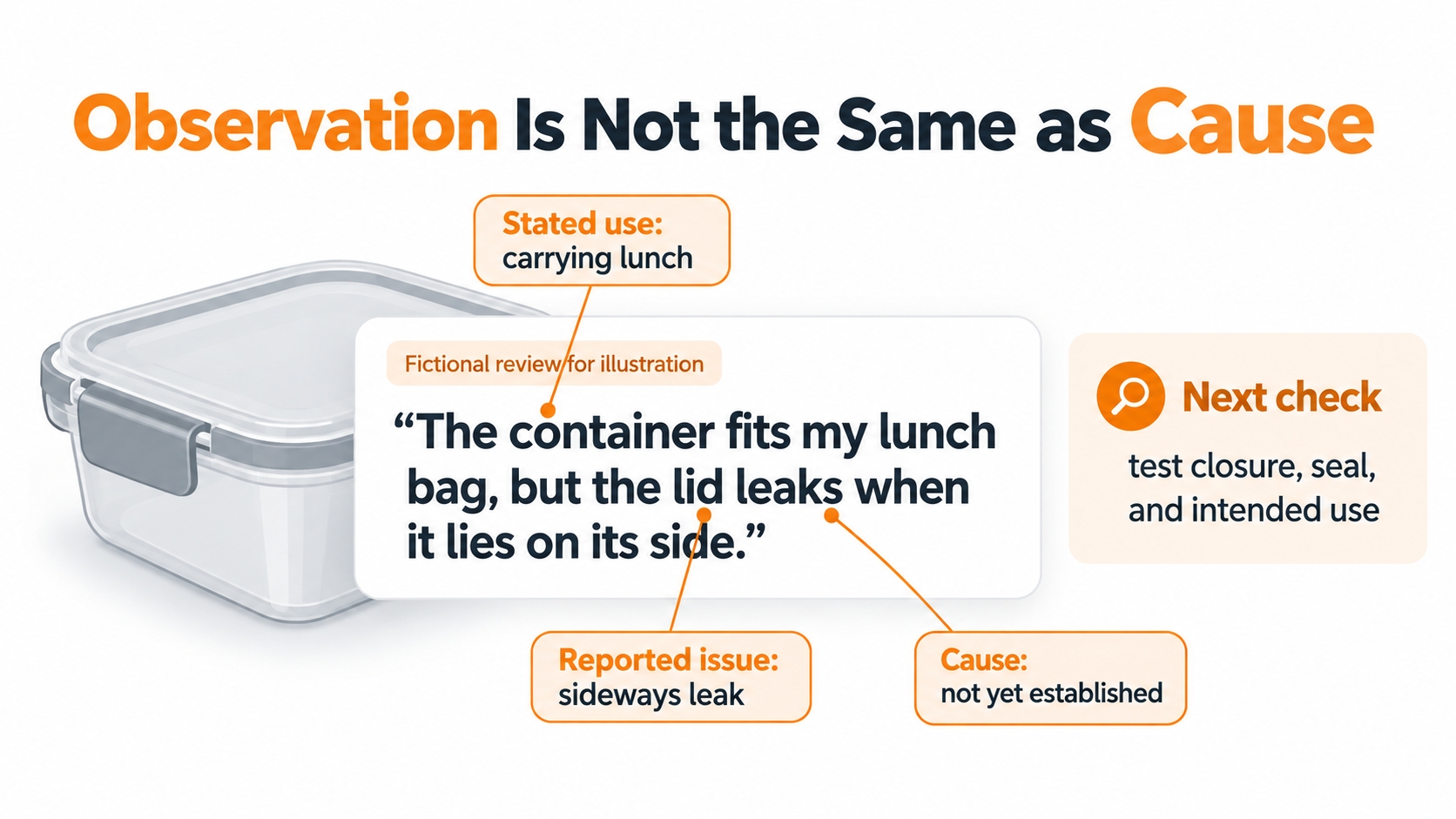
Use a small theme list: quality, fit, durability, instructions, packaging, missing parts, and expectation mismatch. A review can contain more than one theme. Record the described event and supporting text first; assign a possible cause only after checking the product or other evidence.
Illustrative example, not a real review: "The container fits my lunch bag, but the lid leaks when it lies on its side." This supports a portability use case and a reported sideways leak. It does not establish whether the cause is the seal, incomplete closure, damage, or an unsupported use condition. Test the possibilities before calling it a manufacturing defect.
3. Compare Like-for-Like Competitor Products
Choose products serving the same use case, price range, and product configuration. Apply comparable review windows and filters, and distinguish older versions from the current offer. Look for both recurring complaints and praised features; a redesign that solves leakage but removes the compact shape customers value may create another problem.
A competitor complaint is not proof that your product solves it. Check the proposed improvement with your own product tests, costs, and customer expectations. Search-demand research can help assess a new positioning idea, but a usability fix does not need a high-volume keyword to be worthwhile.
4. Assign the Fix to the Right Owner
Turn the finding into an action record: theme, evidence, affected version, severity, proposed test, owner, and review date. Product defects belong with quality or sourcing; missing instructions with content or packaging; order-service issues with operations. An allegation of injury or another serious safety problem warrants prompt investigation even if it appears only once.
5. Record What Remains Uncertain
Keep unresolved causes visible rather than letting a neat summary make them look proven. Record the date of any packaging, supplier, listing, promotion, or inventory change so later feedback can be evaluated against what customers actually received.
Metrics and Decision Criteria
Metrics should show what needs attention and whether a change deserves further testing. Define the unit being counted before comparing a product, a time window, or a competitor.
| Measure | Useful interpretation | Important limit |
|---|---|---|
| Displayed star rating | Track the rating shown for the same product scope over time. | It is not a simple average of your exported written reviews. |
| Rating or review-count change | Record count changes and the interval between observations. | A net count change is not necessarily the number of new written reviews; inspect sharing scope and removals. |
| Recurring-theme share | Count unique sampled reviews mentioning a defined issue. | The denominator is the review sample, not all orders or customers. |
| Recent negative themes | Check whether current feedback still reports an earlier problem. | Review date is not proof of purchase date or product batch. |
| Business and compliance context | Compare confirmed returns, service cases, and documented process gaps. | BSR, price, and ad changes add context but do not prove that reviews caused a result. |
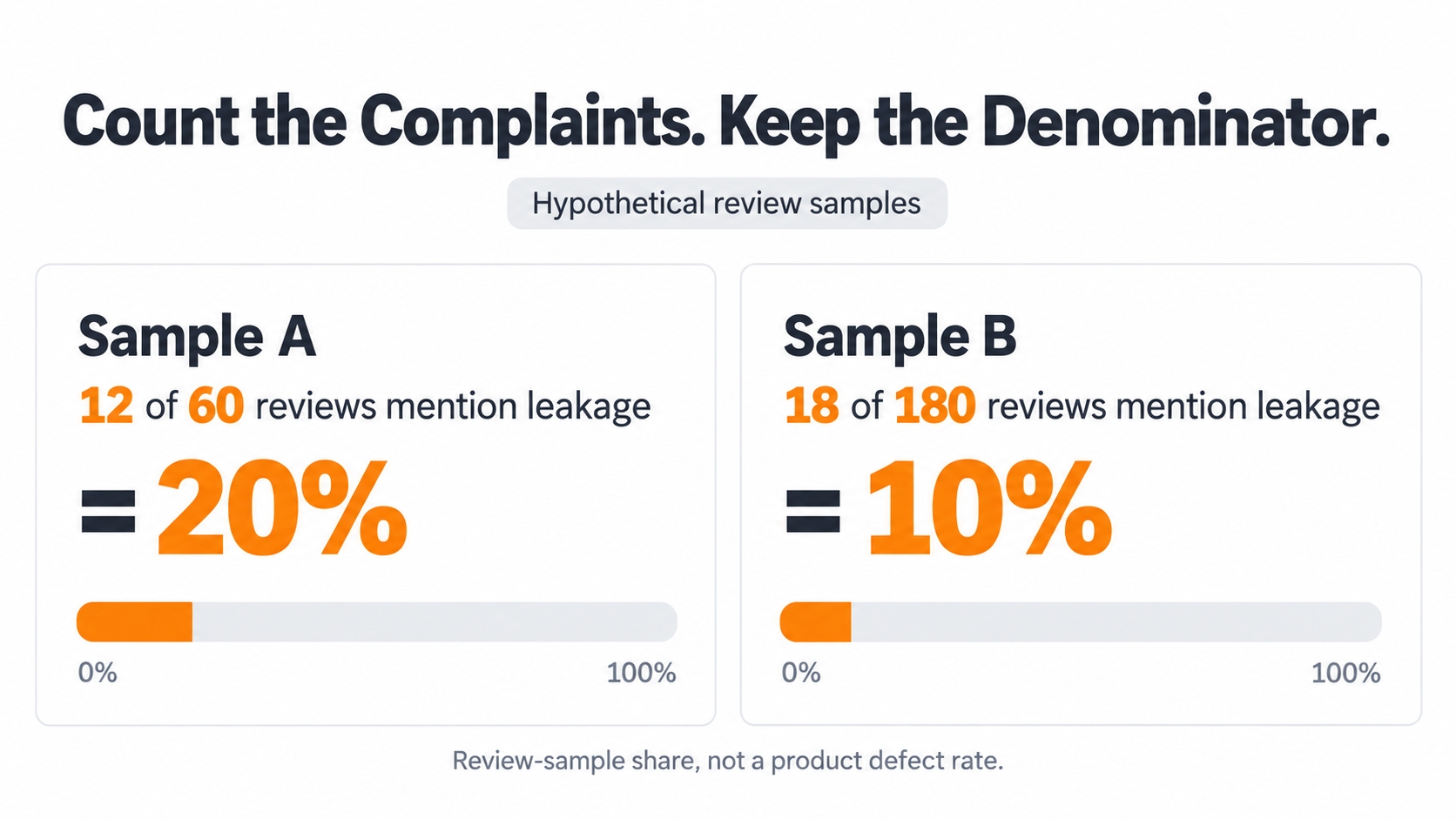
Theme share within a defined sample = unique written reviews mentioning the theme ÷ total written reviews examined in that sample × 100
Hypothetical comparison: 12 leak mentions in 60 reviews equal 20%; 18 in 180 reviews equal 10%. The second sample has more complaints in absolute terms but a lower complaint share. Neither percentage means that 20% or 10% of all shipped products failed.
One review can mention several issues, so theme shares may total more than 100%. Keep the coding rules and sample criteria consistent, remove duplicate review records, and avoid describing a top-review or low-star-only sample as representative of every customer.
Prioritize severity, recurrence, and the strength of the supporting evidence together. For your own products, validate a suspected defect using properly scoped returns, service, and quality records. Do not calculate a competitor's defect rate by dividing review complaints by estimated sales.
When to Report a Suspicious Review
A critical review and a prohibited review are different things. Before escalating, identify the specific content or conduct at issue and compare it with Amazon's Community Guidelines, rather than reporting simply because the rating is low.
Distinguish an Unusual Pattern From Evidence of a Violation
Similar wording, closely timed posts, or an unfamiliar reviewer profile may justify a closer look; none establishes coordination on its own. Check current product versions, recent sales activity, promotion dates, and review-sharing changes before deciding the pattern has no legitimate explanation.
Threats, private information, a documented compensation request, or another specific policy concern provide a more concrete basis for review than disliking the opinion. Reviews focused only on an individual shipping or seller experience have different relevance rules from criticism of the product itself. Keep those distinctions intact in the report.
Submit a Concise Evidence Packet
Use the review's Report option for the applicable issue. For a suspected competitor attack, Amazon's guidelines direct sellers to Seller Central support or Account Health reporting options. Select the relevant reason and follow the current prompts.
- Locate the content: record the ASIN, review link or identifier, and observation date.
- Describe the concern: identify the passage or conduct and the relevant policy, separating facts from assumptions.
- Preserve the outcome: keep the case reference and response in a controlled record; provide further information when requested.
Amazon decides whether the content violates its policies. Do not treat a report as guaranteed removal, organize mass reports, or use a service promising to erase every negative review. Continue investigating a genuine product issue even when a separate policy concern is under review.
Request Reviews Without Steering the Rating
Review requests should invite feedback, not specify the outcome. Keep the request process independent of whether a customer praised the product, complained, or received support.
Use the Standard Request a Review Feature
Amazon's documented Request a Review feature is available on eligible Order Details pages once per order, between 5 and 30 days after delivery. It sends standardized, translated requests for product reviews and seller feedback. Amazon already requests reviews on sellers' behalf; avoid adding duplicate solicitations.
Do not offer refunds, gifts, or discounts for review activity, ask only satisfied buyers, or use family members, employees, or agencies to manufacture reviews. Amazon holds sellers responsible for review-policy violations by partners acting for them.
Use Vine Within the Official Program
For eligible products, Amazon Vine provides a structured route to feedback from invited reviewers. Their opinions can be positive or negative. Check current product eligibility and participation terms, and do not recreate a private product-for-review arrangement outside the program.
Announced program to recheck before launch: Amazon Ads announced a US open beta for Review Requests planned for late October 2026. As of this guide's October 15 review, that is an announced rollout, not a promise of access for every seller. It is distinct from Seller Central's Request a Review button and from paying a customer for a review.
For broader planning around legitimate review growth, see SellerSprite's Amazon reviews guide for sellers. Keep the acquisition plan separate from the evidence used to evaluate product quality.
Handle Critical Feedback Without Chasing Reviewers
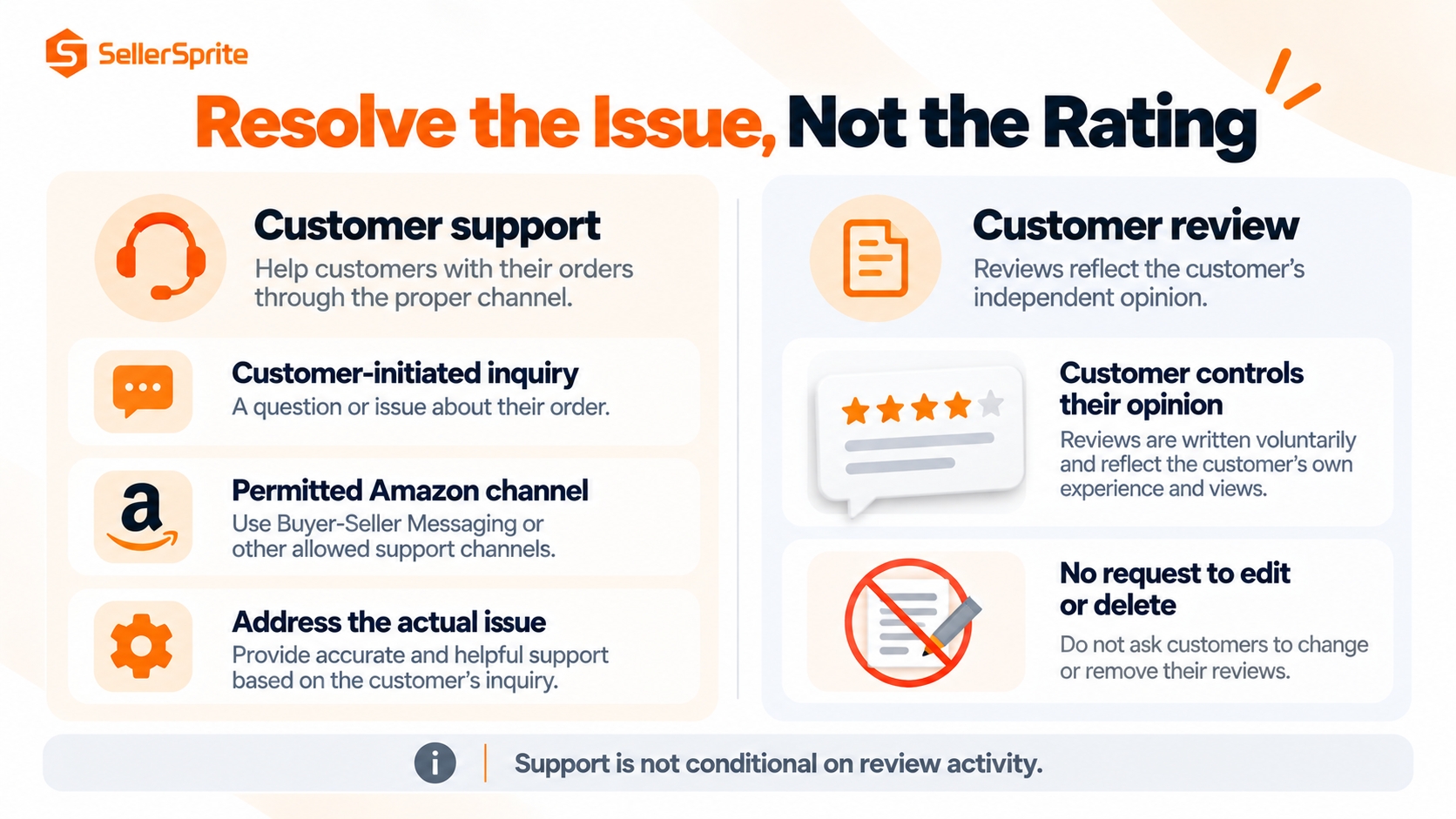
Customer support exists to resolve the customer's issue, not to negotiate a star rating. Do not match a public profile to private orders by guesswork or search for an external email address to bypass Amazon's contact controls.
There is an important documentation difference: Amazon's public Customer Reviews overview describes proactive contact options for some critical reviews, while Seller Central's Contact Customer guidance states that contact must be customer-initiated and specifically addresses restrictions around FBA reviews. Follow the current seller-facing policy and account controls rather than assuming every critical review has a contact option.
Where the customer has already initiated a permitted inquiry, handle it through the appropriate Amazon support or messaging workflow. Resolve the product concern on its merits. Do not ask for an edit or deletion before or after a refund, and do not make assistance conditional on the review outcome.
Use Review Tools to Organize Evidence, Not Judge People
This is a relevant place for review-analysis software: organizing feedback that a team would otherwise inspect manually. Choose tools according to the task, and keep their output separate from proof of a reviewer's identity or conduct.
AI Review Analysis: Organize Themes, Then Check the Source
SellerSprite's AI Review Analysis supports analysis of product strengths and weaknesses, usage scenarios, expectations, and purchasing motivations from available review content. Use it to organize your own or comparable competitors' feedback, then inspect the underlying reviews before approving a product or listing change.
Record the report's review coverage, filters, and date. If an output describes customer profiles or needs, distinguish an explicit statement in the review from an AI inference. The report is not a census of all buyers, a private customer database, or a reliable verdict that a review is fake.
Product Tracking: Add Market Context, Not a Causal Claim
SellerSprite's Product & Keyword Tracker can add supported observations such as price, ratings, BSR, and keyword positions to your change log. Compare these with your own quality and service evidence after an update. Marketplace movement does not, by itself, demonstrate that the review-led fix caused more sales.
Check Whether the Product or Listing Fix Worked
Before making a change, define the outcome you expect: fewer complaints about assembly, clearer accessory expectations, or fewer confirmed failures. Judge that outcome using comparable evidence, not just the next displayed star rating.
For a revised instruction sheet, log when the new version entered sellable inventory, which orders could have received it, and when enough usage time has elapsed to evaluate feedback. A newly posted review can concern an older purchase, so review date alone cannot establish exposure to the change.
Recheck the same themes using the same sampling rules, and compare properly matched service or return records where available. Note simultaneous changes in price, Sponsored Products advertising, promotions, or stock availability. A weekly review can be a useful routine, but active customer issues and safety concerns need attention sooner; this is a suggested cadence, not an Amazon requirement.
Common Mistakes to Avoid
The most costly errors happen when an observation becomes a stronger claim than the evidence allows. Check the following before changing a product, approving a request process, or submitting an abuse report.
- Reading only low-star feedback: useful for failure investigation, but not for estimating overall customer satisfaction.
- Confusing reviewer context with identification: a use case can guide design; a guessed identity should not guide outreach.
- Treating correlation as proof: ratings, BSR, promotions, and sales can change at the same time for different reasons.
- Manipulating variation relationships: Amazon prohibits using variations to inflate ratings through review aggregation.
- Measuring success by removal volume: track resolved product problems, evidence quality, and compliant operations instead of setting targets to erase criticism.
The Bottom Line
Amazon review and reviewer insights are most useful when they lead to a defensible decision: fix a recurring problem, clarify a promise, resolve an eligible support inquiry, or report a specific policy concern. None of those tasks requires control over what a customer says.
Start with one important ASIN, define a review sample, identify a testable theme, and assign an owner. Keep the evidence and uncertainty attached to the finding so the next review cycle shows what you actually learned, not merely whether the rating moved.
FAQs
What are Amazon review and reviewer insights?
They are findings drawn from review content and relevant context, such as the product version, date, stated use case, and purchase or program labels. Sellers use them to understand expectations, investigate recurring issues, and decide what to improve without identifying reviewers privately.
Does a missing Verified Purchase badge mean a review is fake?
No. Amazon also values reviews without that badge. Treat the label as purchase context, not a complete authenticity test, and evaluate specific evidence before making an allegation.
Why does my average of written reviews differ from Amazon's star rating?
Amazon uses a model rather than a simple average, and customers can leave ratings without written reviews. Your export may cover only a subset, so its average and distribution need not match the product page.
Can product variations affect review counts and ratings?
Yes. Amazon's sharing rules distinguish minor variations from differences in core functionality. Check variation scope and sharing changes before assuming a count drop reflects lost customer trust or the removal of particular reviews.
Can sellers request Amazon reviews?
Yes, through compliant, neutral processes. Seller Central's Request a Review feature is documented for eligible orders once between 5 and 30 days after delivery. Do not add incentives or select recipients based on expected positive sentiment.
Can a seller remove a negative product review?
A seller cannot edit a customer's review. Report content that appears to violate policy through Amazon's reporting process; a negative opinion alone does not establish grounds for removal. Amazon evaluates the report.
Can sellers contact everyone who leaves a critical review?
No. Customer contact depends on current policy and available account controls. Seller Central's Contact Customer guidance describes customer-initiated contact restrictions, including FBA-related limitations. Do not use external identity matching to bypass them.
How can AI review analysis help without replacing judgment?
It can organize review themes and use cases so a team can inspect them more efficiently. Verify the sample, source text, and any inferred conclusions; an AI report cannot establish a reviewer's identity or prove review fraud.
References
- Amazon Seller Central: Customer Product Reviews Policies View
- About Amazon: How Customer Reviews and Star Ratings Work View
- Amazon Seller Forums: Amazon Staff Explanation of Verified Purchase Reviews View
- Amazon Seller Central: Reviews Shared Across Product Variations View
- Amazon Seller Central: Answers to Questions About Reviews and Related Topics View
- Amazon Seller Central: Request a Review From a Customer View
- Amazon: Customer Reviews Tool Overview View
- Amazon Seller Central: Contact Customer View
- Amazon Vine: Program Overview View
- SellerSprite: Review Analysis Guide View
- SellerSprite: Product & Keyword Tracker Guide View
- Amazon Ads: Review Requests Launch Announcement View
- SellerSprite: Amazon Reviews Guide for Sellers View
By SellerSprite Content Team
SellerSprite publishes practical guidance on Amazon marketplace research and seller operations. This guide combines official documentation with practical review-analysis methods and clearly labeled examples.
Last reviewed: October 15, 2026