TL;DR: Amazon UK and international shopping can describe two different activities: customers buying across borders and sellers entering Amazon.co.uk. For US sellers, the second requires much more than translating an Amazon.com listing. Validate UK search demand, compare local competitors, calculate VAT-aware margins, choose a workable fulfilment route, and verify product compliance before committing inventory. A product that performs well in the US is a research candidate for Britain, not a proven UK opportunity.
Key Takeaways
- International delivery is not the same as selling locally. A UK customer receiving a product from Amazon.com does not mean the seller has established a competitive listing on Amazon.co.uk.
- Local demand must be measured locally. UK keyword searches, competing ASINs, prices and customer expectations may differ substantially from the US market.
- VAT and fulfilment can change the economics. Evaluate the tax treatment, inbound costs, Amazon fees, delivery commitments and currency conversion together.
- UK market access does not automatically establish product compliance. Safety, marking, import and category requirements depend on the product and the market where it is supplied.
- Expand from evidence, not familiarity. A controlled UK launch should test discoverability, delivered margin, actual conversion and replenishment reliability before scaling.
Table of Contents
- Two Different Journeys Behind International Shopping
- The UK Market Needs Its Own Demand Evidence
- Compare the Product a British Shopper Actually Sees
- The Price Is in Pounds. The Margin Has More Moving Parts.
- Your Fulfilment Route Changes the Customer Promise
- Check the Border Rules Before Shipping Inventory
- Build a Listing for Britain, Not a Copy of America
- A Controlled UK Launch: Four Decisions Before Scale
- What the First UK Results Should Tell You
- Make the Border a Research Question First
- FAQs
- References
Market scope: This guide focuses on US-based businesses evaluating Amazon.co.uk, with a short explanation of cross-border shopping for consumers. Tax examples refer primarily to Great Britain (England, Scotland and Wales). Northern Ireland can have different VAT, customs and product rules. All financial examples are illustrative rather than live Amazon quotations.
Two Different Journeys Behind International Shopping
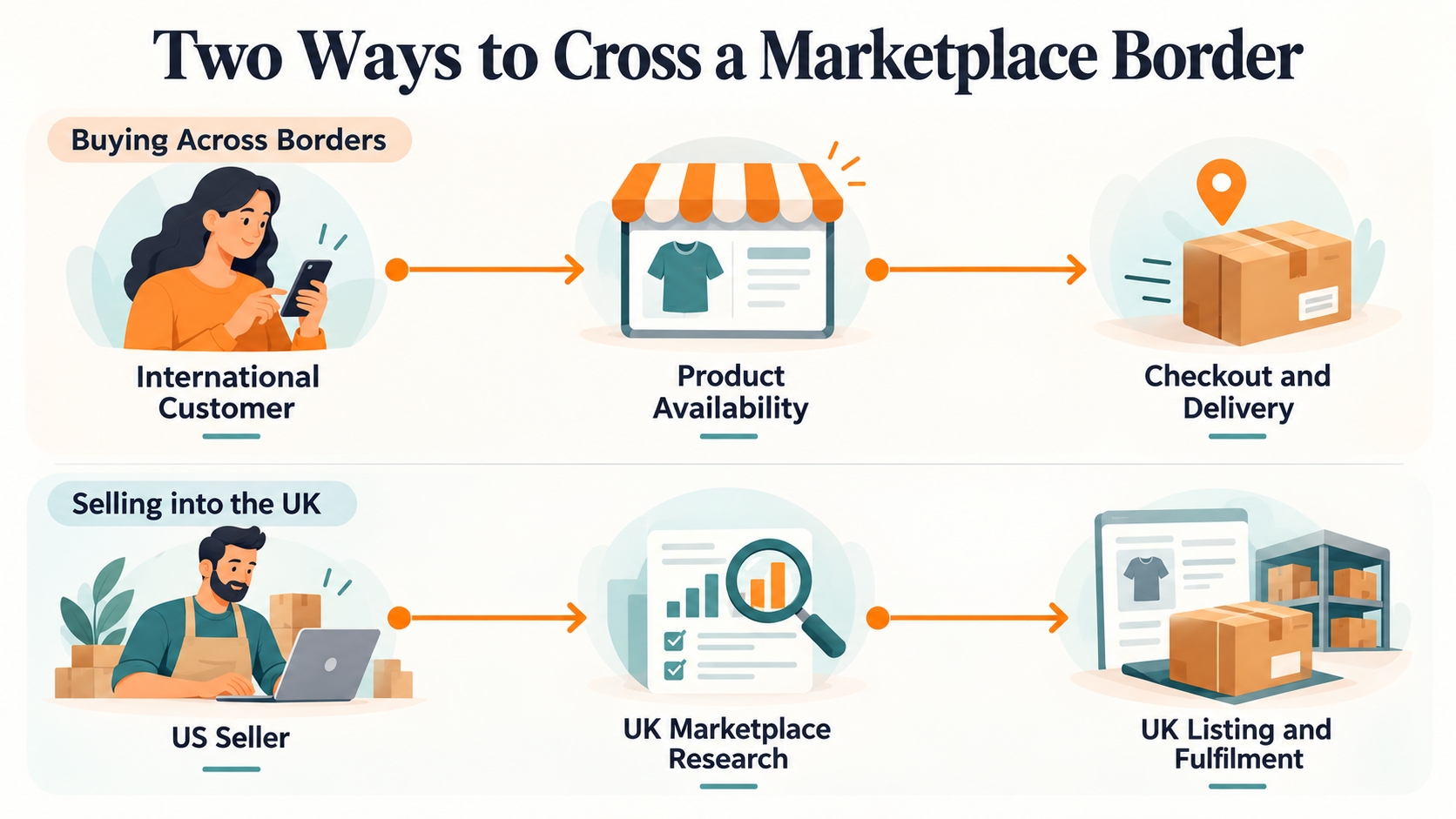
The phrase Amazon UK and International Shopping sounds like a single service. In practice, it can mean two different things: a shopper purchasing from another country's Amazon store, or a seller creating an offer for a new marketplace.
Understanding the distinction matters because each journey changes a different set of decisions. A shopper wants to know whether an item can reach their address and what the final cost will be. A seller needs to establish whether local demand, regulations and fulfilment economics support a sustainable business.
THE CUSTOMER JOURNEY
Buying from Amazon UK Across Borders
A shopper visits Amazon.co.uk from another country, or uses an Amazon store to order an internationally sourced product.
Their questions concern delivery eligibility, total checkout cost, currency, import charges, returns and estimated arrival.
THE SELLER JOURNEY
Entering Amazon.co.uk as an International Seller
A US-based business researches, lists and supplies products to UK shoppers.
Its questions concern local demand, seller accounts, product compliance, VAT, inventory placement, conversion and profitability.
What Should International Shoppers Check?
For someone buying from Amazon UK outside Britain, the first step is to set the correct delivery destination. Product availability and shipping options can change after an address is selected. A UK listing being visible does not guarantee that its seller offers international delivery.
The shopper should then verify the total cost at checkout, including delivery and any applicable estimated import charges, rather than relying on the product's displayed price alone. Some Amazon cross-border services collect import-related amounts in advance, while other arrangements have different tax and customs handling. Returns, warranties and electrical compatibility also deserve attention.
Why the Seller's Decision Is Different
A UK customer may be able to buy an eligible product exported from Amazon.com without the seller operating a local UK marketplace offer. Amazon's US export programmes and selling directly on Amazon.co.uk are not interchangeable. The latter involves marketplace-specific listings, fees and operational requirements.
For a US seller planning an actual UK entry, Amazon provides regional account and expansion guidance. Its European marketplace expansion guidance explains the selling-account setup, product selection, requirements, listing and fulfilment stages. Linked selling accounts can affect the combined subscription arrangement, so check the account configuration instead of assuming one US subscription covers every cost.
The UK Market Needs Its Own Demand Evidence
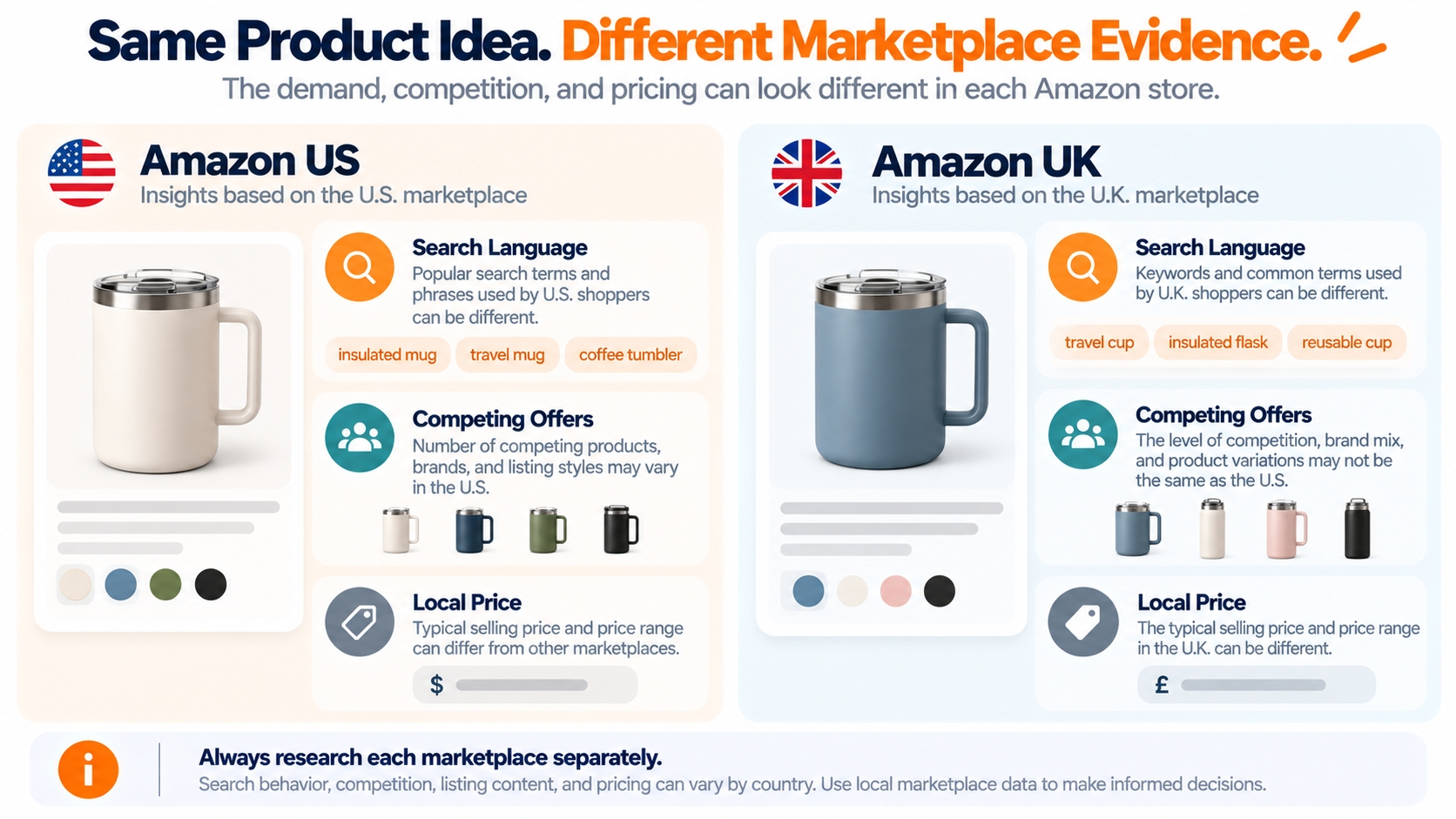
A product's US sales history is useful for generating candidates, but it is not proof that British customers want the same configuration at a viable price. A UK launch deserves its own keyword research, competitor sample and cost assumptions.
Start with the buyer's language. British English and American English are closely related, but shoppers may describe common products differently. Measurements, use cases and expected accessories can differ as well.
Translate the Search Intention, Not Just the Words
| US term | UK term to investigate | Research question |
|---|---|---|
| Stroller | Pushchair | Which product styles, age ranges and search variations matter locally? |
| Flashlight | Torch | Are buyers comparing brightness, batteries, size or outdoor use? |
| Diaper bag | Changing bag | Which size, storage and design benefits appear in leading UK offers? |
These are vocabulary examples, not a claim that the UK version always has higher search volume. Confirm both alternatives in Amazon.co.uk data and inspect the actual results. An American term may still attract UK traffic, while a broadly translated term may return products that do not match your intended ASIN.
Build a UK Keyword Sample Before Writing the Listing
In SellerSprite Keyword Research, select the United Kingdom marketplace and a relevant timeframe. Investigate local monthly search volume, recent trends, purchase-related indicators and the leading products associated with each candidate term. SellerSprite supports marketplace-specific research rather than requiring a US dataset to stand in for Britain.
Separate terms into distinct buyer intentions: general product discovery, specific configurations, problem-solving needs and branded searches. A keyword with substantial traffic may still be unsuitable if shoppers expect a different feature or product type.
The UK demand test: Can you identify relevant local search terms, demonstrate that leading results solve the same customer problem, and find a realistic price range? If any answer is missing, more keyword volume does not yet justify a shipment.
Compare the Product a British Shopper Actually Sees
Search volume tells you that people are looking. Competitor analysis helps determine whether your offer belongs among the results. A US bestseller can face a very different group of brands, price points and customer expectations in Britain.
Start with a manageable UK search-result sample. Record the main organic products and distinguish them from Sponsored Products placements. Confirm each competitor's product identity, size, pack quantity and relevant variation before treating it as comparable.
The Same ASIN Does Not Mean an Identical Competitive Situation
An ASIN may be recognisable across Amazon marketplaces, but its offer availability, pricing, search visibility, reviews displayed and competing sellers can differ by store. Some configurations may need separate catalog treatment. Never assume that matching a product identifier transfers its US ranking or Buy Box performance to Amazon.co.uk.
Compare UK BSR only in its relevant marketplace and category context. BSR is a relative ranking signal, not an exact unit-sales total, and numerical ranks from different countries should not be compared as if they shared the same competitive pool.
Four Signals That Matter More Together
01 / LOCAL PRICE
Look at the delivered GBP price and actual pack size, not a converted USD headline price.
02 / REVIEW MATURITY
Examine review themes and product history, not only the visible average star rating.
03 / OFFER CONCENTRATION
Determine whether results are led by established brands, differentiated products or multiple near-identical sellers.
04 / PRODUCT FIT
Compare packaging, compatibility, local measurements and benefits expected by British customers.
SellerSprite Product Research can support this comparison with marketplace-selected product data and historical signals. Use estimates as research inputs, then validate the current Amazon.co.uk listing, seller mix and actual offer before deciding.
The Price Is in Pounds. The Margin Has More Moving Parts.
One of the most expensive mistakes in international Amazon selling is treating a converted US selling price as a UK contribution estimate. A workable UK price needs to account for the tax treatment, local Amazon fees, product costs, freight, returns, advertising and currency movements.
Understand the VAT Treatment Before Comparing Prices
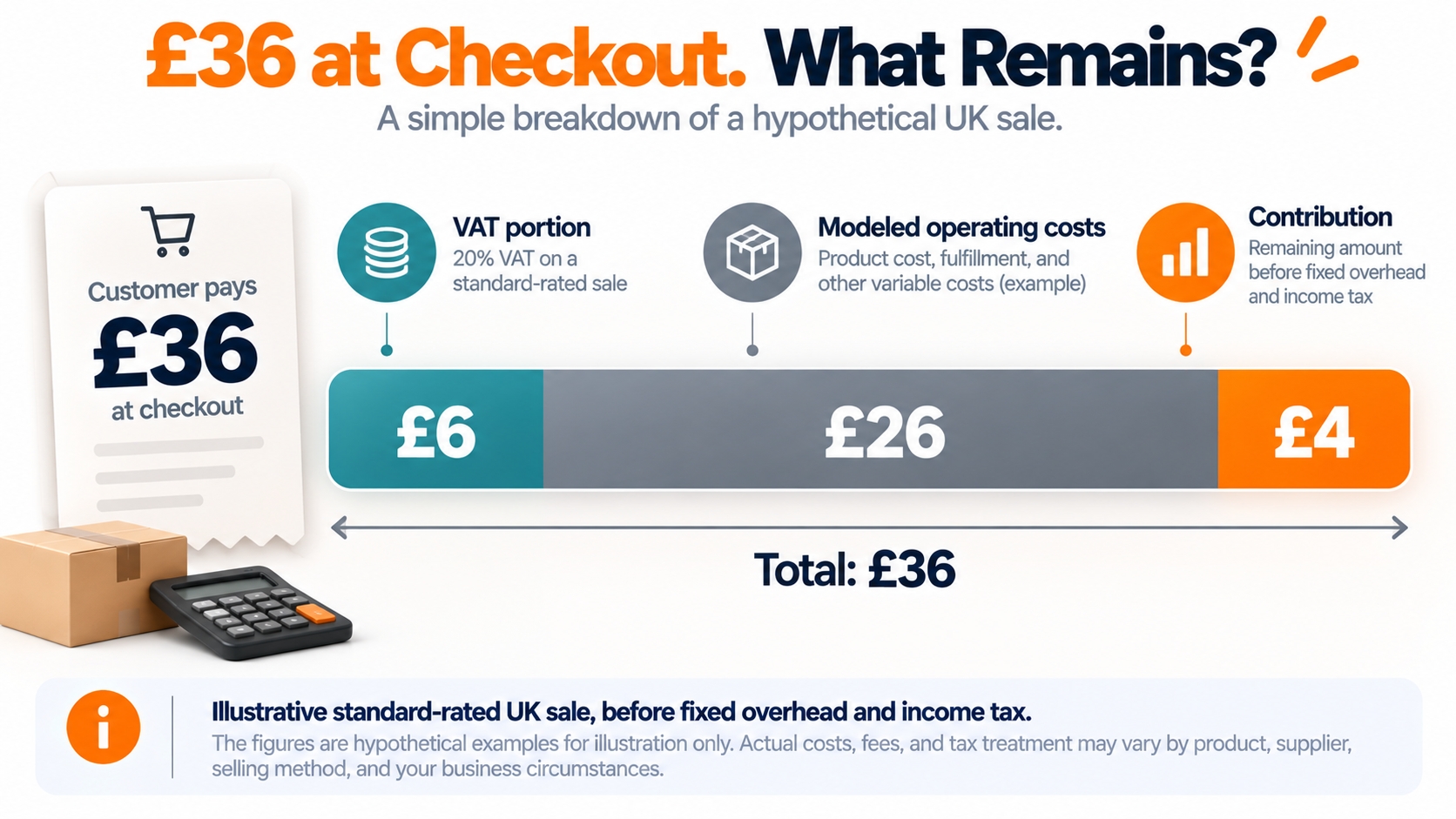
The UK standard VAT rate is currently 20%, although reduced-rate, zero-rated and exempt categories have different treatment. UK consumer-facing prices normally include applicable VAT. That means a visible price of £36 for a standard-rated product corresponds to £30 before VAT, assuming the complete £36 is subject to that rate.
Who accounts for VAT depends on the transaction. For example, HMRC's guidance on overseas goods sold through online marketplaces explains when the marketplace is liable for VAT on qualifying goods. For shipments from outside the UK to customers in Great Britain, the £135 consignment-value rule matters; different treatment can apply to higher-value imports and goods already held in the UK. The threshold refers to a consignment, not an individual product.
This is why an overseas seller should not assume that every UK order carries the same VAT process, or that a marketplace collecting VAT removes all registration, import or recordkeeping obligations. Confirm the treatment for the actual inventory location, seller status, customer and shipment arrangement.
Worked Example: What Remains From a £36 UK Sale?
Consider an illustrative product sold for £36 including standard-rate VAT. The VAT portion would be £6, leaving £30 before VAT. The following assumptions demonstrate an economic model, not a quotation of Amazon's actual fee schedule.
| Item | Amount |
|---|---|
| Customer selling price, including VAT | £36.00 |
| Illustrative VAT portion at 20% | £6.00 |
| Revenue before VAT | £30.00 |
| Product acquisition cost | £10.00 |
| Allocated inbound freight, clearance and preparation | £3.00 |
| Illustrative Amazon selling-fee allowance | £5.00 |
| Illustrative fulfilment cost | £4.00 |
| Storage and expected post-sale allowance | £2.00 |
| Advertising allocation | £2.00 |
| Contribution before fixed overhead and income tax | £4.00 |
In this example, the £36 headline price leaves £4 in modeled unit contribution before fixed overhead and income tax. If the customer price falls to £30 including VAT, the pre-VAT revenue becomes £25. Holding the other illustrative costs constant, the result becomes negative £1. Actual price-linked fees may change with the price, so the complete calculation must be refreshed.
The VAT portion shown is a tax-inclusive pricing illustration, not a statement that the seller personally remits £6 on every transaction. The responsible party and actual tax accounting depend on the circumstances. Do not deduct VAT twice when your accounting or Amazon report already separates it.
Margin checkpoint: Set the lowest acceptable GBP selling price before committing inventory. Stress-test a lower market price, higher freight, slower sell-through and adverse exchange-rate movement. A positive forecast that survives only one perfect scenario is not a reliable expansion case.
Your Fulfilment Route Changes the Customer Promise
Delivery is part of product competitiveness. A US seller can identify genuine UK demand and still lose orders if shipping is too slow, delivery costs are unclear, or returns become difficult.
For a UK marketplace launch, compare where the inventory is held, who imports it, who fulfils the customer order and what the shopper sees at checkout. The cheapest transport quotation is not necessarily the lowest total fulfilment cost.
| Arrangement | How it works | Main constraint to evaluate |
|---|---|---|
| Direct cross-border seller fulfilment | Inventory stays outside Britain and eligible orders are shipped internationally by the seller or its logistics partner. | Delivery times, customs handling, shipping economics and international returns. |
| UK-based FBA inventory | Stock is imported into the UK and held in Amazon's UK fulfilment network for eligible orders. | Import preparation, local stock commitment, VAT and inventory-management costs. |
| International delivery from another Amazon store | An eligible buyer orders from a different Amazon marketplace and the product is delivered across borders. | Destination eligibility and the checkout experience, not automatic UK local-listing coverage. |
The UK Is Not Part of Pan-European FBA
This distinction is particularly important when sellers treat "Europe" as one inventory pool. Since January 1, 2021, the UK has not been part of Pan-European FBA. Amazon's international FBA guidance specifies that UK FBA requires inventory in UK fulfilment centres. Do not assume that joining an EU inventory programme automatically gives your UK listings local UK FBA stock.
Choose the Route That Fits the Product and Test Size
Direct shipment may reduce the amount of inventory committed to Britain, but it can raise per-order logistics costs and make the delivery proposition less competitive. UK FBA can support local fulfilment, but introduces its own inbound, storage and replenishment decisions.
For each option, request a quotation based on the actual packaged item, dimensions, weight and expected destination. Compare the resulting delivered contribution at several order-volume scenarios. Include international return handling and failed-delivery exposure instead of evaluating only outbound freight.
Check the Border Rules Before Shipping Inventory
UK selling eligibility, import clearance and product safety are different questions. Being able to create an Amazon listing does not establish that the product can legally enter the country or be supplied to consumers in its current configuration.
Importer Responsibilities and EORI
Businesses importing goods into England, Scotland or Wales generally need a GB Economic Operators Registration and Identification number, commonly called an EORI number. Different arrangements can apply to Northern Ireland. Confirm who is the importer, who files declarations, and who is responsible for duties, import VAT and supporting documents.
Product Safety and Conformity Marking
Product-specific safety requirements can affect technical documentation, labelling, instructions, conformity assessment and the parties responsible for the product. For applicable regulated products in Great Britain, UKCA or recognised CE marking may be relevant, depending on the product and the governing rules. It is inaccurate to assume every product needs UKCA, or that a CE mark alone resolves all UK requirements.
Electrical goods, toys, cosmetics, food-related products and other regulated categories may carry additional requirements. Check the specific product rather than applying a generic "EU compliant" label to the UK market. The rules for Northern Ireland may differ from those for Great Britain.
Packaging and Environmental Responsibilities
Packaging extended producer responsibility, often called EPR, can affect qualifying organisations and supply-chain roles. The duties depend on factors such as business activity, packaging supplied, turnover and weight thresholds. Check whether responsibility sits with the importer, brand owner, marketplace or another party under the applicable rules instead of assuming all overseas sellers have identical reporting obligations.
Do Not Release the Shipment Until These Questions Are Answered
- Is the exact product eligible for the intended UK listing and condition?
- Who is importing the inventory and handling customs documentation?
- What VAT treatment and registration or reporting requirements apply?
- Are the required product safety, marking and documentation checks complete?
- Does the chosen fulfilment route remain financially viable after these costs?
Build a Listing for Britain, Not a Copy of America
Once the product and selling route pass their initial checks, the UK listing needs to communicate product fit in local terms. A mechanically translated title might be grammatically correct while still missing the phrases, units and purchase considerations UK shoppers use.
Use Cross-Listing Tools Without Delegating the Final Judgment
Amazon's Build International Listings tools can help create and maintain offers across linked stores, subject to account and programme conditions. Automation can reduce repetitive work, but it does not remove the need to check product eligibility, marketplace-specific attributes, legal claims or the relevance of translated content.
Localise the Information That Changes a Buying Decision
- Product terminology: Use relevant British-English search language, with natural phrasing rather than a forced list of alternate keywords.
- Measurements and compatibility: Provide correct dimensions, capacities and applicable local specifications. For electrical products, verify actual voltage and plug compatibility.
- Images and product configuration: Show the exact included components, packaging and usage relevant to the UK version.
- Benefits and objections: Review local customer feedback to identify product expectations that deserve clearer explanation.
- Pricing and delivery: Check the visible GBP offer, local delivery proposition and relevant customer-facing information.
A UK listing should make a precise product promise. Do not add a UK-specific claim simply because competitors use the wording, and do not silently treat a materially different UK configuration as identical to the US product.
A Controlled UK Launch: Four Decisions Before Scale
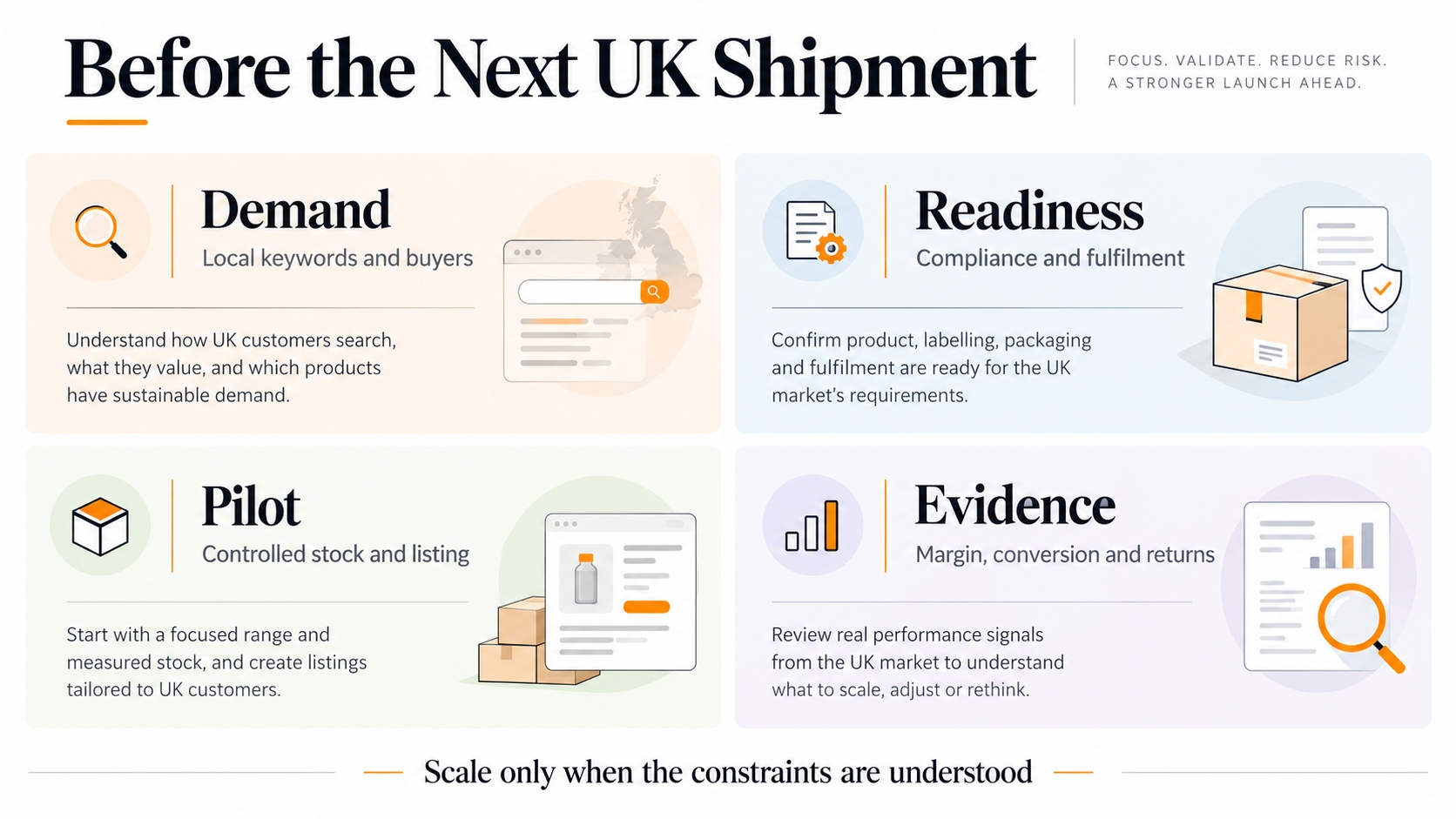
A market-entry test should reduce uncertainty without creating unnecessary inventory exposure. The objective is not to achieve a dramatic first-week sales graph. It is to learn whether the product attracts qualified UK demand at a contribution the business can support.
DECISION 01
Is There a UK Buyer for This Exact Configuration?
Build a locally relevant keyword set, inspect comparable UK products and identify the price range customers are currently offered. Stop if the demand evidence depends on a different product or unverified variation.
DECISION 02
Can the Product Be Sold and Fulfilled Correctly?
Resolve account, customs, VAT and product-compliance requirements. Obtain shipment and fulfilment cost estimates using the actual packaging and delivery route.
DECISION 03
What Is the Smallest Useful Test?
Select an inventory quantity that can generate meaningful operating evidence without relying on speculative demand. Record the test period, starting stock, target price, initial listing version and advertising assumptions.
DECISION 04
Which Evidence Justifies Another Shipment?
Compare actual sales, UK keyword visibility, delivered margin, returns and replenishment timing with the assumptions made before launch. Increase exposure only when the main constraints are understood.
The appropriate pilot duration depends on traffic, product seasonality and the time needed to receive meaningful order data. A 30-day observation window can be a planning starting point, but it is not a guarantee that a low-volume niche will generate enough evidence in a month.
What the First UK Results Should Tell You
International expansion works best when early results answer specific questions. Tracking only orders or revenue can hide a poor keyword fit, an expensive delivery route or margins that disappear after returns.
| Metric | What it can reveal | What it cannot prove alone |
|---|---|---|
| UK keyword visibility | Whether the listing is gaining exposure for locally relevant terms. | That ranking movement will produce profitable sales. |
| Conversion and ordered units | Whether the current offer attracts purchases from the observed traffic. | Whether the product would convert equally well without advertising or promotion. |
| BSR and price movement | How the product's relative position and visible competitive environment are changing. | Exact sales volume or the reason a competitor changed price. |
| Net unit contribution | Whether the realised UK sale supports the business after relevant costs. | That future freight, fees, exchange rates and advertising will remain unchanged. |
| Returns and stock coverage | Whether the product meets local expectations and the replenishment plan is realistic. | That every returned item shares the same cause or that projected demand is certain. |
Review these results together, using comparable time periods and a clear record of promotions, pricing changes and listing revisions. A better BSR during a discount campaign is not proof that localisation alone caused the improvement.
SellerSprite's UK Product Research and Keyword Research data can help provide ongoing competitive context. For actual performance and fees, reconcile those estimates with the relevant Amazon Seller Central reports. Separate market intelligence from account-specific operational results.
The Scale, Adjust or Stop Decision
Scale: Local demand is supported by observed orders, costs remain acceptable, and the product can be replenished compliantly.
Adjust: Demand exists, but the listing, price, delivery method or cost structure needs improvement.
Stop: Eligibility or safety remains unresolved, or the required UK selling price cannot cover realistic costs.
Make the Border a Research Question First
The opportunity in Amazon UK and international shopping is not simply that British buyers can access more products. It is that sellers can identify local needs their current catalog may be capable of serving, provided those products, offers and operating arrangements fit the market.
Begin with UK-specific demand evidence. Confirm the competing products and the real delivered price. Then test the fulfilment, compliance and contribution assumptions before expanding inventory or advertising. A strong US product can provide a useful starting hypothesis, but the UK business case must stand on its own.
FAQs
What does Amazon UK and International Shopping mean?
It can refer to customers buying products across national borders through Amazon or businesses selling to customers in the UK marketplace. Buying internationally and operating a local Amazon.co.uk offer have different requirements for delivery, taxes, listings and inventory.
Can I shop on Amazon UK from the United States?
You can browse Amazon.co.uk from the US, but international delivery depends on the item, seller and destination. Set the correct delivery address and review the checkout total, shipping eligibility, currency and any applicable import charges before purchasing.
Can a US Amazon seller use the same account to sell in the UK?
Existing US sellers can expand through Amazon's international account setup and account-linking tools, but European selling requires the appropriate regional account arrangement. Linked accounts do not eliminate marketplace-specific product, tax and fulfilment obligations.
Does Amazon FBA Export mean I already sell on Amazon.co.uk?
No. An eligible customer may order an internationally shipped product from another Amazon marketplace without the seller having a local UK offer. Selling directly on Amazon.co.uk requires its own marketplace and listing considerations.
Is the UK included in Pan-European FBA?
No. Amazon states that the UK has not been part of Pan-European FBA since January 1, 2021. UK FBA requires inventory in UK fulfilment centres; other cross-border programmes and costs should be checked separately.
Do I need a UK company to sell on Amazon.co.uk?
An overseas business does not necessarily need to establish a UK company solely to sell through Amazon. However, account verification, import arrangements, VAT, product compliance and other legal responsibilities still apply. Consult suitable tax and legal advisers for your business structure.
Does Amazon automatically handle all UK VAT for international sellers?
No. Amazon may be responsible for collecting VAT on certain marketplace transactions, but the treatment varies by consignment value, inventory location, seller status and customer type. Sellers may still have their own import, registration, documentation or reporting responsibilities.
Can I use the same Amazon keywords in the US and UK?
Some terms overlap, but local vocabulary, product configurations and buyer expectations can differ. Research UK search terms independently and verify which products appear in UK results before rewriting the listing.
Which metrics matter most for a UK market-entry decision?
Start with marketplace-specific search demand, comparable product competition, GBP delivered price, VAT-aware contribution, fulfilment feasibility and product compliance. Once selling begins, monitor actual orders, keyword visibility, returns and inventory coverage together.
References
- Amazon: Expand to Europe Through Global Selling View
- Amazon: International FBA and Pan-European FBA Requirements View
- SellerSprite: Amazon Keyword Research New User Guide View
- SellerSprite: Product Research Guide View
- HM Revenue & Customs: VAT on Overseas Goods Sold Through Online Marketplaces View
- UK Government: VAT Rates and Duties View
- UK Government: Import Goods Into the UK View
- UK Government: Placing UKCA or CE Marked Products on the Great Britain Market View
- UK Government: Extended Producer Responsibility for Packaging View
- Amazon: How Build International Listings Supports Global Selling View
- Amazon UK: Selling Plans, Fees and Revenue Calculator View
- UK Government: Tax and Duty on Goods Sent From Abroad View
- Amazon UK: About Import Charges on International Orders View
- Amazon UK: International Selling Guide View
By SellerSprite Content Team
The SellerSprite Content Team brings together Amazon marketplace research specialists, ecommerce data analysts and content professionals. Its research covers international product demand, marketplace competition, keyword behaviour and the commercial signals behind Amazon selling decisions. The team's cross-border work examines how local search patterns, product positioning and regional market conditions influence expansion opportunities, helping sellers interpret marketplace data within the realities of international ecommerce.
Last reviewed: October 20, 2026