By SellerSprite Team
SellerSprite supports Amazon sellers with keyword research, PPC workflow planning, search term mining, and campaign optimization across major Amazon marketplaces. Our recommendations here are based on recurring account patterns we see in Exact Match campaign buildouts, keyword harvesting workflows, and bid control practices used by sellers moving from exploration into PPC refinement.
30-second answer: Exact match campaigns give you the highest control over Amazon PPC keywords, which makes them ideal for proven search terms you want to bid on precisely and scale with discipline. With SellerSprite Keyword Engine, you can filter for high-potential keywords using search volume, competition, conversion intent, and CPC logic, then build exact match campaigns that are easier to optimize for rank and ACoS.
Key Takeaways
- Use exact match after discovery, not before. Auto and broad uncover terms, exact controls winners.
- A mature exact match campaign usually contains a small set of proven core keywords, not hundreds of random terms.
- Bid strategy matters as much as keyword choice. Core terms often deserve higher starting bids than long tail exact terms.
- SellerSprite Keyword Engine helps you score keywords by search volume, competition, conversion potential, and CPC logic before you build the campaign.
Table of Contents
- What is exact match and when should you use it in Amazon PPC?
- Exact match vs phrase vs broad vs auto
- How SellerSprite Keyword Engine finds the best exact match keywords
- Step by step: create your first exact match campaign
- Bid strategies and optimization rules for exact match
- Case study: exact match performance improvement
- Exact campaign checklist
- FAQ
- References
Marketplace note: Examples below use Amazon.com. On other marketplaces, CPC, competition, and shopper phrasing can differ, so use the same structure but localize bids and keyword choices to your market.
What is exact match and when should you use it in Amazon PPC?
Direct answer: Exact match is the most restrictive keyword match type in Sponsored Products, which makes it the best choice when you already know a search term deserves focused budget and tighter bid control.
Use exact match when a keyword has already shown proof through auto campaigns, broad campaigns, phrase campaigns, or search term reports. It belongs in the control stage of PPC, where you want to protect efficiency, improve rank, and prevent irrelevant traffic from eating budget.
Takeaway: Exact match is not your discovery tool. It is your precision tool.
Exact match vs phrase vs broad vs auto: which should you use when?
Direct answer: Think of match types as a funnel. Auto and broad are for discovery. Phrase is for controlled expansion. Exact is for proven, high-value search terms that deserve precise traffic and bid management.
Common mistake: Moving a keyword into exact match too early, before it has enough conversion proof to justify dedicated budget.
How does SellerSprite Keyword tool find the best exact match keywords?
Direct answer: SellerSprite Keyword tool helps you score and filter keywords before you move them into exact match. Instead of guessing, you can prioritize terms using signals such as search volume, competition level, conversion potential, and CPC logic.
The point is not to chase the biggest keyword every time. The goal is to find terms that are both commercially meaningful and realistically controllable inside a Sponsored Products campaign.
- Search volume: enough demand to matter, but not so broad that you buy irrelevant traffic.
- Competition: medium competition terms are often easier to stabilize in exact match than ultra-competitive head terms.
- Conversion potential: look for buyer-intent language, not just traffic volume.
- CPC logic: a keyword can be relevant and still be too expensive for your margin structure.
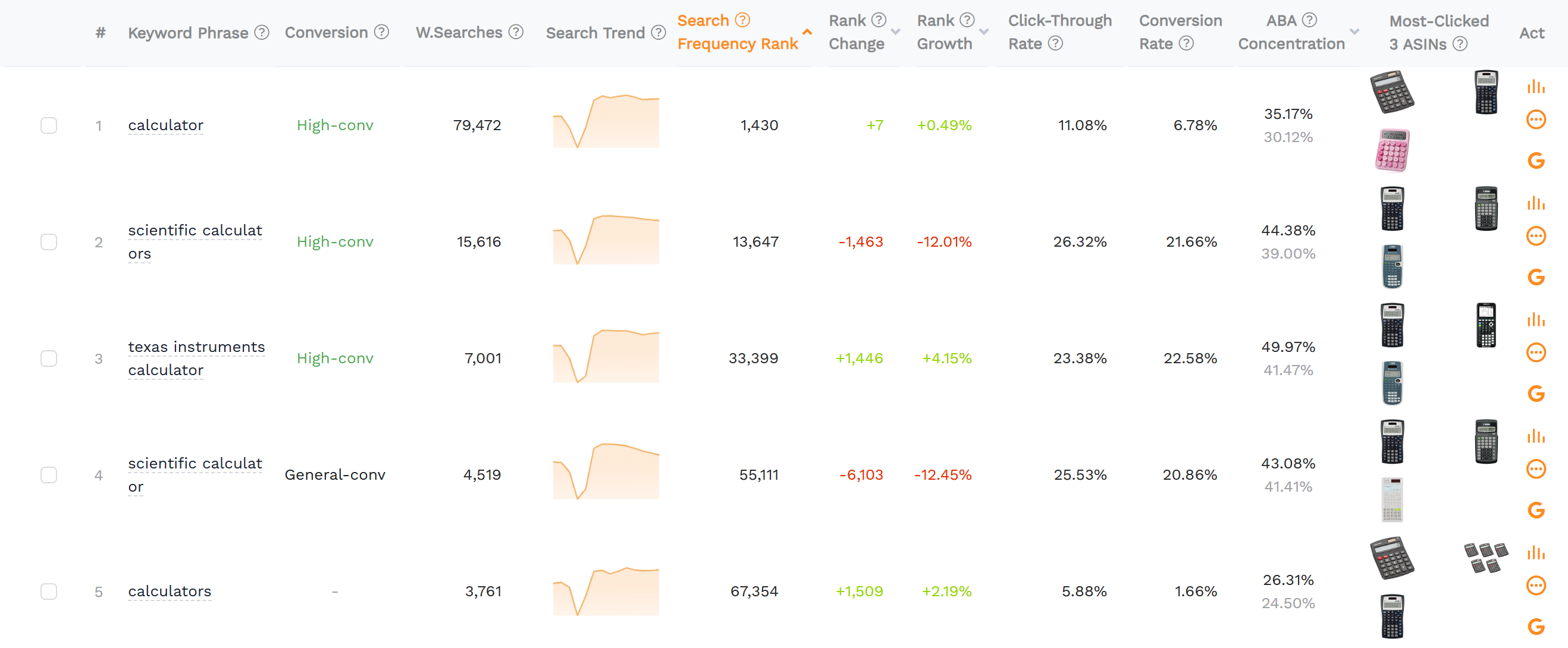
Find exact match candidates fast
- Open SellerSprite Keyword Engine and enter a seed keyword or competitor ASIN.
- Filter out low-potential and high-waste terms using volume, competition, and CPC clues.
- Export the shortlist for your first exact match campaign.
Step by step: how do you create your first exact match campaign?
Direct answer: Start with a focused campaign structure. Exact match works best when each campaign has a clear purpose, a controlled keyword set, and enough budget to gather meaningful click and conversion data.
- Choose 10 to 50 core keywords that already showed some proof in auto, phrase, or broad.
- Create one exact match campaign for a closely related keyword cluster or one product family.
- Set one ad group per logical cluster if you need more control, but do not overcomplicate the structure on day one.
- Separate branded and non-branded exact terms so performance and bids stay readable.
- Add negative protection when phrase or broad campaigns might overlap and steal budget.
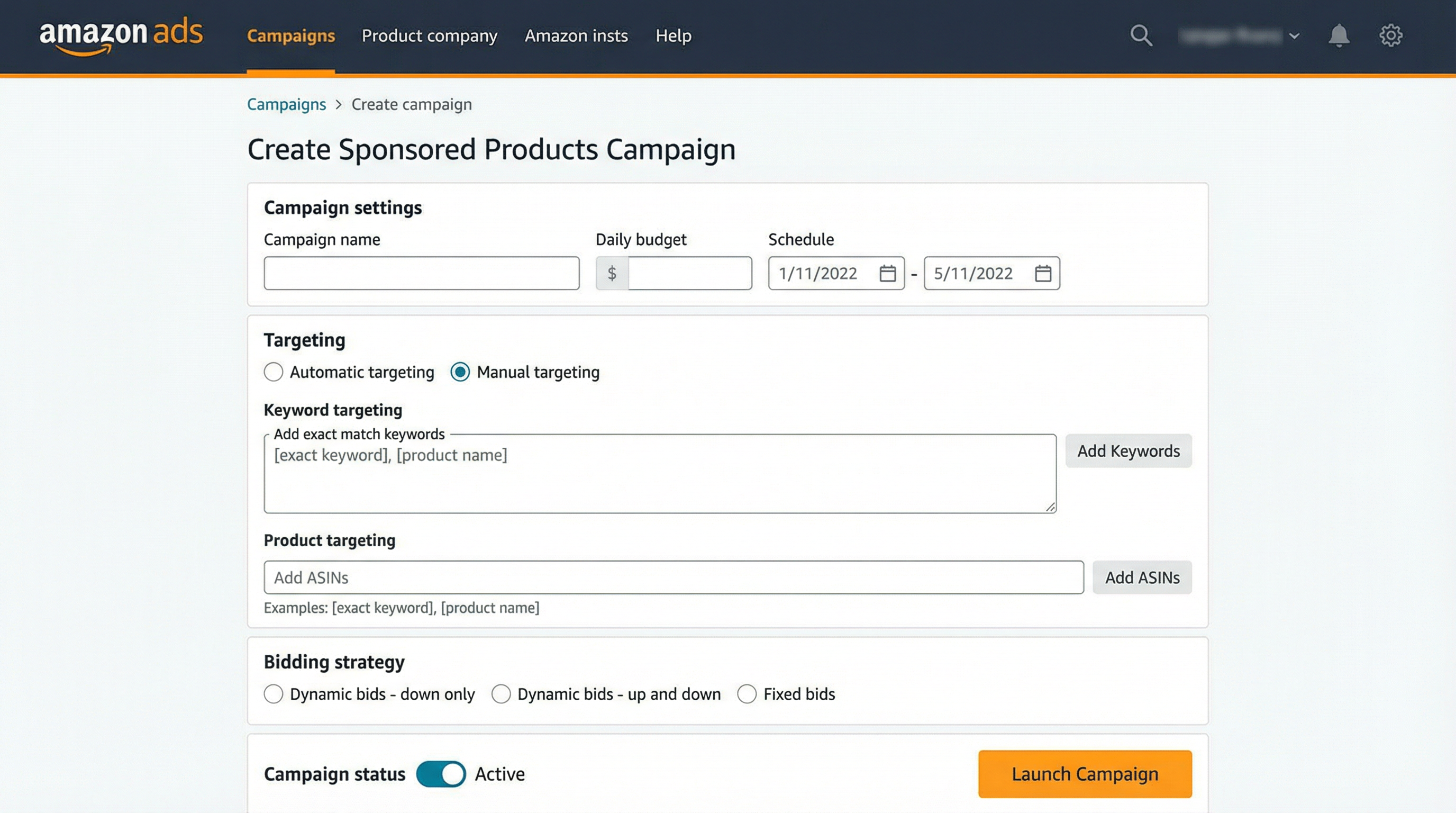
A simple mature exact campaign profile
- Keyword count: often 10 to 50 tightly controlled core terms
- Budget logic: enough to keep the best keywords serving through the day
- Traffic protection: negative keywords used to reduce overlap with discovery campaigns
- Bid behavior: dynamic bids used intentionally, not left random across every keyword
Build the campaign from real data
- Use Keyword Engine to shortlist your exact candidates.
- Use search term data from auto campaigns to confirm proof.
- Launch the exact campaign only after the shortlist is cleaned.
How should you set bids and optimize exact match campaigns?
Direct answer: Exact match bids should reflect confidence. Keywords with stronger proof deserve more aggressive bidding. Keywords with less proof should start lower and earn their way up through data.
Simple bid framework for beginners
- Core exact terms: start around 120 percent of Amazon suggested bid if the keyword already proved relevance and conversion.
- Secondary exact terms: start near suggested bid.
- Long-tail exact terms: often 70 to 90 percent of suggested bid is enough because competition is lower.
A simple 7 day bid adjustment rhythm
- Day 1: set the starting bid based on confidence and match tier.
- Day 7: review clicks, orders, ACoS, and placement performance.
- Raise bids on keywords that convert and still need more impression share.
- Lower bids on keywords that spend but do not convert or have weak click quality.
A practical mature rule set often looks like this: top converting keywords may earn stronger top of search adjustments, while weak terms stay flat or get cut. If a keyword consistently converts above your category average, it can justify a stronger bid or placement modifier.
Takeaway: Exact match bid optimization is not just about lowering ACoS. It is about protecting winners and buying profitable position.
What happens when you move a proven term from auto into exact match?
Direct answer: When the keyword is real and the listing converts, moving it from auto into exact match usually improves budget control and can reduce wasted clicks. It does not always lower ACoS instantly, but it often improves campaign clarity and scaling ability.
Case 1: harvested from auto into exact
A kitchen brand identified one search term from an auto campaign that consistently produced clicks and orders. The seller moved it into an exact match campaign and reduced broad exploration spend around that term.
- Before: keyword lived inside auto with mixed traffic and inconsistent spend
- After: exact campaign isolated the term, bid was raised moderately, and irrelevant variants were reduced
- Typical pattern: click quality improved, conversion stayed stable or improved, and ACoS moved into a more controllable band
Case 2: bid adjustment rhythm on exact
A beauty seller started a core exact keyword at a moderately aggressive bid. After 7 days, the term had enough click and conversion data to justify a higher bid because impression share was still constrained. After another review cycle, the keyword stabilized into a better balance of visibility and ACoS.
- Step 1: start with a confident initial bid
- Step 2: review after 7 days, not after 24 hours
- Step 3: raise or lower based on real conversion efficiency, not emotion
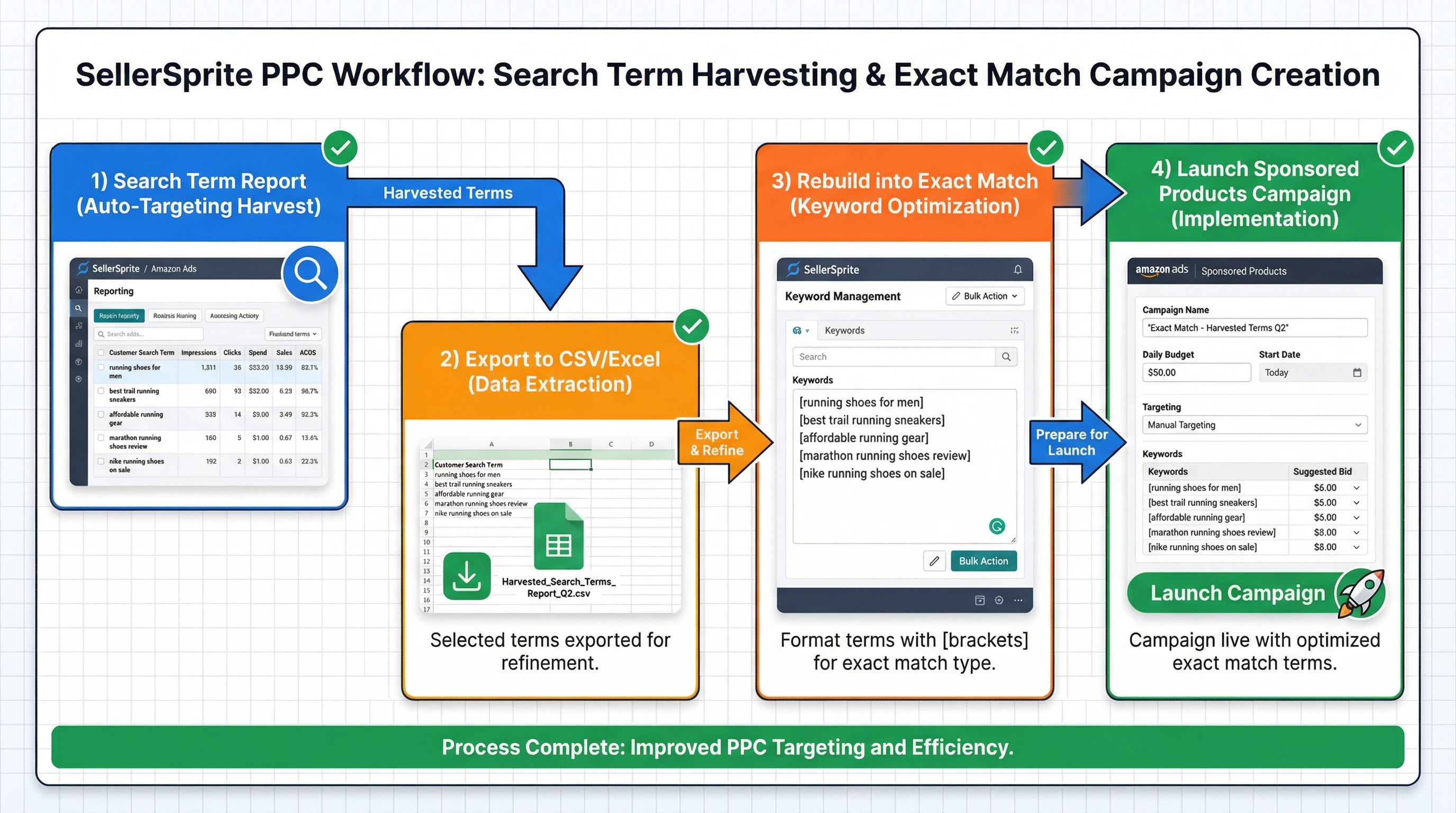
What is the simplest exact match campaign checklist from zero to launch?
Direct answer: If you want a simple from-zero workflow, follow this checklist in order: discover, shortlist, structure, bid, protect, then optimize.
- Discover: mine search terms from auto, broad, and phrase campaigns.
- Shortlist: use SellerSprite Keyword Engine to remove low-value and overcompetitive terms.
- Structure: build a small, focused, exact campaign or ad group set.
- Bid: give core keywords more aggressive bids than long tail exact terms.
- Protect: add negative keywords where overlap or waste is clear.
- Optimize: review every 7 days, not every few hours.
Go from research to campaign
Open SellerSprite Keyword Engine, filter your shortlist, then export the strongest exact candidates and build your campaign while the logic is still fresh.
FAQ
Should I bid higher on exact match keywords?
Usually yes, but only when the keyword has already shown enough proof. Core exact terms often deserve higher bids than long-tail exact terms because they carry more strategic value.
How many keywords should be in an exact match campaign?
A controlled exact campaign often works best with a limited set of high-priority terms. Many advertisers keep it in the 10 to 50 keyword range for cleaner optimization.
When should I harvest keywords from auto into exact?
Harvest when a keyword shows meaningful clicks, conversion proof, or clear ranking relevance. The stronger the proof, the more reason it has to move into exact.
Do I still need phrase and broad if I run exact campaigns?
Yes. Phrase and broad still serve discovery and expansion roles. Exact campaigns work best when supported by other match types feeding new opportunities into them.
How do I know if an exact keyword is worth keeping?
Keep it if it helps one of your main goals: stable conversion, useful rank movement, or acceptable return on ad spend. If it spends without helping any of those, lower the bid, isolate the cause, or remove it.
Get Help From the SellerSprite Community
Share your negotiation situation, get feedback, and learn from other sellers in the SellerSprite Discord and Facebook Group.
View The SellerSprite Course Directory
Ready for the next step? Open the SellerSprite Academy course directory to continue building your Amazon FBA skills chapter by chapter.