TL;DR: Amazon's legacy Small and Light program is gone, but small, lightweight products remain one of the most capital-efficient ways to start or expand on FBA, as long as you respect the size-tier and low-price fee boundaries. This guide weighs the real advantages against the hidden margin traps and shows you how to decide whether to sell, test, redesign, or skip a product.
Key Takeaways
- The standalone Amazon Small and Light program is no longer available in the US; low-priced, compact items now sit inside standard FBA, with Low-Price FBA rates applied to items priced under the current threshold (under $10 in the US at the time of writing). Confirm every threshold in Seller Central before you source.
- Small and light is an operations advantage, not a demand advantage. Compact products are cheaper to test and store, but they still need proven search demand and a clear reason to buy.
- Two boundaries decide profitability: the FBA size-tier line (packaged dimensions plus shipping weight) and the Low-Price FBA price threshold. Crossing either one resets your break-even point.
- Low selling prices magnify fixed per-unit costs. Fulfillment, prep, advertising, and returns all consume a far larger share of a $12 sale than a $35 sale.
- Validate with data instead of intuition: historical sales trends, keyword volume, review complaints, and fee estimates from Amazon's Revenue Calculator or a SellerSprite product research workflow.
Table of Contents
- Introduction: Why Small and Light Products Still Matter
- What "Small and Light" Actually Means for Amazon Sellers Today
- The Real Advantages of Selling Small and Lightweight Products
- The Hidden Disadvantages: Why Low-Priced Products Can Be Harder to Profit From
- The Two Fee Boundaries That Can Change a Product's Profitability
- Which Small and Light Products Are Actually Worth Selling?
- When Small and Lightweight Products Become Operationally Complicated
- Single Units, Multipacks, or Premium Versions
- FBA vs. FBM: Choose the Fulfillment Method That Fits the Product Economics
- How to Evaluate Small and Light Opportunities Using SellerSprite
- The Final Decision: Sell, Test, Redesign, or Skip?
- FAQ
- Next Steps
- References
Note on marketplaces: This guide is specifically optimized for the US market. Fee names, size tiers, and low-price thresholds differ in Europe, Japan, and other regions, so verify the local rules before you apply this math to a non-US marketplace.
Introduction: Why Small and Light Products Still Matter
Almost every "best products for beginners" list points new sellers toward something small, cheap, and lightweight: a cable organizer, a silicone spatula, a pet hair remover. The logic sounds airtight because these products seem to offer low sourcing costs, low shipping costs, and minimal risk. In practice, the same traits that make these products easy to launch also make them easy to copy, and a low selling price leaves very little room for error once fulfillment fees, advertising, and returns are deducted.
This guide is written for sellers at every stage: first-time sellers choosing a starting product, growing sellers auditing an overcrowded catalog, and brand or operations managers who need a defensible answer to the question "should we keep selling this SKU?" It is a decision framework rather than a hype list. By the end, you will understand how FBA size tiers and Low-Price FBA actually work in the US, where small and light margins leak, which product types hold up under pressure, and how to test a candidate before committing inventory. If you want to build the upstream research process first, work through our Amazon product research guide and then return here for the small-and-light economics.
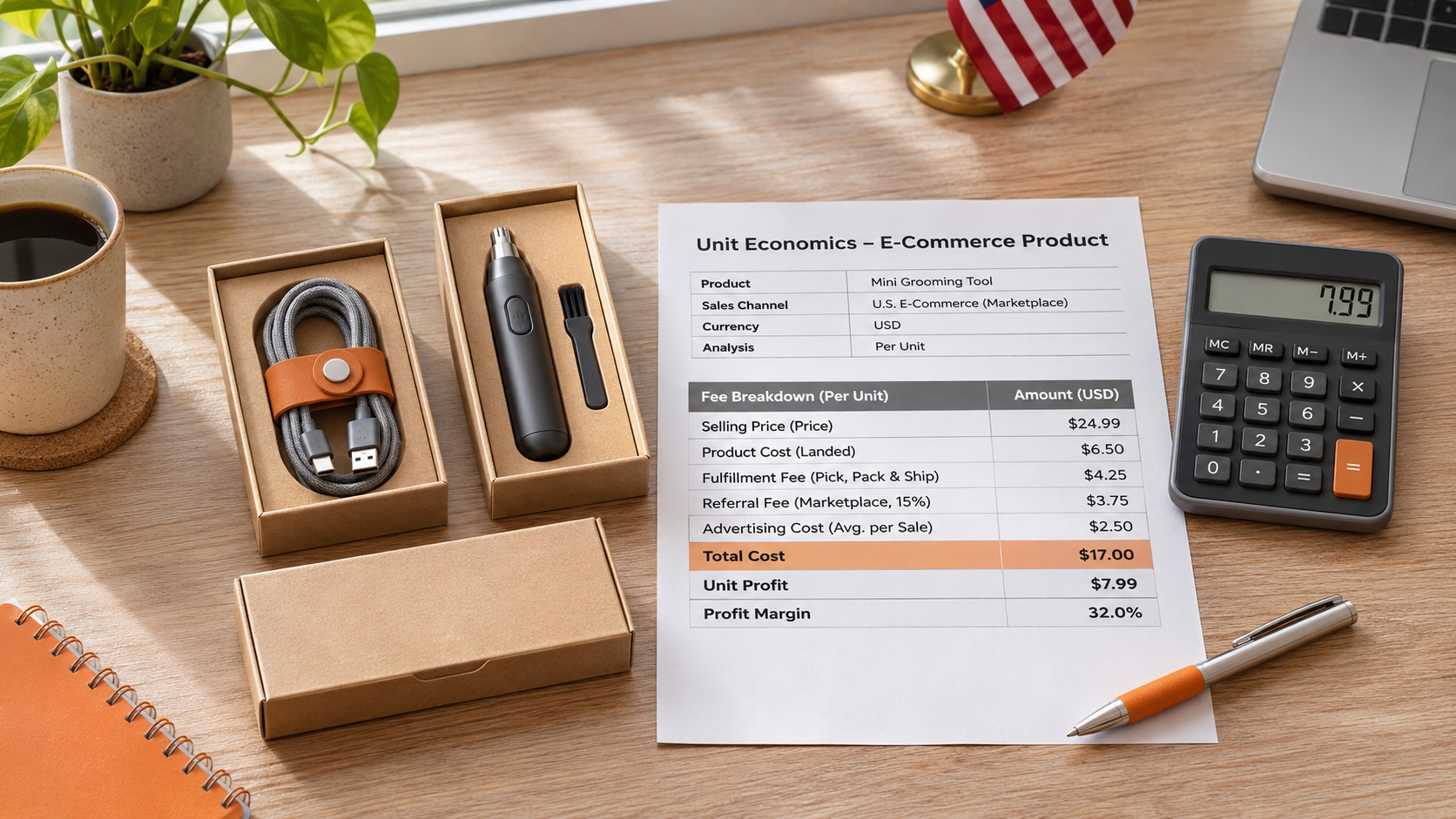
What "Small and Light" Actually Means for Amazon Sellers Today
The phrase "small and light" is used to describe three different things, and mixing them up is the fastest way to build a sourcing model on the wrong assumptions. It can mean the physical size of the product, the FBA size tier your packaged unit falls into, or the low-price rate category for inexpensive items. Only two of those directly change what you pay Amazon per unit, and none of them guarantees that anyone will buy the product. Before we compare advantages and disadvantages, let's separate the vocabulary, because most outdated advice online comes from conflating these concepts.
Why the Original Amazon Small and Light Program Is No Longer Available
Amazon launched the original Small and Light program in 2015 to make low-priced, compact items viable under FBA: reduced fulfillment fees for products below a price cap and inside tight size and weight limits. Amazon has since retired the standalone US program and moved those low-priced items into standard FBA, where Low-Price FBA rates apply below a price threshold. The practical takeaway is simple: never budget from a screenshot. Pull the current fee schedule and run your exact packaged dimensions and price through Amazon's fee tools (see the Amazon selling fee overview) before you place a purchase order.
Small Physical Size, FBA Size Tiers, and Low-Price FBA Are Different Concepts
These three concepts interact, but they are measured in completely different ways, and each one affects a different line in your profit and loss statement. The table below is the mental model worth memorizing before you evaluate any candidate product.
| Concept | What it is measured on | How it affects your margin |
|---|---|---|
| Physical size and weight | Your product plus its retail packaging | Inbound freight, storage fees, prep labor, packaging cost |
| FBA size tier | Packaged dimensions and shipping weight against Amazon's US tier table | The per-unit fulfillment fee charged when an order ships |
| Low-Price FBA | Selling price below Amazon's low-price threshold (under $10 in the US at the time of writing) | A lower fulfillment fee per unit, offset by a lower selling price |
| Demand and competition | Search volume, review counts, price history | Whether any of the rows above matter at all |
Why a Lightweight Product Does Not Automatically Qualify for the Lowest Fulfillment Fee
Fulfillment tiers are not decided by weight alone. Amazon evaluates packaged dimensions alongside unit weight and shipping weight, and the tier is set by whichever measure pushes the item higher. A 6-ounce item shipped in a 20-inch tube can cost more to fulfill than a 1.5-pound item in a compact box, because the long side pushes it into a larger tier. And for seller-fulfilled shipments, carriers bill dimensional weight on volume rather than scale weight. Add a poly bag, a header card, or a display box and the packaged spec you modeled may no longer match reality. Always test the final, retail-ready package, not the prototype.
Keep these three definitions straight
"Small and light" is a sourcing heuristic. "Low-Price FBA" is a fee schedule tied to selling price. The "FBA size tier" is the number that actually bills you. Never use one as a proxy for another.
The Real Advantages of Selling Small and Lightweight Products
The advantages are real, but they are mostly financial and operational rather than commercial. Small products do not sell faster because they are small. What they do is let you move faster with less capital, which is a meaningful edge when you are still learning how a category behaves. Below are the four advantages that consistently hold up plus the one assumption that does not.
Lower Shipping and Storage Requirements Can Improve Capital Efficiency
Freight, inbound placement, and monthly storage are all priced around space and weight. More units per carton and more cartons per pallet translate into a lower landed cost per unit, and smaller cubic volume means less cash tied up in inventory sitting in storage for 90 days. For a seller running a 60-day cash cycle, the difference between $2.10 and $0.70 per unit in logistics is often the difference between reinvesting in a second SKU this quarter and waiting another two months.
Compact Inventory Can Make Product Testing and Replenishment More Flexible
Small products are cheap to air-freight in a test batch of 200 to 300 units, which means you can validate a listing with a fast, modest shipment instead of a 1,000-unit sea freight commitment. That compresses the learning loop: launch, collect conversion and review data, then reorder or exit. Replenishment is also faster and less risky, because a misjudged forecast costs far less to write off. Flexibility is not glamorous, but it is the single biggest advantage a new seller has over an established brand.
Packaging Efficiency Can Create Savings Beyond Product Weight
Right-sizing packaging is one of the few levers that improves fees, damage rates, and customer experience at the same time. Removing a rigid box in favor of a properly sealed poly bag, trimming a quarter inch off a long side, or consolidating two inserts can move a unit into a cheaper size tier and reduce dimensional weight. The discipline is to treat packaging as an engineering decision rather than a branding afterthought and to re-check the fee after every change instead of assuming the old number still applies.
Why Easier Fulfillment Does Not Automatically Mean Faster Sales
Fulfillment is supply-side; velocity is demand-side. A perfectly optimized, low-fee unit in a category where page one holds multiple listings with hundreds of reviews and a $9.99 price floor will not sell, no matter how cheap it is to ship. Cheaper logistics improve your ability to survive a price war, but they do not create demand. Treat small-and-light economics as permission to test, never as permission to order 2,000 units on the assumption that low costs will manufacture sales.
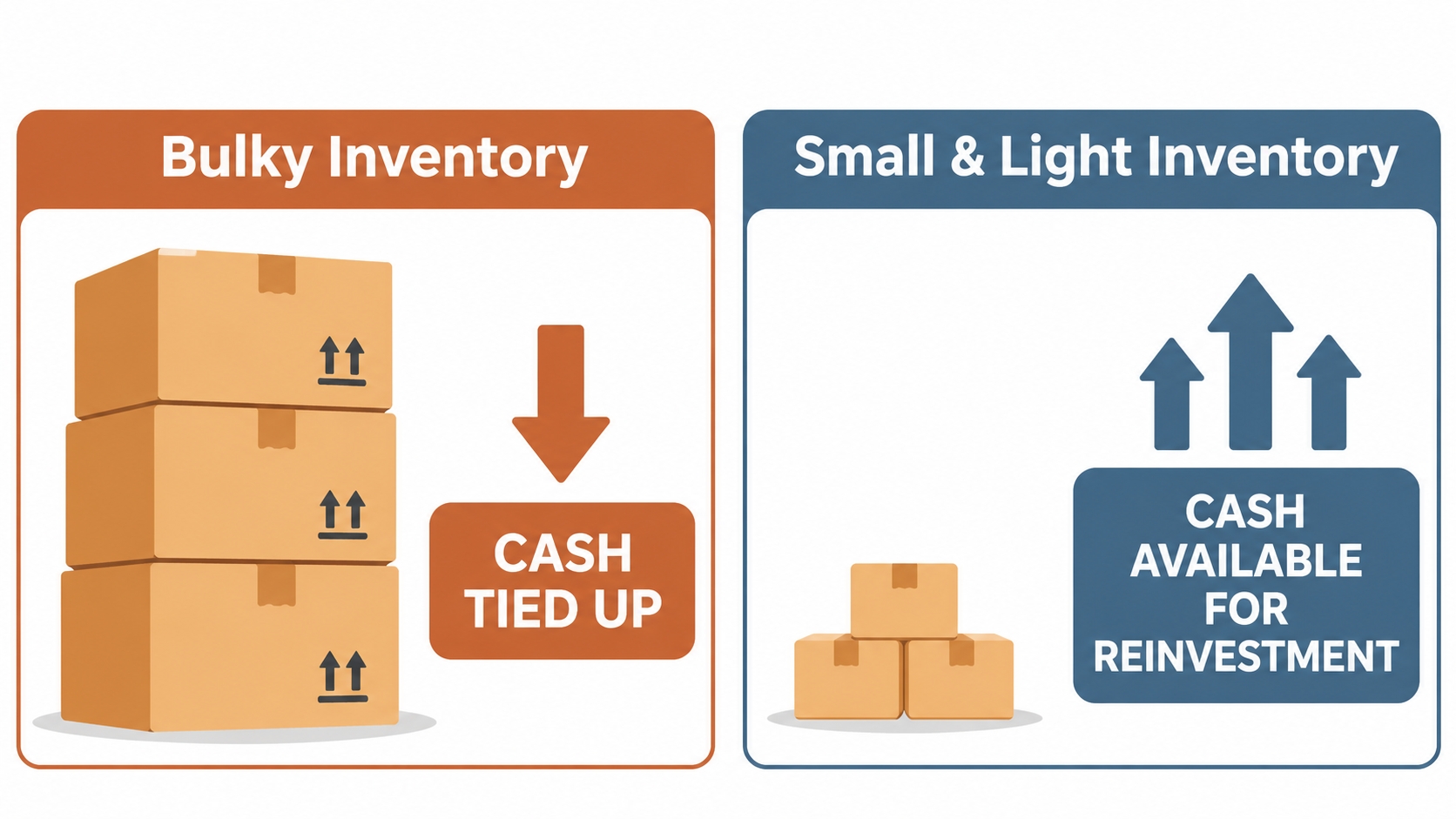
The Hidden Disadvantages: Why Low-Priced Products Can Be Harder to Profit From
The uncomfortable math of cheap products is that part of the fee structure is fixed per unit. Referral fees scale with price, but fulfillment, prep, labeling, inbound handling, storage, and advertising clicks do not scale down nearly as fast. The result is a familiar pattern: a gross margin percentage that looks healthy in a spreadsheet while contribution profit per order stays dangerously thin. These are the four leaks that sink most small-and-light launches.
Fixed Per-Unit Costs Consume a Larger Share of Low Selling Prices
Compare two products with an identical 30% gross margin, one selling at $12 and one at $38. A $3.50 fulfillment fee equals 29% of the $12 price but only 9% of the $38 price. Add prep, labeling, and inbound handling and the cheaper product may be paying half its revenue to Amazon before a single ad click. The lesson is not that you should never sell cheap products, but that doing so requires either a genuine cost advantage or a fee advantage, such as Low-Price FBA rates, and ideally both.
PPC Costs Can Erase a Healthy-Looking Gross Margin
Advertising is priced per click, not per dollar of revenue, which is why it punishes low price points so severely. At a $12 average selling price, a $0.75 cost per click with a 12% conversion rate costs roughly $6.25 per order, which is more than half the price before cost of goods. At $38, the same click and conversion figures represent about 16% of revenue. This single mechanic explains why so many $10 to $15 products look profitable during sourcing and lose money once the ad account turns on.
Returns, Refunds, and Quality Issues Can Wipe Out Multiple Successful Orders
Returns on inexpensive items are often not worth reselling: the unit comes back unsellable, damaged, or not at all. Even when the referral fee is refunded, fulfillment and shipping costs are usually not recovered in full, and every return carries a processing cost. On a $12 product, one return can erase the contribution profit of three to five good orders. Build a return-rate assumption of 5% to 10% into your model for the category, then double it as a stress test before you commit to inventory.
Low Entry Barriers Can Accelerate Price Competition
When a product is cheap to source, cheap to ship, and requires no certification, it attracts sellers quickly. A crowded listing usually means price erosion, Buy Box rotation, and coupon escalation within a few months. A $16 product with a $4 margin can become an $11.99 product with a negative margin in a single quarter. The right question at the sourcing stage is not "can I sell this?" but "does my advantage survive a 25% price cut from a competitor with the same supplier?"
| Line item | $12.00 unit | $19.99 unit | $34.99 unit |
|---|---|---|---|
| Referral fee at 15% | $1.80 | $3.00 | $5.25 |
| Fulfillment fee placeholder | $3.40 | $3.60 | $4.10 |
| Advertising at 20% of revenue | $2.40 | $4.00 | $7.00 |
| Returns reserve at 6% | $0.72 | $1.20 | $2.10 |
| Prep and inbound | $0.60 | $0.60 | $0.65 |
| Contribution before cost of goods | $3.08 | $7.59 | $15.89 |
Illustrative model only: these are not quotes of current Amazon rates. Replace every line with verified figures from Seller Central and the Amazon Revenue Calculator before making sourcing decisions.
The margin trap: a 35% gross margin on a $12 product can still produce under $1 of contribution profit after ads and returns. Always model contribution profit per order, never gross margin percentage alone.
The Two Fee Boundaries That Can Change a Product's Profitability
Most small-and-light profitability mistakes occur not gradually, but at two specific boundaries. The first is the size-tier line, where a millimeter or an ounce moves your packaged unit into the next tier. The second is the Low-Price FBA price threshold, where a single dollar of price changes which fee schedule applies. Both deserve explicit modeling before you order inventory, because both are easy to miss and expensive to correct later.
How Packaged Dimensions and Shipping Weight Affect FBA Size-Tier Costs
Amazon's US fulfillment fee is set by size tier, which combines the longest side, the median side, the shortest side, and the shipping weight of the packaged unit. Because the tier is assigned by the highest applicable measure, a light item can still land in a larger tier if it is bulky. Reducing the long side by half an inch, or replacing a rigid insert with a lighter protective wrap, can move a unit down a tier and save real money on every order. Model your product at its worst realistic package, not its ideal one.
Why the $10 Low-Price FBA Threshold Requires Careful Pricing Decisions
Low-Price FBA rates, applied to items priced under the low-price threshold, which has been $10 in the US at the time of writing, can meaningfully reduce the fulfillment fee per unit. But the discount is not free money. If you cut a $10.49 item to $9.99 to qualify, you give up $0.50 of revenue per unit and reduce your ability to fund advertising. Run the comparison explicitly: the fee saving (old fee minus new fee) versus the revenue sacrificed (old price minus new price). If the fee saving is smaller than the revenue you gave up, the threshold is not helping you. Always confirm the current threshold and rates in Seller Central before repricing a catalog.
Seasonal Fulfillment Fees and Surcharges Can Change the Break-Even Point
FBA economics are not constant across the year. Peak-season fulfillment fees, storage rate changes, aged-inventory surcharges, and inbound placement costs can all stack on top of the base fee during the busiest quarter. Build two versions of your unit economics, including a standard month and a peak month, and confirm the product is still profitable in the peak version. If a product only works in the cheapest month of the year, it does not work; it simply has not failed yet.
Which Small and Light Products Are Actually Worth Selling?
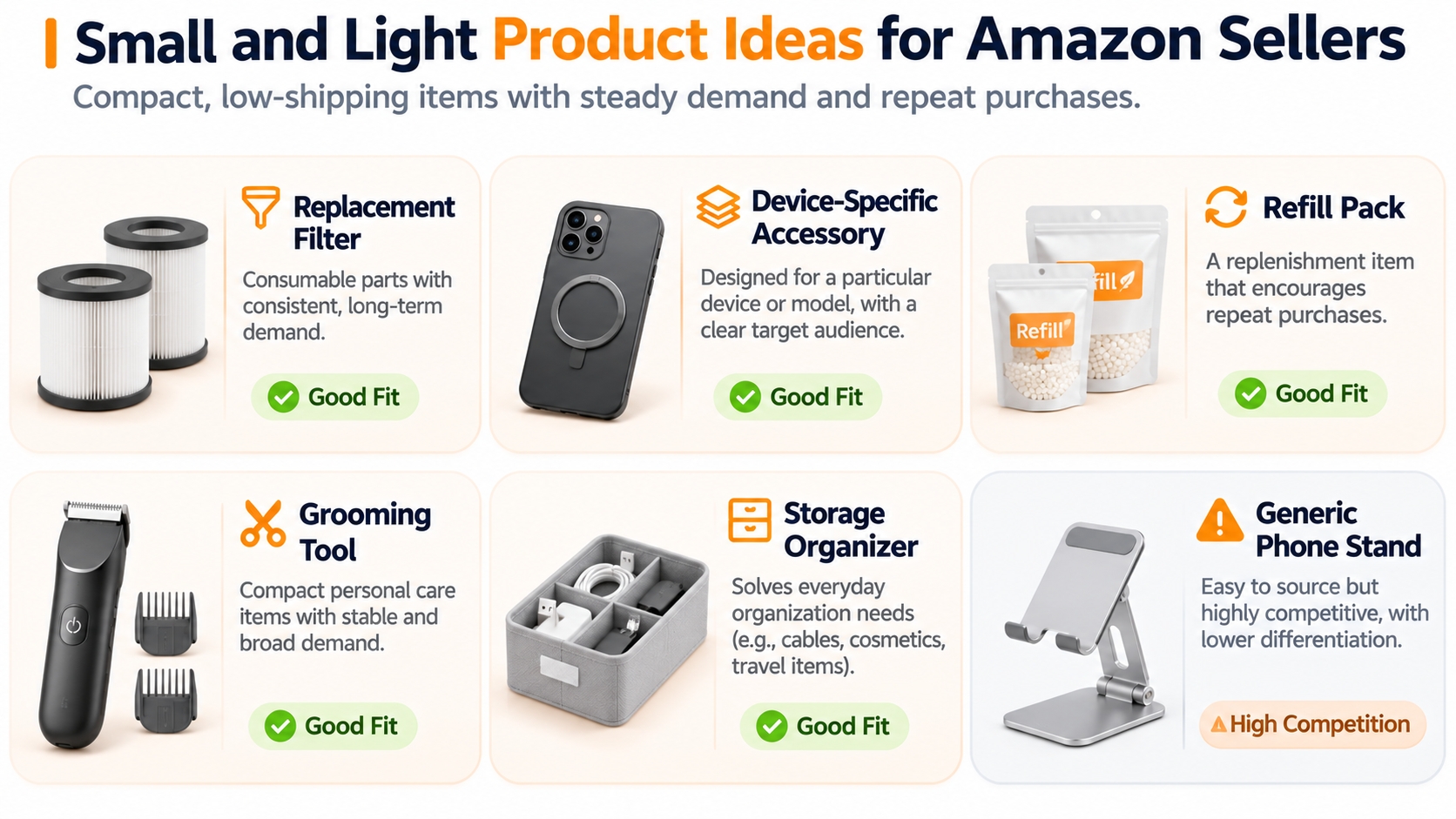
The best candidates share a pattern: a specific customer, a repeated need, and something about the product that is hard to copy cheaply. Weight is secondary. Use the four filters below as a first screen, and remember that "small" describes the package, not the size of the opportunity. A narrow product with a loyal repeat audience will almost always outperform a generic item with a huge but indifferent audience.
Products That Solve a Specific, Repeated Customer Problem
Repeated use drives repeat purchases, reviews, and word of mouth, which in turn lower your blended advertising cost per order. Strong examples include a replacement filter for a common appliance, a cleaning tool built for one specific surface, or a storage solution for a single hobby. The narrower the problem, the less you compete purely on price. Avoid vague gift items with no repeat use case because they attract one-time buyers, seasonal traffic spikes, and very little brand loyalty.
Compact Accessories With Clear Compatibility or Use-Case Advantages
Compatibility sells. "Fits model X, years 2023 to 2026" converts better than a generic claim and reduces returns at the same time. A precise fit also creates a defensible listing, because a competitor must either match your compatibility data or accept a higher return rate. Verify fit across model years, state exclusions clearly in the bullet points, and photograph the product installed. Accessories are small by nature, but the value is in the specificity, not the size.
Replenishable Products With Sustainable Repeat-Purchase Potential
Consumables such as wipes, refills, pads, adhesives, and grooming supplies build lifetime value faster than one-off items. A $14 first order that repeats every ten weeks can be worth far more than a $30 one-time sale, and repeat customers dramatically reduce your ad cost per order over time. Before committing, confirm there is no expiry constraint, dangerous-goods restriction, or Subscribe & Save eligibility issue that would block the repeat model you are counting on.
Generic, Easily Copied Items That Look Attractive but Offer Little Differentiation
Phone stands, hair clips, plain cable ties, and unbranded kitchen gadgets have low sourcing costs and even lower barriers to entry, which is exactly why they attract relentless competition and rapid price erosion. If you cannot explain in one sentence why a customer should choose your version, low price becomes your only selling point rather than a genuine advantage, and there will always be someone willing to offer a lower price. Treat these categories as a warning sign rather than a starting point.
When Small and Lightweight Products Become Operationally Complicated
Compact does not mean simple. Several categories lose their entire shipping advantage the moment compliance, protects packaging, or return handling enters the cost model. Before you celebrate a low fulfillment fee, check whether the product carries hidden operational obligations that only appear after the first shipment or after the first policy notice.
Fragility, Leakage, and Battery Restrictions Can Cancel Out Shipping Advantages
Glass, ceramics, liquids, powders, and anything containing a lithium battery need extra packaging, testing, or documentation. Lithium batteries and some aerosols are regulated dangerous goods, may require hazmat review, and can be restricted to certain fulfillment paths. A $6 unit that needs a $0.90 protective insert plus a $0.40 leak-proof bag is no longer a $6 unit, and its damage rate may still be higher than a comparable non-fragile product. Calculate the fully protected package cost, not the bare product cost.
Compatibility Errors and Poor Quality Control Create Disproportionate Return Risk
On a $12 item, a single return can consume the profit of several orders, so return rate matters far more than it does on a premium product. Compatibility mistakes are the most common cause: one unclear measurement, one unlisted model year, or one ambiguous photo, and returns spike. Invest in pre-shipment quality control, include dimensioned photos and a clear compatibility list, and audit your first production run personally. Cheap products with high return rates destroy cash flow quietly.
Small Size Does Not Eliminate Intellectual Property or Compliance Requirements
Size has nothing to do with legal exposure. Design patents, utility patents, trademarks, and copyrighted characters apply just as strictly to a $7 item as to a $70 one. Depending on the category, you may also need FCC authorization, FDA registration, CPSIA compliance, or state-level chemical disclosures such as California's Proposition 65. A cheap product with an unresolved IP or compliance problem is the most expensive product in your catalog, because the cost arrives all at once.
Single Units, Multipacks, or Premium Versions: Which Business Model Makes More Sense?
Most sellers default to single units because that is the simplest listing to build. But the business model you choose changes your fee per unit, your advertising headroom, and your competitive position more than the product itself does. The question is not "which model is best" in the abstract, but "which model fits this product's price ceiling, repeat behavior, and physical packaging limits."
Why Selling More Units Is Not Always Better Than Increasing Order Value
Three $12 orders cost three fulfillment fees, three pick-and-pack events, three return exposures, and three separate chances to earn a bad review. One $36 order costs one of each. This is why average order value, not unit price, so often determines whether advertising is affordable at all. If your category can support a bundle, a larger size, or a multi-use kit, test the higher-AOV version first, as it usually delivers a healthier contribution margin even when the product cost remains the same.
When Multipacks Improve Contribution Margin and When They Do Not
Multipacks help when the units are genuinely consumable, when the combined price stays clear of the next fee or psychological threshold, and when the added packaging does not push the unit into a larger size tier. They hurt when the multipack cannibalizes your single-unit listing, when the higher price reduces conversion enough to offset the margin gain, or when the larger pack size creates storage and cash-flow pressure. Test one pack configuration at a time and measure conversion, not just revenue per order.
How Premium Positioning Can Create More Advertising Headroom
Every dollar of price is potential advertising budget. A $34 product can absorb an ACOS near 30% and still contribute profit; a $12 product often struggles to survive 15%. Premium positioning, achieved through better materials, clearer documentation, an improved unboxing experience, and a recognizable brand, gives you greater flexibility to bid for visibility in competitive advertising auctions. It only works when the product visibly justifies the price through photos, reviews, and packaging, so budget for creative assets as part of the strategy.
Recalculate Fees After Every Packaging or Bundle Change
Fees attach to the physical unit as packaged, not to your intention. Adding a second item, a gift box, or a printed manual can change weight, dimensions, or price tier, and silently change your margin by 15% or more. Keep a versioned unit-economics sheet for every SKU and update it whenever packaging, bundle contents, or price changes. This single habit prevents most of the unpleasant surprises that appear on a monthly settlement report.
| Business model | Typical role | Fee pressure | Main risk |
|---|---|---|---|
| Single unit | Entry listing and demand testing | High per unit | Thin contribution profit per order |
| Multipack | Margin lift and order value | Lower per unit, higher per order | Cannibalizing the single listing, tier jump |
| Premium or upgraded | Brand building and ad headroom | Similar per unit, higher revenue | Perceived value too weak for the price |
FBA vs. FBM: Choose the Fulfillment Method That Fits the Product Economics
For small and light products, the FBA-versus-FBM decision usually comes down to two questions: is Prime eligibility worth the per-unit fee, and is your sales volume predictable enough to justify holding inventory inside Amazon's network? For a full breakdown of the trade-offs, read our Amazon FBA vs. FBM comparison. Here we focus specifically on how the choice interacts with low-priced, compact items.
When FBA's Convenience and Prime Eligibility Justify Its Costs
FBA buys you the Prime badge, stronger buy box eligibility, customer service, and returns handling. For a small, robust, fast-moving item with predictable demand, those benefits frequently outweigh the fulfillment fee, because they lift conversion rate enough to pay for themselves. The calculation changes when the fee reaches roughly a third of the selling price: at that point you are buying conversion with margin you may not have. Compare the conversion lift against the fee, not the fee in isolation.
When FBM Can Be a Better Starting Point for Unproven Demand
If you are testing a new SKU, FBM or a small FBA test lets you keep inventory at home, ship on your own schedule, and avoid committing to Amazon's inbound requirements before demand is proven. Lightweight items are often economical to self-ship through a carrier's ground service, and you keep full control of packaging and inserts. Once demand and unit economics are confirmed, move the winning SKU to FBA and let the fee buy you scale.
Why Some Sellers Benefit From a Hybrid Fulfillment Strategy
Hybrid models use FBA for the fast-moving core and FBM for slow movers, oversized variations, or seasonal bursts. This keeps storage and long-term inventory costs down while preserving Prime eligibility where it actually influences conversion. It also provides a backup channel when inbound shipments are delayed or capacity is constrained. The trade-off is operational complexity: two inventory pools, two sets of performance metrics, and more opportunities for stockouts if forecasting is weak.
Simple decision rules
Proven demand plus a fulfillment fee under about 25% of price: FBA. Unproven demand or a fee above 35% of price: start FBM or with a small FBA test. Mixed catalog with seasonal peaks: run hybrid and review the split every quarter.
How to Evaluate Small and Light Opportunities Using SellerSprite
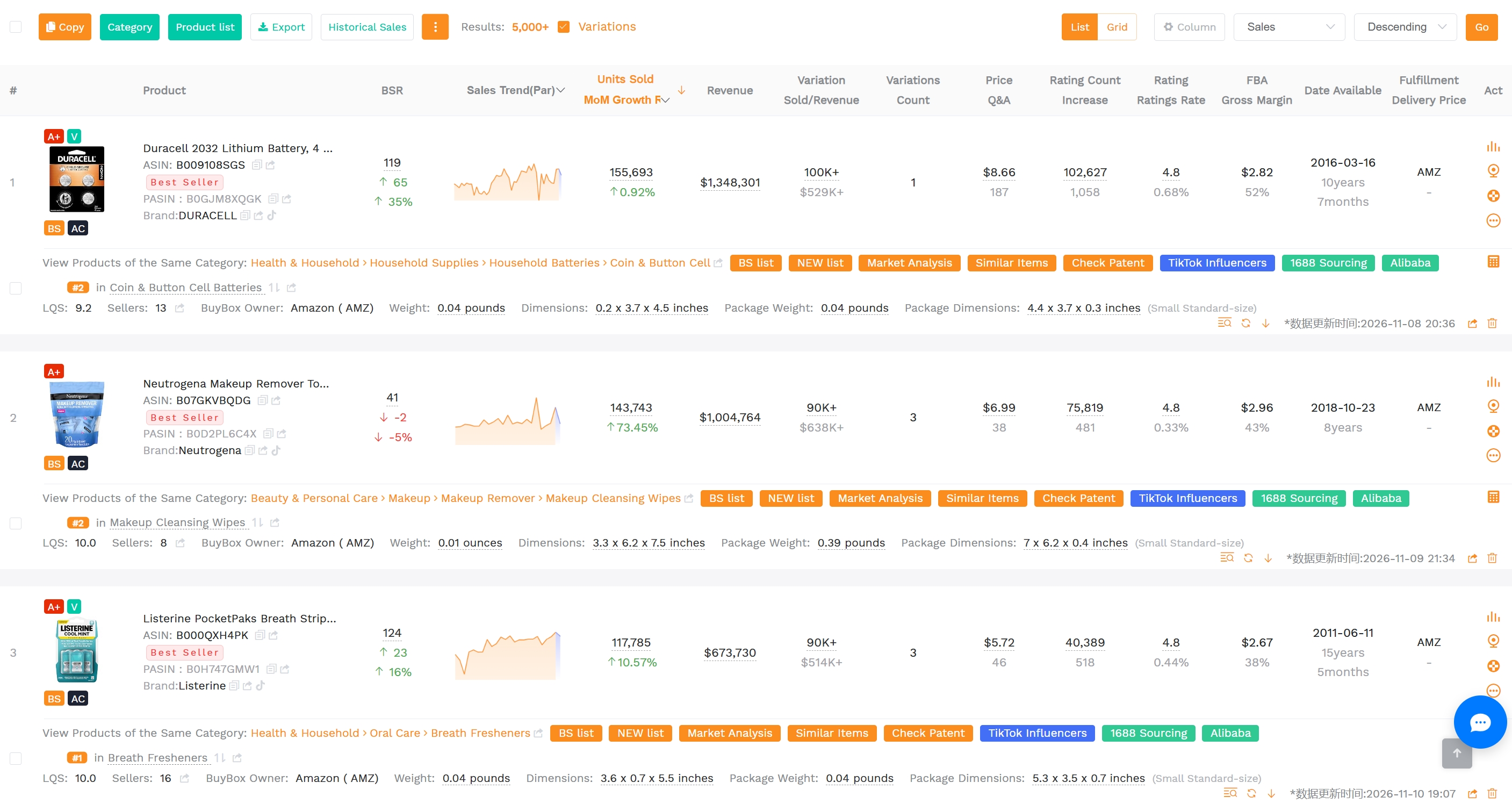
The fastest way to avoid a bad small-and-light product is to look at data before you look at supplier catalogs. SellerSprite's Product Research tool lets you filter by price band, sales trend, review count, and category, all of which are key factors in determining whether a low-priced, compact product can be profitable. The five-step review below turns raw filters into a defensible sourcing decision.
Filter Potential Products by Price, Sales Trends, and Competitive Conditions
Start with a price band that matches your fee model: for example $15 to $35 if you want advertising headroom, or $8 to $15 if you have a genuine sourcing advantage and can use low-price rates. Then layer in conditions: monthly sales above a minimum threshold, review counts below a level you can realistically beat within six months, and a sales trend that is flat-to-growing rather than collapsing. Save the filter set so you can rerun the same screen monthly.
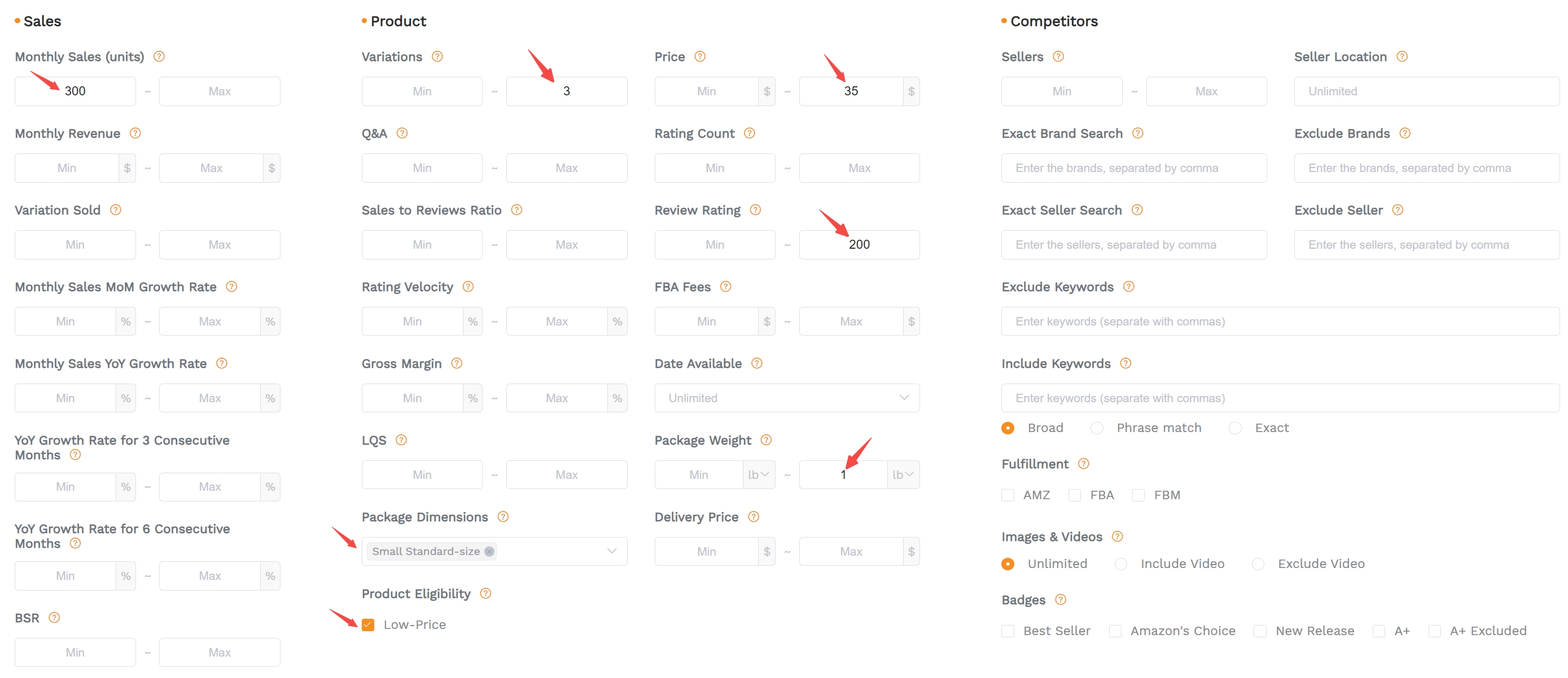
Check Historical Demand Before Treating High Sales as Sustainable
A single strong month can come from a viral moment, a competitor's stockout, or a seasonal spike that will not repeat. Look at a full twelve-month history, identify the seasonality curve, and check whether the category is growing or declining overall. Products with steady year-round demand are easier to replenish, easier to advertise, and far cheaper to hold than products with a two-month window and a long storage tail.
Use Reverse ASIN and Keyword Research to Evaluate Search Demand
Reverse ASIN analysis shows which keywords a competitor actually ranks for, including terms you would never guess from the listing title. Cross-check those keywords against search volume and competition to see whether demand is concentrated in a few expensive head terms or spread across long-tail phrases that are cheaper to enter. This is especially valuable for compact accessories, where buyers often search by model number or a very specific use case rather than a generic category term.
Analyze Customer Reviews to Identify Differentiation Opportunities
Reviews are a free product brief. Sort by critical reviews, cluster the complaints, and look for patterns a redesign could solve: a lid that leaks, a size that runs small, a part that snaps, instructions that confuse. These patterns are the openings where a slightly higher-priced product wins, because you are solving a problem the incumbent has publicly failed to fix. Document the top five recurring complaints for every candidate before you contact a supplier.
Validate Profitability With Real Sourcing Costs and Amazon Fee Estimates
Once a candidate passes the demand and differentiation checks, rebuild the unit economics from scratch: quoted FOB cost, freight per unit, duties, prep, packaging, referral fee, fulfillment fee from the Amazon Revenue Calculator, expected return rate, and a realistic cost per click. If contribution margin after advertising is not sustainably positive under conservative assumptions, the product is not ready, no matter how promising its sales trend appears.
The Final Decision: Sell, Test, Redesign, or Skip?
By this point you should have four numbers for every candidate: expected monthly units, contribution profit per unit after fees and advertising, sensitivity to a 25% price cut, and your confidence in the product's differentiation. Those four numbers lead to one of four decisions: sell, test, redesign, or skip. Making that decision explicitly is far less costly than discovering the answer after investing in inventory.
Identify Products With Strong Demand and Sustainable Contribution Margins
Green-light products usually show three things at once: proven, repeatable demand; a contribution margin that survives normal fee and advertising fluctuation; and at least one clear reason a customer would choose you over the incumbent. If any one of those is missing, the product is at best a test, and should be funded like one. A "yes" decision should be backed by a written unit-economics sheet, not a feeling about the category.
Stress-Test Profitability Against Higher CPCs, Returns, and Price Cuts
Run three scenarios before committing: cost per click up 50%, return rate at double your estimate, and a competitor forcing a 20% price cut. If a product is only viable under the best-case scenario, it is more of a gamble than a sound business opportunity. A useful rule is that the base case should still show a contribution margin of roughly 15% to 20% after advertising, so there is room to absorb normal variance without the SKU turning negative.
Recognize When a Product Should Be Repriced, Bundled, or Rejected
Some products are not inherently bad; their profitability problems stem from inappropriate pricing or packaging. If demand is real but margin is thin, test a multipack, a premium variant, or a modest price increase before abandoning the SKU, and recalculate fees after each change. Reject the product when the problem is structural: no meaningful differentiation, a category price ceiling below your landed cost, or a market where you cannot defend a position against sellers with the same supplier and a bigger budget.
Pre-launch checklist for small and light products
- Final retail packaging measured and weighed, with the size tier confirmed in the Revenue Calculator
- Price point tested against the Low-Price FBA threshold, including the revenue sacrificed to qualify
- Contribution margin modeled at three price points and in a peak-season fee month
- Return rate, damage rate, and defect assumptions double-checked against category reviews
- IP, compliance, and dangerous-goods status confirmed before the first purchase order
FAQ
Is Amazon's Small and Light Program Still Available?
Not as a standalone US program. Amazon retired the original Small and Light program and moved low-priced, compact items into standard FBA, where Low-Price FBA rates apply below the current price threshold (under $10 in the US at the time of writing). Because program names, thresholds, and rates change, confirm the current rules in Seller Central before you build a pricing model around them. Outside the US, check whether the local marketplace runs an equivalent low-price program.
What Qualifies for Low-Price FBA in the US?
Eligibility is based primarily on selling price: items priced below Amazon's low-price threshold (under $10 in the US at the time of writing) can qualify for reduced fulfillment rates. Products must still meet standard FBA requirements for packaging, size, weight, and restricted items. The exact rate also depends on the size tier your packaged unit falls into, so a low price alone does not guarantee the lowest fee. Verify both the threshold and the tier table before locking in a price point.
Are Small and Lightweight Products More Profitable Than Larger Products?
Not automatically. They are usually cheaper to ship, store, and test, which improves capital efficiency and lowers the cost of failure. But low selling prices mean fixed per-unit costs take a larger share of revenue, and advertising, returns, and prep can erase thin margins. Profitability depends on contribution margin after all fees and ads, not on weight. A well-differentiated $30 compact product often outperforms a commoditized $9 one.
What Are the Biggest Risks of Selling Cheap Products on Amazon?
Four risks dominate: margin compression from fixed per-unit costs, advertising costs that exceed the gross margin, return and refund costs that wipe out several orders at once, and rapid price competition from new entrants. Add intellectual property and compliance exposure if the product is easily copied or restricted, plus cash-flow risk if you over-order inventory that later sells below cost. Stress-testing each of these before buying inventory is the cheapest insurance available.
Is FBA or FBM Better for Small and Lightweight Products?
It depends on demand certainty. FBA is usually better once a product is proven, because Prime eligibility and Amazon's handling typically lift conversion and simplify operations. FBM is often better for unproven SKUs, very slow movers, or items that are cheap and easy to ship yourself, since it avoids inbound commitments and long-term storage costs. Many experienced sellers use both: FBA for the core catalog, FBM for tests and tail SKUs.
Are Multipacks a Good Way to Improve Margins?
Often, yes, but only when the math works. A multipack spreads one fulfillment fee and one pick-and-pack event across several units, raising average order value and giving you more room to absorb advertising costs. It backfires when the larger pack pushes the unit into a higher size tier, when the higher price kills conversion, or when it cannibalizes your single-unit listing. Test one pack configuration at a time and recalculate fees after every change.
How Can I Find Small and Light Products With Lower Competition?
Filter for measurable gaps rather than guessing. Look for categories with steady historical demand, relatively low review counts on the top listings, and long-tail keywords that are not dominated by a single brand. Then read critical reviews to find unmet needs, such as leaks, fit issues, and unclear instructions, that you can design around. Tools such as SellerSprite's Product Research let you combine price band, sales trend, review count, and keyword data on one screen, which is far faster than browsing Best Sellers lists manually.
Next Steps
- Build a fee-first shortlist: measure and weigh your final retail packaging, then confirm the size tier and fulfillment fee in the Amazon Revenue Calculator before you contact suppliers.
- Run the demand screen in SellerSprite Product Research using a price band, a sales-trend filter, and a review-count ceiling you can realistically beat.
- Create a versioned unit-economics sheet with three scenarios (base case, higher CPC, doubled return rate) and confirm contribution margin stays positive in all three.
- Launch with a small test batch, review conversion and return data at 60 days, and only then decide whether to scale, reprice, bundle, or exit.
References
- Amazon: Selling on Amazon pricing and fee overview View
- Amazon: FBA Revenue Calculator View
- Amazon: Fulfillment by Amazon program overview View
- Amazon Seller Central Help: current FBA fees, size tiers, and low-price eligibility (sign-in required) View
- USPS: Business shipping prices for seller-fulfilled orders View
- SellerSprite: Amazon product research guide View
Fee schedules, size tiers, and program thresholds change frequently. Every dollar figure in this article is illustrative and marked for verification; confirm current rates in Seller Central before making sourcing, pricing, or inventory decisions.
By SellerSprite Success Team
The SellerSprite Success Team combines deep Amazon marketplace expertise with data science to help sellers grow profitably. With years of experience in e-commerce analytics, we focus on ethical, sustainable strategies that align with Amazon's evolving algorithms and policies. Our insights are trusted by thousands of sellers worldwide.
Last updated: 2026-11-12