A practical setup guide, a cleaner measurement framework, and a launch checklist for Amazon sellers who want to use Google Search traffic with more confidence.
Google Ads can absolutely support an Amazon product launch, but only when the foundation is ready. The listing must already be conversion-focused, the keyword map must reflect real buyer intent, and tracking must be strong enough to tell you whether traffic is actually producing profitable momentum. In 2026, that means using Amazon Attribution as the primary measurement layer whenever your account is eligible, keeping promo codes as a secondary validation method, and factoring in the Brand Referral Bonus in your ROI math if you qualify.
This guide keeps the setup process beginner-friendly, but updates the framework so it is more useful for real launch decisions. You will learn when Google Ads is a smart move, how to structure your first Search campaign, how to measure performance properly, and how to use SellerSprite to make sure the traffic you buy is aligned with the keyword opportunity on Amazon.
Key takeaways
- Google Ads works best for Amazon launches when the product already has a conversion-ready listing, a clear buyer keyword set, and a compelling offer.
- Start with Google Search intent, not broad awareness. Exact match and tightly controlled phrase match are usually the cleanest first test.
- Use Amazon Attribution as the main tracking layer whenever possible. Use promo codes as a supporting signal, not the whole reporting framework.
- If you are an eligible US Seller Brand Owner, the Brand Referral Bonus can materially improve your launch ROI and should be included in your financial model.
- SellerSprite should support the Amazon side of the launch before traffic goes live, especially for keyword selection, listing readiness, review insight mining, and post-launch keyword tracking.
Table of contents
- Should you use Google Ads for an Amazon product launch?
- Why Google Ads can work for Amazon launches
- Prerequisites before launch
- Step-by-step setup
- Tracking and measurement
- Common mistakes and risk controls
- A practical 7-day launch test plan
- Research to launch workflow with SellerSprite
- FAQ
- References
- About the author
Should You Use Google Ads for an Amazon Product Launch?
The short answer is yes, but not for every product and not at every stage.
This is a strong fit when
- Your product solves a clear problem and has obvious buyer keywords.
- Your Amazon listing is already conversion-ready with strong images, clear bullets, competitive pricing, and a believable offer.
- You can use Amazon Attribution, or at a minimum, run a clean promo code validation method.
- You are launching in a category where search intent matters more than impulse discovery.
- You want a traffic source that can support both immediate sales and Amazon keyword momentum.
This should not be your first move when
- The listing still has weak images, unclear positioning, or obvious conversion friction.
- Your keyword strategy is still vague, and you do not yet know which search terms actually describe the product best.
- You cannot measure results with enough clarity to know whether you are buying profitable traffic or just expensive clicks.
- The niche relies more on social discovery than on active search intent.
Practical mindset: Google Ads is not a rescue tool for a weak listing. It is an amplifier for a launch that is already strategically prepared.
Why Google Ads Can Work for Amazon Launches
Google captures demand before Amazon does
Many shoppers begin with a search engine when they are comparing solutions, researching product types, or looking for a very specific item. That means your future customer may be searching on Google before they ever type into Amazon. If your product is invisible there, you are missing a meaningful part of the buying journey.
External traffic can support launch momentum.
The value of Google Ads is not limited to direct sales. Well-targeted external traffic can also support listing activity during launch. When the search term, ad message, and Amazon listing all align, the traffic is highly intent-driven, which makes it far more useful than broad, low-quality visits.
Amazon already has the trust and conversion infrastructure
A shopper who lands on Amazon does not need to learn a new checkout flow, wonder whether shipping is reliable, or evaluate whether the store is legitimate. That existing trust can make your paid clicks work harder. In many launch situations, sending a shopper to Amazon is more practical than sending them to a standalone store.
Promotional support can improve first-test efficiency.
Google sometimes offers promotional credits to new advertisers, depending on the market and current account offers. Treat that as a bonus, not the strategy itself. The real advantage comes from intent quality, clean structure, and disciplined measurement.
Prerequisites Before Launch
1. Listing readiness comes first
Do not buy traffic for a listing that still looks unfinished. Before launch, tighten the main image, title, bullets, A plus content if available, price positioning, and offer. Use SellerSprite Keyword Research and Reverse ASIN to confirm which buyer keywords matter most, then use Listing Builder to make sure those themes appear naturally and persuasively on the listing.
2. Offer readiness matters more than many sellers expect
A launch ad does not sell the whole product by itself. It sells the click. The listing and offer sell the conversion. If your price is high, your review count is still low, or your value proposition is not immediately obvious, add a realistic conversion trigger such as a coupon or launch offer.
3. Tracking should be defined before the campaign goes live
In 2026, Amazon Attribution should be the default measurement framework whenever your account is eligible. If you only add tracking after launch, you lose the clean baseline that makes optimization possible. A unique promo code can still help validate results, but it should no longer be your only measurement method.
4. Your budget should fit launch math, not guesswork
Take your total launch budget, decide how much belongs to Google Ads, and divide that amount by the number of launch days you are willing to fund. That daily budget is your control limit, not your guaranteed spend. In a tightly targeted campaign, you may spend below the cap, especially at the start.
Launch readiness checklist
- Primary buyer keywords confirmed with SellerSprite
- Listing copy and imagery aligned with those keywords
- Coupon or promo strategy decided
- Amazon Attribution tags created, if eligible
- Brand Referral Bonus status checked, if you are a US Seller Brand Owner
- Daily budget and stop-loss rules defined
Step-by-Step Setup
Step 1. Build a buyer keyword map with SellerSprite
Before opening Google Ads, define the search demand you actually want to buy. Start in SellerSprite Keyword Research to find the most relevant seed terms for the product. Then use Reverse ASIN to identify which keywords competing listings are already connected to. Finally, use Review Analysis to surface the phrases customers use when describing what they love, what frustrates them, and what they expected before purchase. Those phrases often become your best ad angles.
At the end of this step, you should have three short lists:
- Core exact keywords with strong buyer intent
- Supporting phrase keywords that are still commercially relevant
- Negative terms that signal research intent or the wrong product type
Step 2. Create your Amazon measurement-ready URL
If you are eligible for Amazon Attribution, create the attribution tag before the campaign goes live and use the tagged URL as the final destination. This gives you a clean channel-level measurement from the first click. If you are also using a launch offer, prepare a unique promo code that is reserved for Google Ads traffic only. That creates a second layer of validation.
Pro tip: Do not mix one generic coupon, one generic promo code, and multiple untagged ad URLs at the same time. Keep the traffic path clean enough that you can explain the result later.
Step 3. Create a Search campaign in Google Ads
The interface may change over time, but the launch logic is consistent. Create a campaign built around Google Search intent and send traffic directly to your tagged Amazon URL.
Choose the objective and campaign type.
If the interface asks for an objective, choose the option that is closest to sending traffic to a destination URL. Then choose Search as the campaign type. For a launch campaign like this, Search is the most direct way to capture active demand.
Keep the first test narrow.
Start with Google Search only. Keep extra networks and partner inventory off for the first test unless you already have strong conversion data. The cleaner the first data set, the easier it is to decide whether the traffic source deserves more budget.
Set location and language based on the marketplace you are selling in
If the listing is for the US marketplace, target the United States and write ads in English. The ad language should match how the buyer thinks and searches, not just how the listing happens to be written.
Set a daily budget that matches your launch window
A simple planning method is to take the portion of your launch budget assigned to Google Ads and divide it by the number of launch days you want to fund. That gives you a controlled starting point instead of a random number.
Choose a bidding strategy that keeps the first test readable.
For a first, tightly controlled launch test, many sellers prefer Manual CPC because it allows direct bid control at the keyword level. That matters when you are still learning which search terms deserve spending. As data accumulates, you can evaluate whether more automation is warranted, but control is usually the better starting point for a small launch test.
Step 4. Structure ad groups by search intent, not by convenience
Do not put every keyword into one mixed bucket. The cleaner structure is to separate keywords by intent level and language similarity. A strong beginner setup looks like this:
Recommended starter structure
- Ad Group 1: Exact match core buyer terms
- Ad Group 2: Phrase match support terms and long-tail variations
- Negative keyword list: Irrelevant product types, DIY queries, informational queries, and low-buying-intent modifiers
This structure makes it easier to understand which type of intent is generating quality traffic. It also makes it easier to adjust bids and pause waste without damaging the whole campaign.
Step 5. Write ad copy that matches the buyer's decision point
Your ad should not sound like a generic brand statement. It should mirror the reason the person searched in the first place. Build the copy from your product's strongest features and benefits, especially the phrases you confirmed with SellerSprite and the objections surfaced in Review Analysis.
Strong launch ad copy usually includes:
- The product type or core use case
- A clear benefit, not only a feature list
- A trust signal such as quality, speed, durability, or ease of use
- A launch incentive, such as a coupon or limited offer, if relevant
Step 6. Use assets to make the ad larger and more persuasive
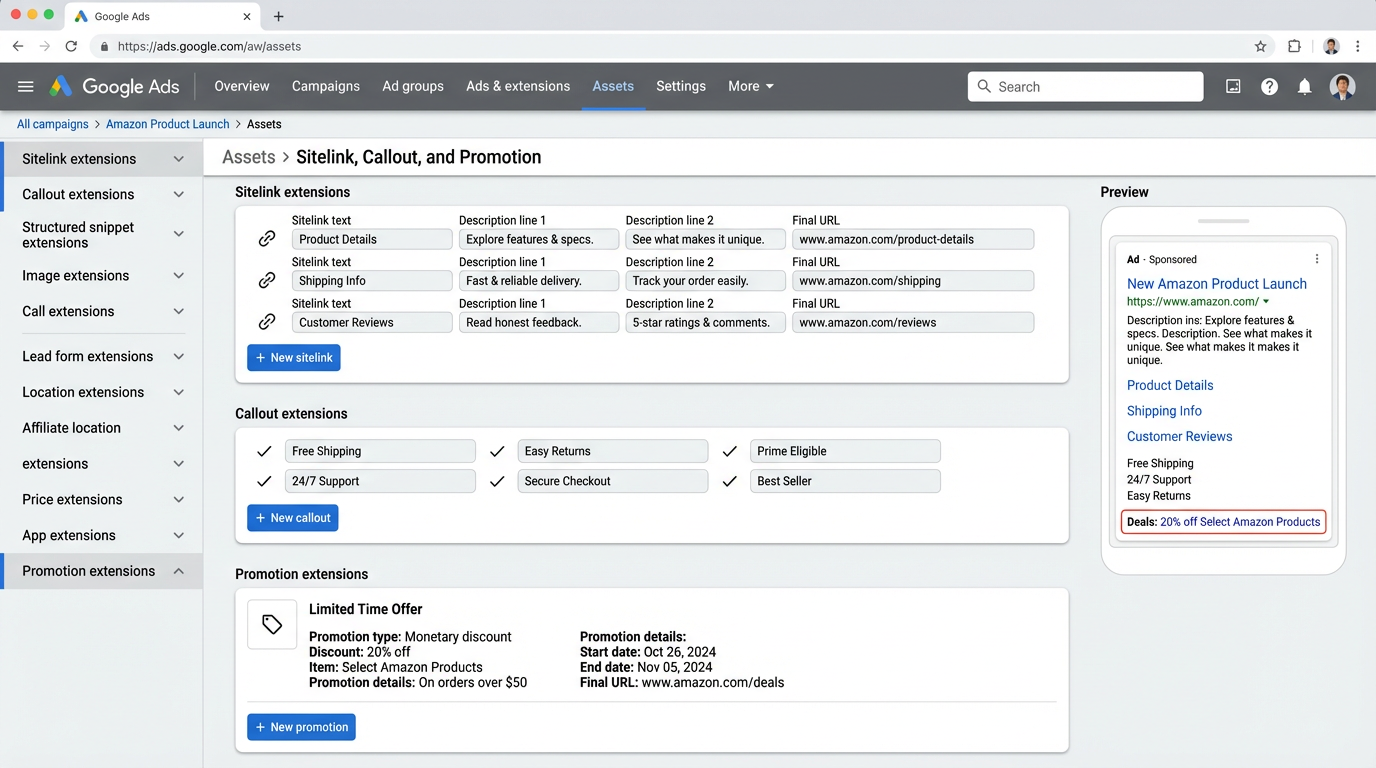
Assets matter because they give your ad more room to communicate value. For launch campaigns, three asset types are especially useful: sitelinks, callouts, and promotion assets.
Sitelinks
Sitelinks help the ad occupy more visual space and can highlight product-specific value. Google recommends adding at least four, and high-volume campaigns often benefit from more. For an Amazon launch, the safest approach is to keep the messaging tightly tied to product benefits and send those sitelinks to the same tagged Amazon destination when appropriate.
Callouts
Callouts do not need extra links, but they do help reinforce why your offer is worth the click. Use short, scannable value points such as premium material, easy cleaning, giftable packaging, or beginner-friendly design. Add at least four.
Promotion assets
If your launch includes a real offer, promotion assets can improve click appeal. This is especially useful when the listing still needs a stronger conversion trigger. Keep the discount believable and profitable. A modest coupon can still be effective if the rest of the listing does its job.
Messaging shortcut: Start with a simple feature and benefit inventory. List what the product is, what pain it removes, what result it creates, and what makes it safer to buy now. Those four buckets usually generate your best sitelinks, callouts, and headlines.
Tracking and Measurement
This is the biggest area where many launch guides are outdated. If your account is eligible, Amazon Attribution should now be the primary way to measure off-Amazon traffic. A promo code is still useful, but it is not enough on its own if you want a clear view of launch quality.
Use Amazon Attribution as the main measurement layer.
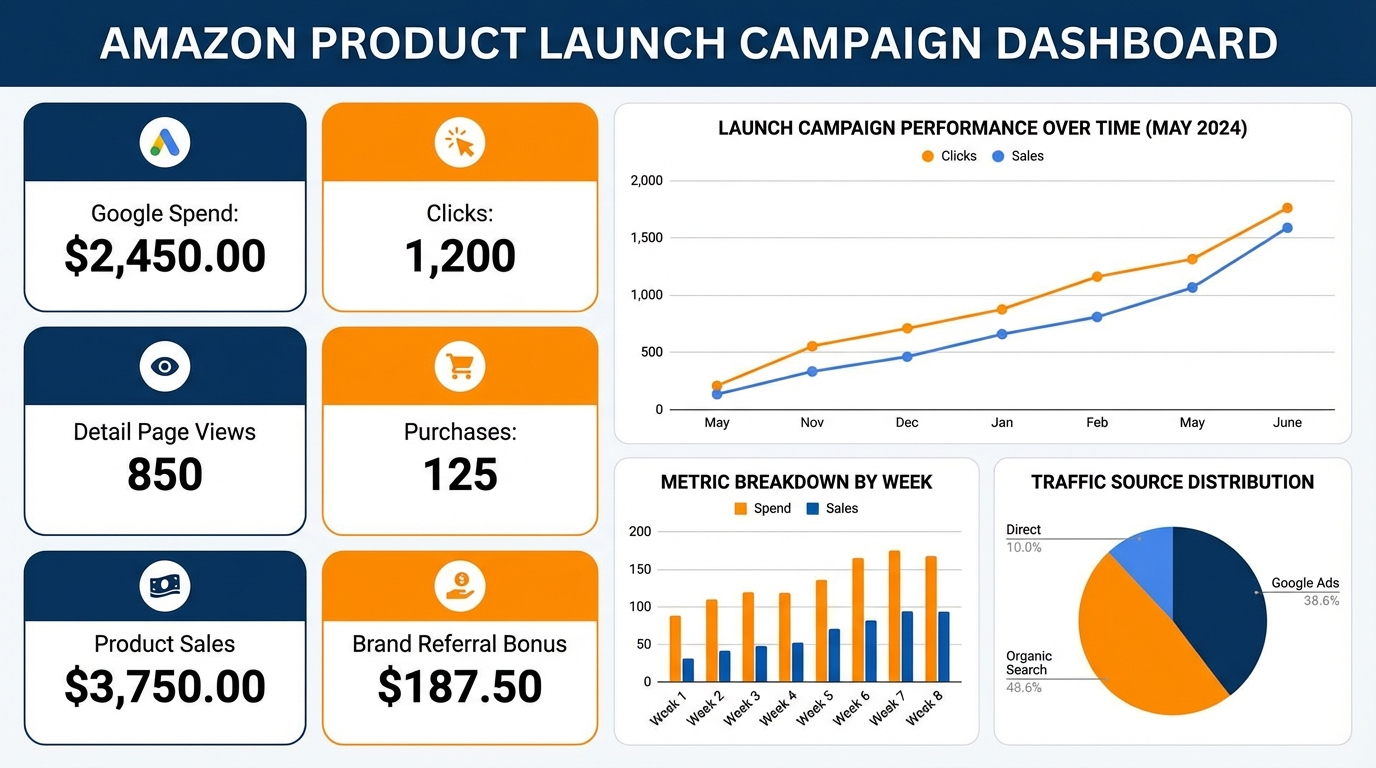
Amazon Attribution is designed for non-Amazon channels such as search, social, video, and email. It gives you a much better picture of what your Google Ads clicks are doing after they reach Amazon. Depending on the report and setup, the key metrics can include clicks, detail page views, add to cart, purchases, units sold, product sales, and new-to-brand signals where available.
Keep promo codes as a secondary validation method.
A dedicated Google Ads promo code is still valuable because it creates a direct redemption signal. That can help you sanity check attribution results, especially during the first launch test. Just do not mistake it for a full-funnel reporting system. Some buyers will click the ad and purchase without using the code, and some will use the code later than expected.
Factor Brand Referral Bonus into your ROI model
If you are an eligible US Seller Brand Owner enrolled in the program, the Brand Referral Bonus can materially change your launch economics. Amazon describes the bonus as averaging about 10 percent of qualifying product sales driven by measured non-Amazon traffic, and the benefit can also apply to additional purchases from the same brand made within the allowed post-click window. This is why BRB should not be treated as an afterthought. It belongs in the core ROI calculation.
| Method | Best use | Strengths | Limits |
|---|---|---|---|
| Amazon Attribution | Primary measurement | Tracks off-Amazon traffic into Amazon actions and sales with much better visibility | Requires account eligibility and disciplined setup |
| Promo code | Secondary validation | Easy to understand, useful for launch offer tests | Underreports buyers who convert without redeeming the code |
| Brand Referral Bonus | ROI improvement layer | Can reduce effective traffic cost and improve launch efficiency | Only applies to eligible sellers and qualifying sales |
A simple ROI block to use during launch
You do not need a complex attribution model to make better launch decisions. Start with a practical scorecard:
Launch scorecard fields
- Google spends
- Clicks
- CTR
- Detail page views
- Add to cart
- Purchases
- Units sold
- Attributed product sales
- Brand Referral Bonus credit
- Coupon or promo cost
- Estimated gross margin
- Net launch contribution
A useful working formula is: estimated gross margin from attributed sales + Brand Referral Bonus credit - Google spend - launch discount cost. Once this scorecard is stable, you can layer in deeper product economics.
Common Mistakes and Risk Controls
Sending paid traffic to a weak listing
If the listing cannot convert organic traffic, it is usually not ready for paid traffic either. Fix the page before you scale the campaign.
Buying broad traffic too early
Early launch traffic should be high intent. Broad discovery traffic creates noisy data and makes it harder to diagnose the real problem.
Running without a primary measurement layer
If you launch without Attribution or another clean measurement plan, you create uncertainty right when you need clarity the most. The result is usually premature scaling or premature panic.
Testing too many variables at once
Do not change keyword match types, offer structure, landing URL tagging, and ad copy all at the same time. The more variables you stack, the harder it becomes to learn anything useful.
Ignoring search term quality after launch
The point of the first launch test is not just to spend. It is to discover which search terms deserve more money and which ones should be blocked. Review the data early and add negatives aggressively when needed.
Common mistake: Treating Google Ads as a ranking shortcut instead of a disciplined acquisition channel. The traffic still has to convert. If the economics do not make sense, pause and fix the fundamentals before spending more.
A Practical 7 Day Launch Test Plan
You do not need a huge budget to get a useful signal. You need a controlled window, a focused keyword set, and a clear review rhythm.
Day 0: Prepare the system
- Finalize the listing and offer
- Confirm buyer keywords in SellerSprite
- Create Amazon Attribution tags
- Set a promo code if you want a secondary validation layer
- Define your stop-loss limit and target metrics
Days 1 to 3: Gather clean intent data
- Keep the campaign narrow
- Monitor clicks, search terms, detail page views, and early conversion signals
- Do not overreact to limited data, but remove obviously irrelevant terms fast
Days 4 to 7: Tighten and decide
- Shift budget toward the cleanest search terms
- Pause weak intent clusters
- Review Attribution sales and supporting promo code results
- Recalculate net launch contribution with BRB included if eligible
At the end of seven days, you should be able to answer three questions clearly: which keywords deserve more budget, whether the listing converts this type of traffic well enough, and whether the launch economics support another round of scale.
Research to Launch Workflow With SellerSprite
The Google Ads campaign is only one part of the launch system. SellerSprite should handle the Amazon research, listing preparation, and post-launch monitoring around it.
Keyword Research
Use this to identify seed keywords, commercial modifiers, and buyer language before the campaign is built.
Reverse ASIN
Use this to confirm how competing listings are connected to search demand and to build a tighter keyword shortlist for launch.
Review Analysis
Use this to extract benefit language, complaints, expectation gaps, and purchase motivations that can improve both ad copy and listing copy.
Listing Builder
Use this to tighten keyword placement and message clarity before external traffic begins.
Keyword Tracker
Use this during and after the launch to monitor whether the traffic push is helping the listing gain keyword visibility.
Profitability Calculator
Use this to pressure-test whether the product can absorb ad spend, coupon cost, and launch discounting without damaging the business case.
Simple workflow: validate demand, tighten the listing, launch a narrow Search campaign, measure with Attribution, then use SellerSprite tracking to see whether the external push is supporting your Amazon keyword footprint.
Share Your Sourcing Journey With SellerSprite Community
Join the SellerSprite community on the Facebook Group to share your sourcing journey, ask questions, and get support from fellow Amazon sellers.
FAQ
Do I need Brand Registry to use this strategy?
Not every part of the strategy depends on Brand Registry, but Brand Registry and account eligibility matter a lot if you want to use Amazon Attribution fully and potentially benefit from Brand Referral Bonus. If you are eligible, the measurement quality is much better.
Should I start with an exact match or phrase match?
Start with an exact match for your cleanest buyer terms. Then add a small phrase match lane to discover nearby variations. This keeps the first launch test readable while still allowing some learning.
Should I still use a promo code if I already have Amazon Attribution?
Yes, if you can keep the offer clean and controlled. Attribution should be the main measurement layer. Promo codes are useful as a secondary validation signal and can also strengthen click appeal when used carefully.
How much should I spend per day?
Use your launch budget to decide that, not the other way around. Allocate a defined portion of launch spend to Google Ads, divide it by your testing window, and keep the first test small enough that you can learn without forcing scale too early.
What if the Google Ads interface looks different from older tutorials?
That is normal. The interface changes, but the strategic logic does not. You still want a Search campaign, a clean keyword structure, controlled bidding, useful assets, a tagged Amazon destination, and a measurement framework that can support real optimization.
Can Google Ads help with ranking on Amazon?
Google Ads can help create qualified traffic and sales momentum, which is why many sellers use it during launch. The campaign still has to send relevant buyers to a listing that converts well. Strong traffic with weak conversion rarely produces the result sellers want.
View The SellerSprite Course Directory
Ready for the next step? Open the SellerSprite Academy course directory to continue building your Amazon FBA skills chapter by chapter.
References
- Amazon Ads: Basics of Amazon Attribution
- Amazon Ads Support Center: Amazon Attribution metric definition
- Amazon Ads: Brand Referral Bonus in Amazon Attribution reporting
- Google Ads Help: Add assets
- Google Ads Help: About sitelink assets
- Google Ads Help: Manual CPC bidding
About the author
SellerSprite Success Team. SellerSprite helps Amazon sellers turn product research, keyword analysis, listing optimization, and launch execution into repeatable workflows. Our editorial approach is to combine platform documentation, operational logic, and practical seller workflows so new and growing brands can launch with more clarity and fewer avoidable mistakes.